- All products
- Development Boards
- Arduino
- Arduino Boards
- Romeo V2- an Arduino Robot Board (Arduino Leonardo) with Motor Driver - DRF0225
- Arduino Boards
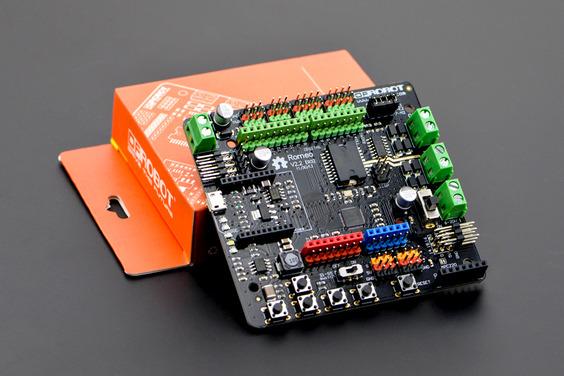
Features:
- Wide operating input voltage
- Directly support Xbee and XBee form factor WiFi, Bluetooth, and RF modules
- ON/OFF switch to control the system power from external motor power
- 3 Digital I/O extensions (D14-D16)
- S1 - S5 switch replace jump cap, allows free use for the GPIO
- Micro USB instead of A-B USB connector
- Analog sensor extension port: Orange for Signal, Red for Vcc, Black for GND
Principle of Work:
The Romeo V2 is based on Arduino, which is free hardware. Arduino provides the framework so that any other individual or business can design their own boards, each of which can be unique yet function well when built upon the same framework, just like DFrobot with Romeo. Free software is a computer program whose source code is available to anybody, allowing them to use and alter it as they see fit. Arduino provides the Arduino IDE (Integrated Development Environment) platform to program and upload your code (sketch) with the help of an embedded bootloader, eliminating the need for an external programmer. Arduino libraries enable easy programming of the robot using pre-made libraries.
Servo Power Terminal:
- Integrated external servo power terminal with input range of 5-12V. Recommended use: 5V.
- The servo power terminal does not supply system working voltage.
Motor Power Terminal:
- On: Supplies power to the motor driver and system power regulator (5-23V input)
- Off: Isolates system power from motor power. System voltage must be supplied separately.
Pins and Sockets:
- Digital Pins: 3 Digital I/O extensions (D14-D16)
- Analog Pins: A0-A5, A6-A11 (on digital pins 4, 6, 8, 9, 10, 12)
- Serial: Pin1 TX, Pin0 RX
- External Interrupts: Pin 2 & Pin 3
- PWM Pins: 3, 5, 6, 9, 10, 11, 13
- Bluetooth Integrated Sockets: APC220 RF Module, DF-Bluetooth Module
- Motor Sockets: Two-way Motor Driver, 2A maximum current
- ON/OFF Switch: Controls system power from external motor power
- Analog Sensor Extension Port: Orange for Signal, Red for Vcc, Black for GND
- SPI Pins: Pin16 MOSI, Pin14 MISO, Pin15 SCK
- I2C/TWI Interface: Three pin sets, supports Wire library
Applications:
- IoT Robots
- XBee Robots
- Bluetooth Robots
- Motor based projects
Technical Details:
- DC Supply: USB Powered or External 6V ~ 23V DC
- DC Output: 5V(2A) / 3.3V DC
- Motor Driver Continuous Output Current: 2A
- Microcontroller: ATmega32u4
- Bootloader: Arduino Leonardo
- Compatible with Arduino R3 pin mapping
- Analog Inputs: A0-A5, A6-A11
- PWM: 3, 5, 6, 9, 10, 11, 13
- 5 Key Inputs for Testing
- Auto-sensing/Switching External Power Input
- Serial Interface TTL Level
- USB Interface
- Support Male and Female Pin Header
- Built-in XBee Socket
- Integrated sockets for APC220 RF Module and DF-Bluetooth Module
- Three I2C/TWI Interface Pin Sets
- Two-way Motor Driver with 2A maximum current
- One Stepper Motor Drive with 2A maximum current
- Board Size: 89 x 84 x 14 mm
Comparisons:
The main difference between Romeo V1 and V2 is the use of the ATmega32u4 chip, which provides 2 UARTs for wireless communication. Romeo V2 is more suitable for beginners building wireless robotics projects, offering a more stable and easier to connect platform than using a Leonardo and separate motor driver module.
Features:
- Wide operating input voltage
- Directly support Xbee and XBee form factor WiFi, Bluetooth, and RF modules
- ON/OFF switch to control the system power from external motor power
- 3 Digital I/O extensions (D14-D16)
- S1 - S5 switch replace jump cap, allows free use for the GPIO
- Micro USB instead of A-B USB connector
- Analog sensor extension port: Orange for Signal, Red for Vcc, Black for GND
Principle of Work:
The Romeo V2 is based on Arduino, which is free hardware. Arduino provides the framework so that any other individual or business can design their own boards, each of which can be unique yet function well when built upon the same framework, just like DFrobot with Romeo. Free software is a computer program whose source code is available to anybody, allowing them to use and alter it as they see fit. Arduino provides the Arduino IDE (Integrated Development Environment) platform to program and upload your code (sketch) with the help of an embedded bootloader, eliminating the need for an external programmer. Arduino libraries enable easy programming of the robot using pre-made libraries.
Servo Power Terminal:
- Integrated external servo power terminal with input range of 5-12V. Recommended use: 5V.
- The servo power terminal does not supply system working voltage.
Motor Power Terminal:
- On: Supplies power to the motor driver and system power regulator (5-23V input)
- Off: Isolates system power from motor power. System voltage must be supplied separately.
Pins and Sockets:
- Digital Pins: 3 Digital I/O extensions (D14-D16)
- Analog Pins: A0-A5, A6-A11 (on digital pins 4, 6, 8, 9, 10, 12)
- Serial: Pin1 TX, Pin0 RX
- External Interrupts: Pin 2 & Pin 3
- PWM Pins: 3, 5, 6, 9, 10, 11, 13
- Bluetooth Integrated Sockets: APC220 RF Module, DF-Bluetooth Module
- Motor Sockets: Two-way Motor Driver, 2A maximum current
- ON/OFF Switch: Controls system power from external motor power
- Analog Sensor Extension Port: Orange for Signal, Red for Vcc, Black for GND
- SPI Pins: Pin16 MOSI, Pin14 MISO, Pin15 SCK
- I2C/TWI Interface: Three pin sets, supports Wire library
Applications:
- IoT Robots
- XBee Robots
- Bluetooth Robots
- Motor based projects
Technical Details:
- DC Supply: USB Powered or External 6V ~ 23V DC
- DC Output: 5V(2A) / 3.3V DC
- Motor Driver Continuous Output Current: 2A
- Microcontroller: ATmega32u4
- Bootloader: Arduino Leonardo
- Compatible with Arduino R3 pin mapping
- Analog Inputs: A0-A5, A6-A11
- PWM: 3, 5, 6, 9, 10, 11, 13
- 5 Key Inputs for Testing
- Auto-sensing/Switching External Power Input
- Serial Interface TTL Level
- USB Interface
- Support Male and Female Pin Header
- Built-in XBee Socket
- Integrated sockets for APC220 RF Module and DF-Bluetooth Module
- Three I2C/TWI Interface Pin Sets
- Two-way Motor Driver with 2A maximum current
- One Stepper Motor Drive with 2A maximum current
- Board Size: 89 x 84 x 14 mm
Comparisons:
The main difference between Romeo V1 and V2 is the use of the ATmega32u4 chip, which provides 2 UARTs for wireless communication. Romeo V2 is more suitable for beginners building wireless robotics projects, offering a more stable and easier to connect platform than using a Leonardo and separate motor driver module.