- All products
- Development Boards
- NodeMCU
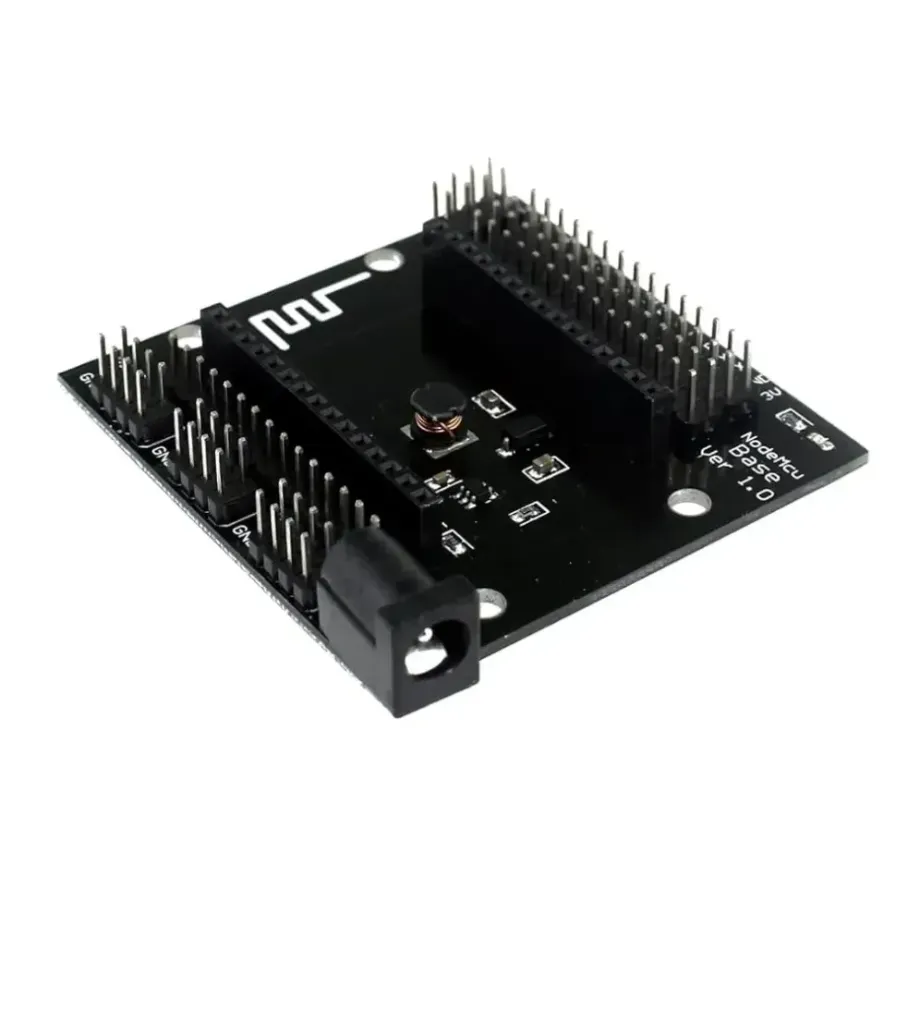
- NodeMcu v3 Basic Base Board
- NodeMCU
Features
- Specifically designed for NodeMCU V3 (Lolin)
- Full GPIO breakout to easy-access header pins
- Clearly labeled power pins: Vin, VUSB, 5V, 3.3V, and GND
- Plug-and-play design for rapid prototyping
- Eliminates the need for an external breadboard
- Supports direct connection of sensors and actuator modules
- On-board 5V voltage regulator with up to 1A output
- DC barrel jack for flexible power input
- Wide operating input voltage range
- On-board power indicator LED
Specifications
- Board Compatibility: NodeMCU LUA V3 (Lolin)
- Power Input: DC barrel jack
- Input Voltage Range: 6V to 24VDC
- Maximum Output Current: 1A
- On-board Regulator: 5V linear regulator
- Available Outputs: Vin, 5V, 3.3V, GND
- Indicator: Power status LED
Pinout
Power Pins:
- Vin: Input voltage from the DC barrel jack (6V–24VDC)
- VUSB: 5V supply from the NodeMCU USB connection
- 5V: Regulated 5V output from the on-board voltage regulator
- 3.3V: Regulated 3.3V output from the NodeMCU
- GND: Ground reference
GPIO Pins (Extended from NodeMCU V3):
- D0: GPIO16 – deep sleep wake-up support
- D1: GPIO5 – I2C SCL
- D2: GPIO4 – I2C SDA
- D3: GPIO0 – boot mode pin
- D4: GPIO2 – on-board LED / boot mode pin
- D5: GPIO14 – SPI SCLK
- D6: GPIO12 – SPI MISO
- D7: GPIO13 – SPI MOSI
- D8: GPIO15 – SPI CS
- RX: GPIO3 – UART RX
- TX: GPIO1 – UART TX
- A0: Analog input (ADC)
Power Architecture
- Single DC input powers both the NodeMCU and external modules
- On-board regulator converts 6–12VDC input to stable 5V
- NodeMCU generates 3.3V for ESP8266 and low-power peripherals
- Power LED provides instant visual feedback
Applications
- ESP8266 and NodeMCU rapid prototyping
- IoT development and smart home projects
- Sensor data acquisition systems
- Relay and actuator control platforms
- Educational and training labs
- Proof-of-concept and product testing
- Wireless automation and monitoring systems
Compatibility
- NodeMCU V3 (Lolin)
- ESP8266-based development environments
- Arduino IDE, PlatformIO, and Lua-based firmware
Features
- Specifically designed for NodeMCU V3 (Lolin)
- Full GPIO breakout to easy-access header pins
- Clearly labeled power pins: Vin, VUSB, 5V, 3.3V, and GND
- Plug-and-play design for rapid prototyping
- Eliminates the need for an external breadboard
- Supports direct connection of sensors and actuator modules
- On-board 5V voltage regulator with up to 1A output
- DC barrel jack for flexible power input
- Wide operating input voltage range
- On-board power indicator LED
Specifications
- Board Compatibility: NodeMCU LUA V3 (Lolin)
- Power Input: DC barrel jack
- Input Voltage Range: 6V to 24VDC
- Maximum Output Current: 1A
- On-board Regulator: 5V linear regulator
- Available Outputs: Vin, 5V, 3.3V, GND
- Indicator: Power status LED
Pinout
Power Pins:
- Vin: Input voltage from the DC barrel jack (6V–24VDC)
- VUSB: 5V supply from the NodeMCU USB connection
- 5V: Regulated 5V output from the on-board voltage regulator
- 3.3V: Regulated 3.3V output from the NodeMCU
- GND: Ground reference
GPIO Pins (Extended from NodeMCU V3):
- D0: GPIO16 – deep sleep wake-up support
- D1: GPIO5 – I2C SCL
- D2: GPIO4 – I2C SDA
- D3: GPIO0 – boot mode pin
- D4: GPIO2 – on-board LED / boot mode pin
- D5: GPIO14 – SPI SCLK
- D6: GPIO12 – SPI MISO
- D7: GPIO13 – SPI MOSI
- D8: GPIO15 – SPI CS
- RX: GPIO3 – UART RX
- TX: GPIO1 – UART TX
- A0: Analog input (ADC)
Power Architecture
- Single DC input powers both the NodeMCU and external modules
- On-board regulator converts 6–12VDC input to stable 5V
- NodeMCU generates 3.3V for ESP8266 and low-power peripherals
- Power LED provides instant visual feedback
Applications
- ESP8266 and NodeMCU rapid prototyping
- IoT development and smart home projects
- Sensor data acquisition systems
- Relay and actuator control platforms
- Educational and training labs
- Proof-of-concept and product testing
- Wireless automation and monitoring systems
Compatibility
- NodeMCU V3 (Lolin)
- ESP8266-based development environments
- Arduino IDE, PlatformIO, and Lua-based firmware