- All products
- Power
- DC Converters
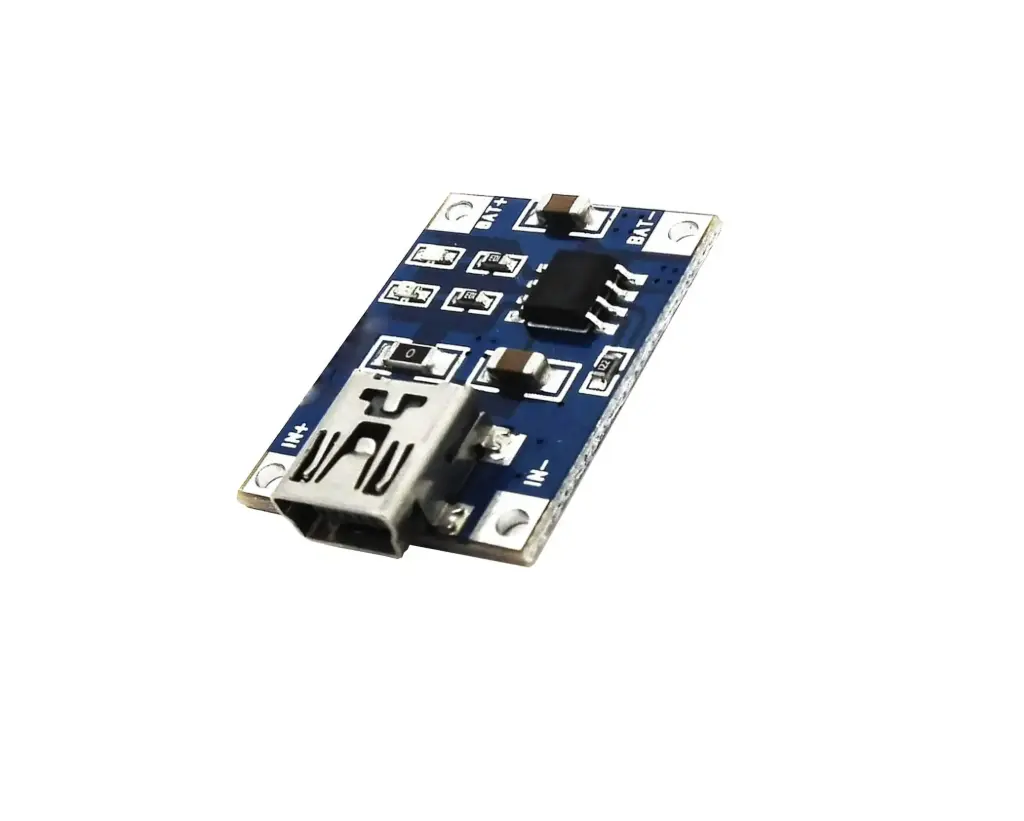
- DC-DC Battery Mini USB LiPo Charging Board Module TP4056 5V 1A
- DC Converters
Features
- Based on the mature and widely used TP4056 lithium battery charging IC.
- Designed for charging a single LiPo/Li-ion cell or cells connected in parallel.
- 1A maximum charging current, adjustable by changing the onboard resistor.
- Linear charging method with automatic charging control.
- Charging voltage accuracy of approximately 1.5%.
- Compact and lightweight design suitable for portable electronics.
- Mini USB input for convenient connection to a 5V power source.
- Uses SMD components and automated assembly for consistent production quality.
- Each module is tested before shipment for reliable operation.
- Suitable for DIY electronics, embedded systems, RC projects, and portable devices.
Principle of Operation
The TP4056 module converts a regulated 5V USB input into a controlled charging current for a single lithium-ion or LiPo battery cell. The TP4056 uses a constant-current/constant-voltage charging process.

During the initial charging stage, the module supplies the programmed charging current to the battery. As the battery voltage approaches approximately 4.2V, the charger transitions to constant-voltage operation and gradually reduces the charging current. Charging terminates automatically when the current falls to the termination level defined by the TP4056. The charging current can be adjusted by changing the onboard programming resistor, allowing the module to be configured for batteries with different capacities.
Applications
- LiPo and single-cell Li-ion battery charging
- DIY rechargeable battery projects
- Portable electronic devices
- Arduino and microcontroller projects
- Embedded electronics
- Battery-powered sensors and IoT devices
- RC and hobby projects
- USB-powered battery charging systems
- Small robotics projects
- Portable lighting and other battery-powered devices
Pinout
| Pin / Interface | Function |
|---|---|
| Mini USB | 5V power input for the charging module |
| IN+ | Positive charging power input, typically 5V |
| IN− | Ground / negative input |
| B+ | Positive terminal of the LiPo/Li-ion battery |
| B− | Negative terminal of the LiPo/Li-ion battery |
Wiring
Connect a regulated 5V USB power source to the Mini USB input and connect the single-cell LiPo/Li-ion battery to the B+ and B− terminals.
| TP4056 Connection | Connect To |
|---|---|
| Mini USB 5V | 5V regulated USB power supply |
| B+ | Battery positive (+) |
| B− | Battery negative (−) |
Important: The battery polarity must be connected correctly. Reverse connection at the battery output can damage the charging IC. The module does not provide reverse-polarity protection at the battery connection.
Specifications
| Product Name | TP4056 LiPo Battery Charging Board |
| IC | TP4056 |
| Charging Method | Linear CC/CV charging |
| Input Voltage | 4.5V–5.5V |
| Charging Current | Up to 1A, adjustable |
| Full-Charge Voltage | 4.2V |
| Charge Accuracy | Approximately 1.5% |
| Input Interface | Mini USB |
| Supported Battery | Single LiPo/Li-ion cell or parallel cells |
| Reverse Input Protection | Not supported |
| Operating Temperature | −10°C to +85°C |
| Dimensions | 25 × 19 × 10 mm |
| Weight | Approximately 1.8 g |
Important Notes
- Use the module only with compatible single-cell LiPo/Li-ion batteries.
- Do not reverse the battery polarity. Reverse battery connection can damage the TP4056 IC.
- Use a stable 5V input within the specified voltage range.
- For accurate current measurement, an ammeter must be connected in series with the 5V input.
- A charging current of approximately 0.37 × battery capacity is recommended according to the supplied module information.
- Avoid thin or excessively long charging wires to minimize voltage drop and charging losses.
- Ensure reliable electrical contact between the battery and the B+ / B− terminals.
- The module may become warm during charging; normal operating temperature can reach approximately 60°C depending on charging conditions.
- When charging multiple cells in parallel, the cells should be compatible and at similar voltage levels before connecting them together.
Features
- Based on the mature and widely used TP4056 lithium battery charging IC.
- Designed for charging a single LiPo/Li-ion cell or cells connected in parallel.
- 1A maximum charging current, adjustable by changing the onboard resistor.
- Linear charging method with automatic charging control.
- Charging voltage accuracy of approximately 1.5%.
- Compact and lightweight design suitable for portable electronics.
- Mini USB input for convenient connection to a 5V power source.
- Uses SMD components and automated assembly for consistent production quality.
- Each module is tested before shipment for reliable operation.
- Suitable for DIY electronics, embedded systems, RC projects, and portable devices.
Principle of Operation
The TP4056 module converts a regulated 5V USB input into a controlled charging current for a single lithium-ion or LiPo battery cell. The TP4056 uses a constant-current/constant-voltage charging process.

During the initial charging stage, the module supplies the programmed charging current to the battery. As the battery voltage approaches approximately 4.2V, the charger transitions to constant-voltage operation and gradually reduces the charging current. Charging terminates automatically when the current falls to the termination level defined by the TP4056. The charging current can be adjusted by changing the onboard programming resistor, allowing the module to be configured for batteries with different capacities.
Applications
- LiPo and single-cell Li-ion battery charging
- DIY rechargeable battery projects
- Portable electronic devices
- Arduino and microcontroller projects
- Embedded electronics
- Battery-powered sensors and IoT devices
- RC and hobby projects
- USB-powered battery charging systems
- Small robotics projects
- Portable lighting and other battery-powered devices
Pinout
| Pin / Interface | Function |
|---|---|
| Mini USB | 5V power input for the charging module |
| IN+ | Positive charging power input, typically 5V |
| IN− | Ground / negative input |
| B+ | Positive terminal of the LiPo/Li-ion battery |
| B− | Negative terminal of the LiPo/Li-ion battery |
Wiring
Connect a regulated 5V USB power source to the Mini USB input and connect the single-cell LiPo/Li-ion battery to the B+ and B− terminals.
| TP4056 Connection | Connect To |
|---|---|
| Mini USB 5V | 5V regulated USB power supply |
| B+ | Battery positive (+) |
| B− | Battery negative (−) |
Important: The battery polarity must be connected correctly. Reverse connection at the battery output can damage the charging IC. The module does not provide reverse-polarity protection at the battery connection.
Specifications
| Product Name | TP4056 LiPo Battery Charging Board |
| IC | TP4056 |
| Charging Method | Linear CC/CV charging |
| Input Voltage | 4.5V–5.5V |
| Charging Current | Up to 1A, adjustable |
| Full-Charge Voltage | 4.2V |
| Charge Accuracy | Approximately 1.5% |
| Input Interface | Mini USB |
| Supported Battery | Single LiPo/Li-ion cell or parallel cells |
| Reverse Input Protection | Not supported |
| Operating Temperature | −10°C to +85°C |
| Dimensions | 25 × 19 × 10 mm |
| Weight | Approximately 1.8 g |
Important Notes
- Use the module only with compatible single-cell LiPo/Li-ion batteries.
- Do not reverse the battery polarity. Reverse battery connection can damage the TP4056 IC.
- Use a stable 5V input within the specified voltage range.
- For accurate current measurement, an ammeter must be connected in series with the 5V input.
- A charging current of approximately 0.37 × battery capacity is recommended according to the supplied module information.
- Avoid thin or excessively long charging wires to minimize voltage drop and charging losses.
- Ensure reliable electrical contact between the battery and the B+ / B− terminals.
- The module may become warm during charging; normal operating temperature can reach approximately 60°C depending on charging conditions.
- When charging multiple cells in parallel, the cells should be compatible and at similar voltage levels before connecting them together.