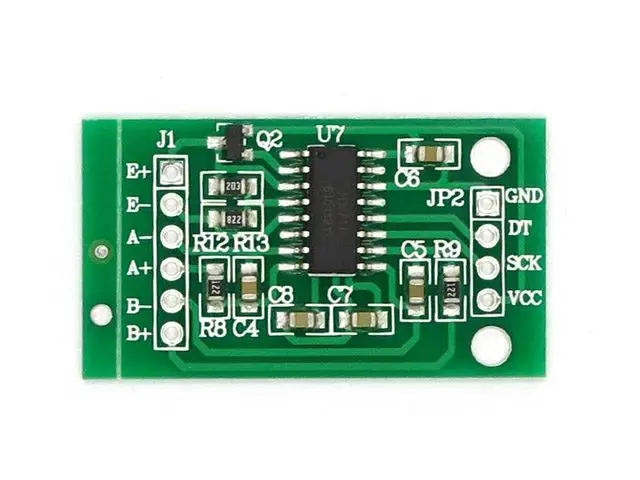
Features
- 24-bit analog-to-digital conversion: The HX711 provides high-precision 24-bit A/D conversion, ensuring accurate and stable readings even in demanding applications.
- Precision amplification: The HX711 amplifies the low-level output signals from load cells or strain gauges, making it possible to measure weight or pressure accurately.
- Low noise amplifier: The amplifier is designed with a low noise floor, minimizing the effects of interference and improving measurement accuracy.
- Programmable gain amplifier: The gain of the amplifier can be programmed, allowing for flexible adjustment based on the specific requirements of each application.
- Onboard A/D converter: The onboard A/D converter in the HX711 provides stable and accurate measurements without the need for external components.
- Single power supply operation: The HX711 operates on a single power supply, making it easy to integrate into a wide range of systems.
- Simple serial interface: The HX711 can be controlled using a simple serial interface, reducing the complexity of system integration.
- Adjustable offset and gain: The HX711 includes adjustable offset and gain, allowing users to calibrate their system to meet their specific requirements.
- Ideal for weigh scale and industrial control applications: The HX711 is specifically designed for weigh scale and industrial control applications, making it an ideal solution for a variety of use cases.
Principle of Work
The HX711 load cell amplifier operates on the principle of bridge sense. A load cell or strain gauge is used to measure weight or pressure, and the HX711 amplifies the low-level output signal from the load cell. The load cell works by deforming under an applied load, and this deformation changes the electrical resistance of the strain gauge. The HX711 measures the change in electrical resistance and converts it into a digital signal, which can be easily read and processed by a microcontroller or computer. The HX711 includes a programmable gain amplifier (PGA), which allows the gain of the amplifier to be set according to the specific requirements of the application. The PGA is used to amplify the small output signal from the load cell, making it possible to accurately measure weight or pressure. The HX711 also includes an adjustable offset, which can be used to compensate for any residual offset in the system. This offset is added to the digital signal produced by the HX711 and can be used to correct any measurement errors.
Pinout of the Module
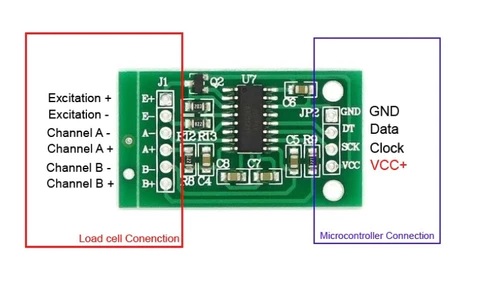
- VCC: Power supply pin, typically connected to a 5V supply.
- GND: Ground pin, used to connect the HX711 to the ground of the system.
- SCK: Serial clock input pin, used to clock in data from the load cell.
- DT: Data output pin, used to output the digital data from the HX711.
- E+: Positive excitation input pin, used to provide power to the load cell.
- E-: Negative excitation input pin used to return current from the load cell.
- E+ (A channel): Positive excitation input pin for the A channel, used to provide power to the load cell.
- E- (A channel): Negative excitation input pin for the A channel, used to return current from the load cell.
- E+ (B channel): Positive excitation input pin for the B channel, used to provide power to the load cell.
- E- (B channel): Negative excitation input pin for the B channel, used to return current from the load cell.
These pins provide the interface to the HX711 and allow it to communicate with a microcontroller or computer, receive power, and receive signals from the load cell. The HX711 is designed to be easy to integrate into a wide range of systems, making it a versatile solution for load cell amplification and data conversion.
Applications
- Weighing scales: The HX711 is commonly used in digital weighing scales, providing amplification and conversion of the signals from
- Force measurement: The HX711 can be used to measure forces in various applications, such as load testing, compression testing, and tension testing.
- Pressure measurement: The HX711 can be used to measure pressures in various applications, such as tire pressure monitoring systems, pressure sensors, and fluid pressure sensors.
- Load cell calibration: The HX711 can be used as a calibration tool for load cells, providing precise measurement of the output of the load cell.
- Other sensor interfaces: The HX711 can be used to interface with a variety of other sensors, such as potentiometers, force-sensitive resistors (FSRs), and strain gauges.
- Data acquisition: The HX711 can be used as a component in a data acquisition system, providing digitization of analog signals from sensors for further processing or storage.
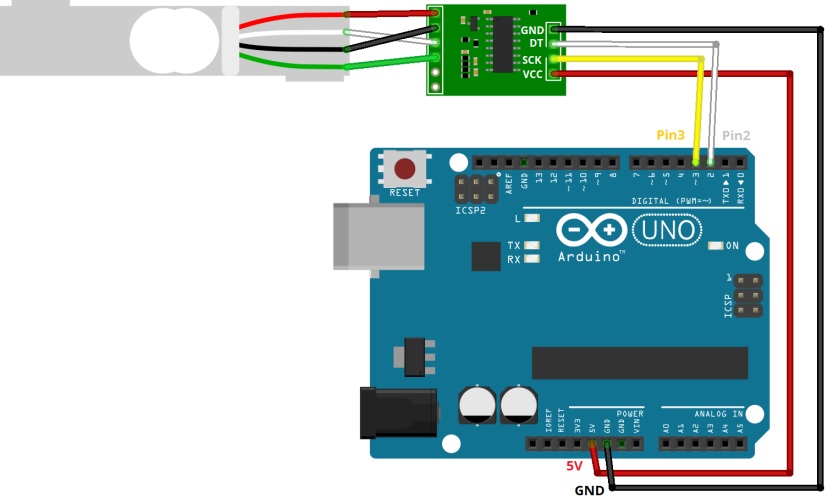
Circuit
Library
- Open the Arduino IDE.
- Go to
Sketch>Include Library>Manage Libraries. - Search for
HX711in the search bar. - Find the
HX711 Load Cell Amplifierlibrary in the list and clickInstall. - Wait for the library to be installed, then close the library manager.
- You should now be able to include the
HX711.hlibrary in your sketches and use it to communicate with the HX711 load cell amplifier.
Code
example code in C++ for using the PCF8591 with a potentiometer connected to input channel A0, and the module connected to the I2C bus on A5 (SDA) and A4 (SCL) pins of an Arduino Uno:
#include "HX711.h"

HX711 scale;

void setup() {
  Serial.begin(9600);
  scale.begin(2, 3);
  scale.set_scale(1000);  // set the scale factor to 1000 for a 1k load cell
  scale.tare();
}

void loop() {
  float weight = scale.get_units();
  Serial.println(weight);
}
- The code starts by including the
HX711.hlibrary, which provides the necessary functions and definitions for using the HX711 load cell amplifier with an Arduino. - The
HX711 scalethe object is declared, which represents the HX711 device and provides access to its functions and properties. - In the
setupfunction, the serial communication is initialized with a baud rate of 9600, and thescale.beginfunction is called with the digital pins 2 and 3 specified as the DT and SCK pins, respectively. - The
scale.set_scalethe function is called with a parameter of 1000, which sets the scale factor for the 1k load cell. This value is used to convert the raw ADC values from the HX711 into units of weight. - The
scale.tarethe function is called, which sets the current weight reading as the zero point, effectively subtracting the weight of any containers or other components connected to the load cell. - In the
loopfunction, thescale.get_unitsthe function is called, which returns the current weight reading in units of weight (determined by the scale factor set earlier). The weight value is then printed to the serial port using theSerial.printlnfunction
Technical Details
- Operating voltage: 2.7V to 5.5V DC
- Input impedance: greater than 10MΩ
- ADC resolution: 24-bit
- Conversion rate: 10 samples per second (default), up to 80 samples per second (maximum)
- Channel selection: automatic, via external pin or via software command
- Load cell excitation voltage: 5V DC
- Load cell input voltage range: ±15mV
- Load cell input resistance: 350Ω to 700Ω
- Load cell input current: less than 60μA
- Load cell input capacitance: less than 15pF
- Operating temperature range: -40°C to +85°C
- Dimensions: 24mm x 20mm x 14mm
- Weight: 2.1g
Resources
Comparisons
The HX711 and ADS1115 are both integrated circuits (ICs) that function as analog-to-digital converters (ADCs). However, they have some differences in their specifications and capabilities:
- ADC resolution: The HX711 has a 24-bit ADC resolution, while the ADS1115 has a 16-bit ADC resolution.
- Conversion rate: The HX711 has a default conversion rate of 10 samples per second, with a maximum rate of 80 samples per second. The ADS1115 has a default conversion rate of 860 samples per second.
- Input channels: The HX711 has two input channels (A and B), while the ADS1115 has four input channels.
- Operating voltage: The HX711 operates on a voltage range of 2.7V to 5.5V DC, while the ADS1115 operates on a voltage range of 2.0V to 5.5V DC.
- Power consumption: The HX711 has a lower power consumption than the ADS1115.
- Load cell interface: The HX711 is specifically designed to interface with load cells, while the ADS1115 can be used with a variety of different sensors and signals.
Features
- 24-bit analog-to-digital conversion: The HX711 provides high-precision 24-bit A/D conversion, ensuring accurate and stable readings even in demanding applications.
- Precision amplification: The HX711 amplifies the low-level output signals from load cells or strain gauges, making it possible to measure weight or pressure accurately.
- Low noise amplifier: The amplifier is designed with a low noise floor, minimizing the effects of interference and improving measurement accuracy.
- Programmable gain amplifier: The gain of the amplifier can be programmed, allowing for flexible adjustment based on the specific requirements of each application.
- Onboard A/D converter: The onboard A/D converter in the HX711 provides stable and accurate measurements without the need for external components.
- Single power supply operation: The HX711 operates on a single power supply, making it easy to integrate into a wide range of systems.
- Simple serial interface: The HX711 can be controlled using a simple serial interface, reducing the complexity of system integration.
- Adjustable offset and gain: The HX711 includes adjustable offset and gain, allowing users to calibrate their system to meet their specific requirements.
- Ideal for weigh scale and industrial control applications: The HX711 is specifically designed for weigh scale and industrial control applications, making it an ideal solution for a variety of use cases.
Principle of Work
The HX711 load cell amplifier operates on the principle of bridge sense. A load cell or strain gauge is used to measure weight or pressure, and the HX711 amplifies the low-level output signal from the load cell. The load cell works by deforming under an applied load, and this deformation changes the electrical resistance of the strain gauge. The HX711 measures the change in electrical resistance and converts it into a digital signal, which can be easily read and processed by a microcontroller or computer. The HX711 includes a programmable gain amplifier (PGA), which allows the gain of the amplifier to be set according to the specific requirements of the application. The PGA is used to amplify the small output signal from the load cell, making it possible to accurately measure weight or pressure. The HX711 also includes an adjustable offset, which can be used to compensate for any residual offset in the system. This offset is added to the digital signal produced by the HX711 and can be used to correct any measurement errors.
Pinout of the Module
- VCC: Power supply pin, typically connected to a 5V supply.
- GND: Ground pin, used to connect the HX711 to the ground of the system.
- SCK: Serial clock input pin, used to clock in data from the load cell.
- DT: Data output pin, used to output the digital data from the HX711.
- E+: Positive excitation input pin, used to provide power to the load cell.
- E-: Negative excitation input pin used to return current from the load cell.
- E+ (A channel): Positive excitation input pin for the A channel, used to provide power to the load cell.
- E- (A channel): Negative excitation input pin for the A channel, used to return current from the load cell.
- E+ (B channel): Positive excitation input pin for the B channel, used to provide power to the load cell.
- E- (B channel): Negative excitation input pin for the B channel, used to return current from the load cell.
These pins provide the interface to the HX711 and allow it to communicate with a microcontroller or computer, receive power, and receive signals from the load cell. The HX711 is designed to be easy to integrate into a wide range of systems, making it a versatile solution for load cell amplification and data conversion.
Applications
- Weighing scales: The HX711 is commonly used in digital weighing scales, providing amplification and conversion of the signals from
- Force measurement: The HX711 can be used to measure forces in various applications, such as load testing, compression testing, and tension testing.
- Pressure measurement: The HX711 can be used to measure pressures in various applications, such as tire pressure monitoring systems, pressure sensors, and fluid pressure sensors.
- Load cell calibration: The HX711 can be used as a calibration tool for load cells, providing precise measurement of the output of the load cell.
- Other sensor interfaces: The HX711 can be used to interface with a variety of other sensors, such as potentiometers, force-sensitive resistors (FSRs), and strain gauges.
- Data acquisition: The HX711 can be used as a component in a data acquisition system, providing digitization of analog signals from sensors for further processing or storage.
Circuit
Library
- Open the Arduino IDE.
- Go to
Sketch>Include Library>Manage Libraries. - Search for
HX711in the search bar. - Find the
HX711 Load Cell Amplifierlibrary in the list and clickInstall. - Wait for the library to be installed, then close the library manager.
- You should now be able to include the
HX711.hlibrary in your sketches and use it to communicate with the HX711 load cell amplifier.
Code
example code in C++ for using the PCF8591 with a potentiometer connected to input channel A0, and the module connected to the I2C bus on A5 (SDA) and A4 (SCL) pins of an Arduino Uno:
#include "HX711.h"

HX711 scale;

void setup() {
  Serial.begin(9600);
  scale.begin(2, 3);
  scale.set_scale(1000);  // set the scale factor to 1000 for a 1k load cell
  scale.tare();
}

void loop() {
  float weight = scale.get_units();
  Serial.println(weight);
}
- The code starts by including the
HX711.hlibrary, which provides the necessary functions and definitions for using the HX711 load cell amplifier with an Arduino. - The
HX711 scalethe object is declared, which represents the HX711 device and provides access to its functions and properties. - In the
setupfunction, the serial communication is initialized with a baud rate of 9600, and thescale.beginfunction is called with the digital pins 2 and 3 specified as the DT and SCK pins, respectively. - The
scale.set_scalethe function is called with a parameter of 1000, which sets the scale factor for the 1k load cell. This value is used to convert the raw ADC values from the HX711 into units of weight. - The
scale.tarethe function is called, which sets the current weight reading as the zero point, effectively subtracting the weight of any containers or other components connected to the load cell. - In the
loopfunction, thescale.get_unitsthe function is called, which returns the current weight reading in units of weight (determined by the scale factor set earlier). The weight value is then printed to the serial port using theSerial.printlnfunction
Technical Details
- Operating voltage: 2.7V to 5.5V DC
- Input impedance: greater than 10MΩ
- ADC resolution: 24-bit
- Conversion rate: 10 samples per second (default), up to 80 samples per second (maximum)
- Channel selection: automatic, via external pin or via software command
- Load cell excitation voltage: 5V DC
- Load cell input voltage range: ±15mV
- Load cell input resistance: 350Ω to 700Ω
- Load cell input current: less than 60μA
- Load cell input capacitance: less than 15pF
- Operating temperature range: -40°C to +85°C
- Dimensions: 24mm x 20mm x 14mm
- Weight: 2.1g
Resources
Comparisons
The HX711 and ADS1115 are both integrated circuits (ICs) that function as analog-to-digital converters (ADCs). However, they have some differences in their specifications and capabilities:
- ADC resolution: The HX711 has a 24-bit ADC resolution, while the ADS1115 has a 16-bit ADC resolution.
- Conversion rate: The HX711 has a default conversion rate of 10 samples per second, with a maximum rate of 80 samples per second. The ADS1115 has a default conversion rate of 860 samples per second.
- Input channels: The HX711 has two input channels (A and B), while the ADS1115 has four input channels.
- Operating voltage: The HX711 operates on a voltage range of 2.7V to 5.5V DC, while the ADS1115 operates on a voltage range of 2.0V to 5.5V DC.
- Power consumption: The HX711 has a lower power consumption than the ADS1115.
- Load cell interface: The HX711 is specifically designed to interface with load cells, while the ADS1115 can be used with a variety of different sensors and signals.