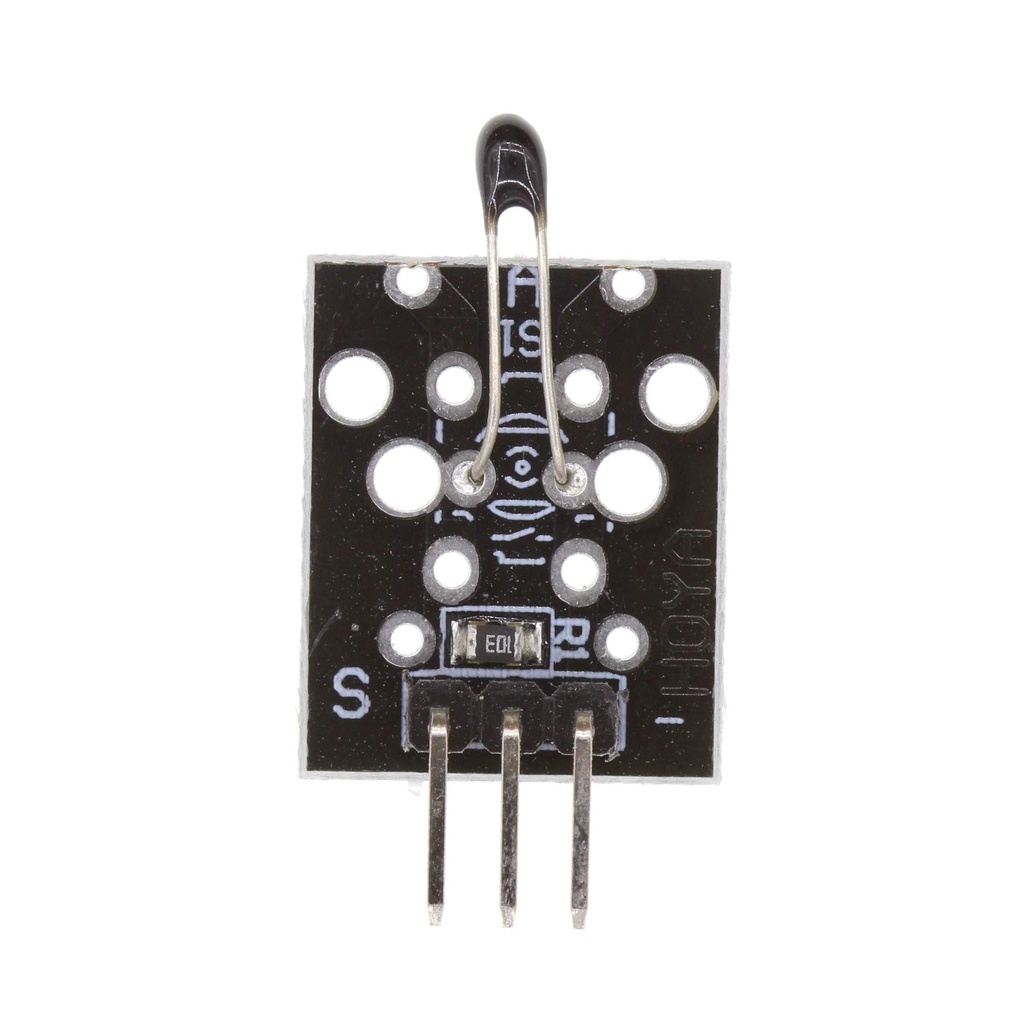
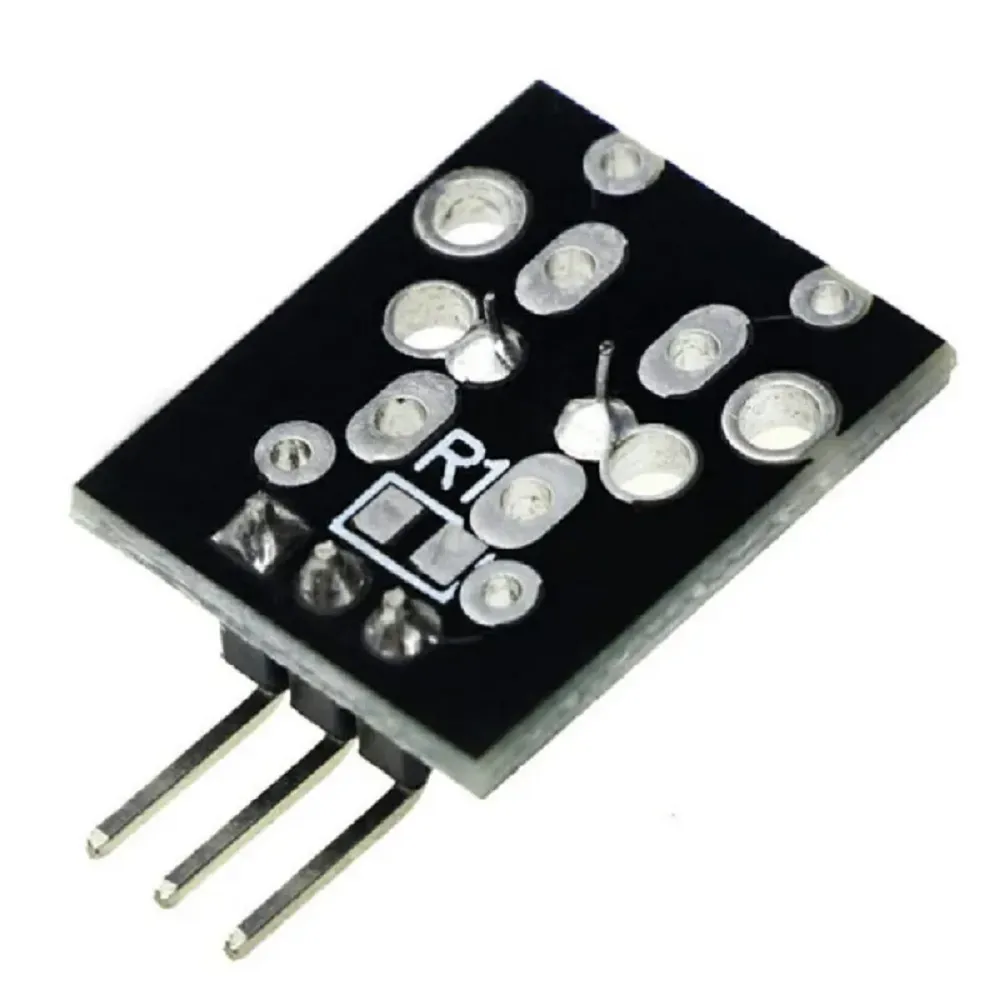
Features
- Thermistor cost is economical
- Provided with lacquer-coated thermistor disk
- Copper leads have a coating of tin.
- Onboard resistors, no need for external components
- Good stability, and durability in the environment
- Provide high accuracy in resistance and B-constant
Principle of Work
The resistance of thermometers, which are variable resistors, varies with temperature. They are categorized based on how they react to temperature changes in terms of resistance. Resistance decreases as temperature rises in thermistors with a negative temperature coefficient (NTC). The most popular thermistors are NTC ones.
NTC thermistors are created by heating and compressing a semiconducting material (like metal oxide or ceramic) to create a temperature-sensitive conducting material. Charge carriers in the conducting material enable current to pass through it. The semiconducting material releases more charge carriers when the temperature is elevated.
Electrons are the charge carriers in ferric oxide-based NTC thermistors. Electron holes serve as the charge carriers in nickel oxide NTC thermistors.
To measure the resistance of the NTC Thermistor, first, we will measure the voltage from the voltage divider which is the output or s pi.
Vout = Vin * [R2 / (R1 + R2)]
Since we know Vin, R1, and Vout we can calculate the value of the NTC thermistor R2 with the following equation:
R2 = (Vout * R1) / (Vin - Vout)
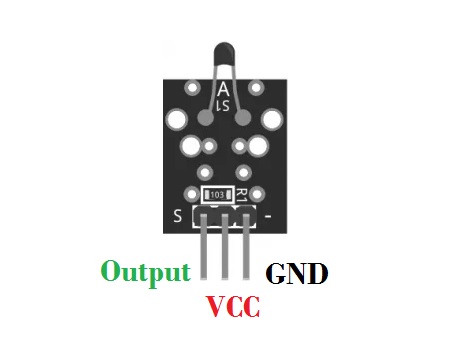
Pinout of the Board
| KY-013 | Description |
|---|---|
| S | Analog signal out |
| middle | 5V |
| – | GND |
Applications
- Domestic application – Fridges, freezers, cookers and deep-fat fryers, etc.
- Industrial, Telecommunication application – Process control, heating and ventilation, air conditioning, fire alarms, temperature protection in battery management/charging systems, video and audio equipment, mobile phones, and camcorders, etc.
- Automotive application – Inlet air-temperature control, engine temperature control, airbag electronic systems, etc.
- Thermistors can be used for temperature compensation, temperature measurement, and temperature control.
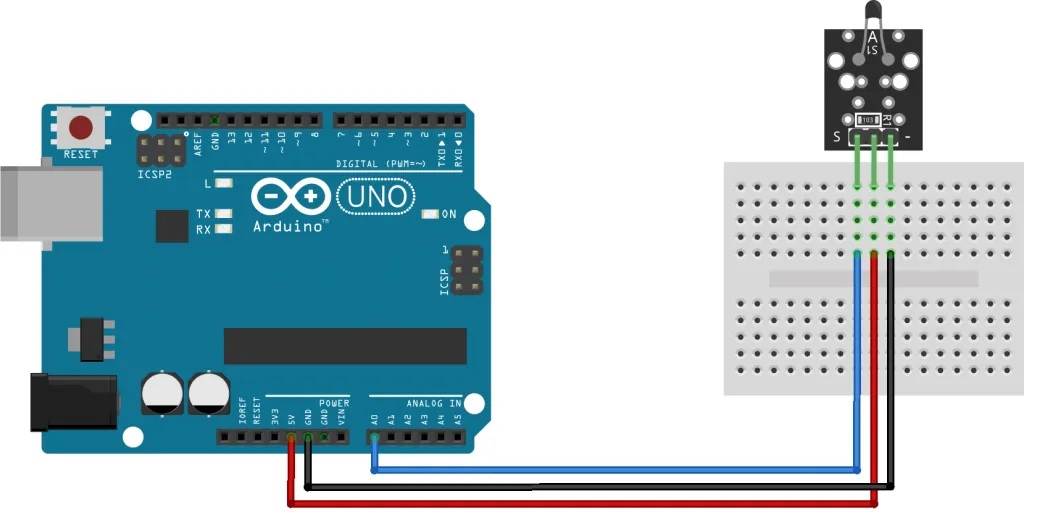
Circuit
S pin to pin A0 on Arduino
– pin to GND on Arduino
middle pin to 5V on Arduino
Library
You don't need any library to work with this sensor.
Code
#define ntc_pin A0
#define vd_power_pin 2
#define nominal_resistance 10000
#define nominal_temeprature 25
#define samplingrate 5
#define beta 3950
#define Rref 10000

int samples = 0;

void setup(void) {
  pinMode(vd_power_pin, OUTPUT);
  Serial.begin(9600);
}

void loop(void) {
  uint8_t i;
  float average;
  samples = 0;

  digitalWrite(vd_power_pin, HIGH);
  for (i = 0; i < samplingrate; i++) {
    samples += analogRead(ntc_pin);
    delay(10);
  }
  digitalWrite(vd_power_pin, LOW);

  average = samples / samplingrate;

  Serial.print("ADC readings ");
  Serial.println(average);

  average = 1023 / average - 1;
  average = Rref / average;

  Serial.print("Thermistor resistance ");
  Serial.println(average);

  float temperature;
  temperature = average / nominal_resistance;
  temperature = log(temperature);
  temperature /= beta;
  temperature += 1.0 / (nominal_temeprature + 273.15);
  temperature = 1.0 / temperature;
  temperature -= 273.15;

  Serial.print("Temperature ");
  Serial.print(temperature);
  Serial.println(" *C");

  delay(2000);
}
Technical Details
- Resistance at 25 degrees C: 10K ± 1%
- B-value (material constant): 3950 ± 1%
- Dissipation factor δth (in air): approx. 7.5mW/K
- Thermal cooling time constant (in air): ≤ 20 seconds
- Thermistor temperature range: -55°C to 125°C
- Operating Voltage: 5V
Comparisons
Thermometers are very cheap, but imprecise, and their resistance changes with temperature in a non-linear manner, determining the temperature requires a little work on your software's part.
Although more expensive, active devices like the LM35 are more accurate and provide a linear voltage-vs-temperature characteristic, making it simpler to determine the temperature. The LM35 is calibrated and does not require any external calibration or trimming.
Features
- Thermistor cost is economical
- Provided with lacquer-coated thermistor disk
- Copper leads have a coating of tin.
- Onboard resistors, no need for external components
- Good stability, and durability in the environment
- Provide high accuracy in resistance and B-constant
Principle of Work
The resistance of thermometers, which are variable resistors, varies with temperature. They are categorized based on how they react to temperature changes in terms of resistance. Resistance decreases as temperature rises in thermistors with a negative temperature coefficient (NTC). The most popular thermistors are NTC ones.
NTC thermistors are created by heating and compressing a semiconducting material (like metal oxide or ceramic) to create a temperature-sensitive conducting material. Charge carriers in the conducting material enable current to pass through it. The semiconducting material releases more charge carriers when the temperature is elevated.
Electrons are the charge carriers in ferric oxide-based NTC thermistors. Electron holes serve as the charge carriers in nickel oxide NTC thermistors.
To measure the resistance of the NTC Thermistor, first, we will measure the voltage from the voltage divider which is the output or s pi.
Vout = Vin * [R2 / (R1 + R2)]
Since we know Vin, R1, and Vout we can calculate the value of the NTC thermistor R2 with the following equation:
R2 = (Vout * R1) / (Vin - Vout)
Pinout of the Board
| KY-013 | Description |
|---|---|
| S | Analog signal out |
| middle | 5V |
| – | GND |
Applications
- Domestic application – Fridges, freezers, cookers and deep-fat fryers, etc.
- Industrial, Telecommunication application – Process control, heating and ventilation, air conditioning, fire alarms, temperature protection in battery management/charging systems, video and audio equipment, mobile phones, and camcorders, etc.
- Automotive application – Inlet air-temperature control, engine temperature control, airbag electronic systems, etc.
- Thermistors can be used for temperature compensation, temperature measurement, and temperature control.
Circuit
S pin to pin A0 on Arduino
– pin to GND on Arduino
middle pin to 5V on Arduino
Library
You don't need any library to work with this sensor.
Code
#define ntc_pin A0
#define vd_power_pin 2
#define nominal_resistance 10000
#define nominal_temeprature 25
#define samplingrate 5
#define beta 3950
#define Rref 10000

int samples = 0;

void setup(void) {
  pinMode(vd_power_pin, OUTPUT);
  Serial.begin(9600);
}

void loop(void) {
  uint8_t i;
  float average;
  samples = 0;

  digitalWrite(vd_power_pin, HIGH);
  for (i = 0; i < samplingrate; i++) {
    samples += analogRead(ntc_pin);
    delay(10);
  }
  digitalWrite(vd_power_pin, LOW);

  average = samples / samplingrate;

  Serial.print("ADC readings ");
  Serial.println(average);

  average = 1023 / average - 1;
  average = Rref / average;

  Serial.print("Thermistor resistance ");
  Serial.println(average);

  float temperature;
  temperature = average / nominal_resistance;
  temperature = log(temperature);
  temperature /= beta;
  temperature += 1.0 / (nominal_temeprature + 273.15);
  temperature = 1.0 / temperature;
  temperature -= 273.15;

  Serial.print("Temperature ");
  Serial.print(temperature);
  Serial.println(" *C");

  delay(2000);
}
Technical Details
- Resistance at 25 degrees C: 10K ± 1%
- B-value (material constant): 3950 ± 1%
- Dissipation factor δth (in air): approx. 7.5mW/K
- Thermal cooling time constant (in air): ≤ 20 seconds
- Thermistor temperature range: -55°C to 125°C
- Operating Voltage: 5V
Comparisons
Thermometers are very cheap, but imprecise, and their resistance changes with temperature in a non-linear manner, determining the temperature requires a little work on your software's part.
Although more expensive, active devices like the LM35 are more accurate and provide a linear voltage-vs-temperature characteristic, making it simpler to determine the temperature. The LM35 is calibrated and does not require any external calibration or trimming.