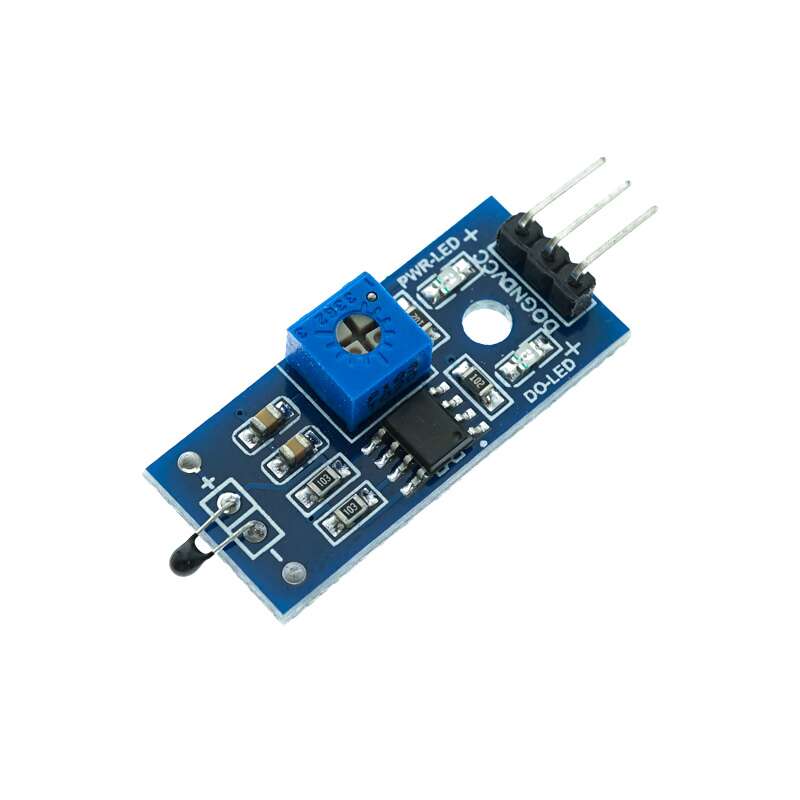
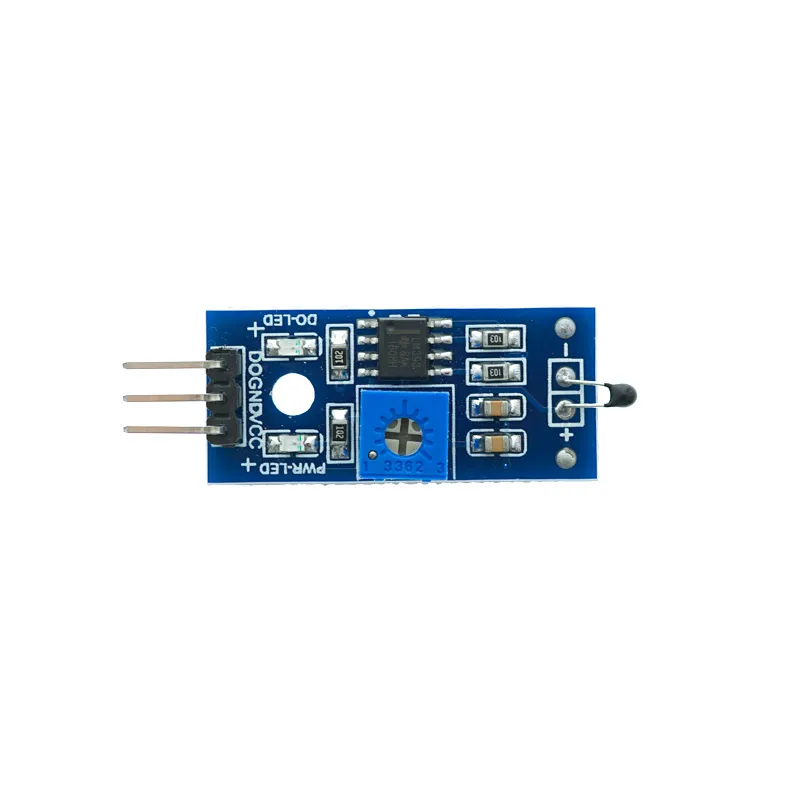
Features
- Economical thermistor based temperature sensing
- Supports analog and digital output
- Adjustable sensitivity using onboard potentiometer
- Two onboard LEDs for power indication and digital output status
- Lacquer coated thermistor disk for protection
- Tin coated copper leads for improved durability
- Onboard resistors with no need for external components
- Operating voltage range from three point three volts to five volts
- Digital switching output with logic zero and one
- Fixed mounting holes for easy installation
- Uses LM393 comparator
- Good stability and durability in environmental conditions
- High accuracy resistance and B constant
Principle of Work
Thermistors are temperature sensitive resistors whose resistance varies with temperature. In negative temperature coefficient thermistors, resistance decreases as temperature increases. These thermistors are manufactured from semiconducting materials such as metal oxides or ceramics. As temperature rises, the material releases more charge carriers, allowing increased current flow. This change in resistance is detected by the comparator circuit on the module to generate a digital output signal when a preset temperature threshold is reached.
Pinout of the Board
| Pin Name | Description |
|---|---|
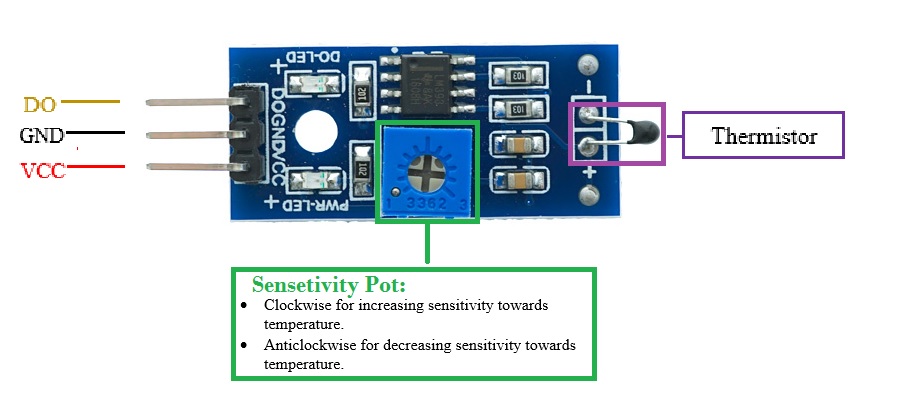
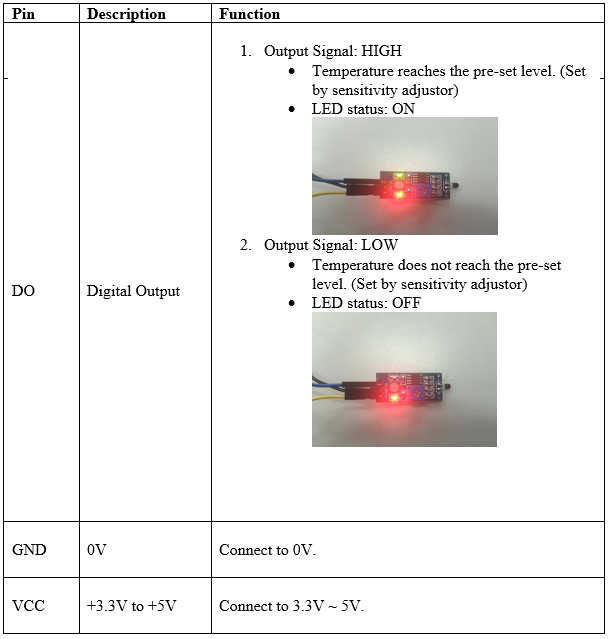
| VCC | Power supply input from three point three volts to five volts |
| GND | Ground connection |
| D0 | Digital output signal from comparator |
Applications
- Domestic appliances such as refrigerators freezers cookers and fryers
- Temperature compensation circuits
- Temperature measurement systems
- Temperature control and protection circuits
Circuit
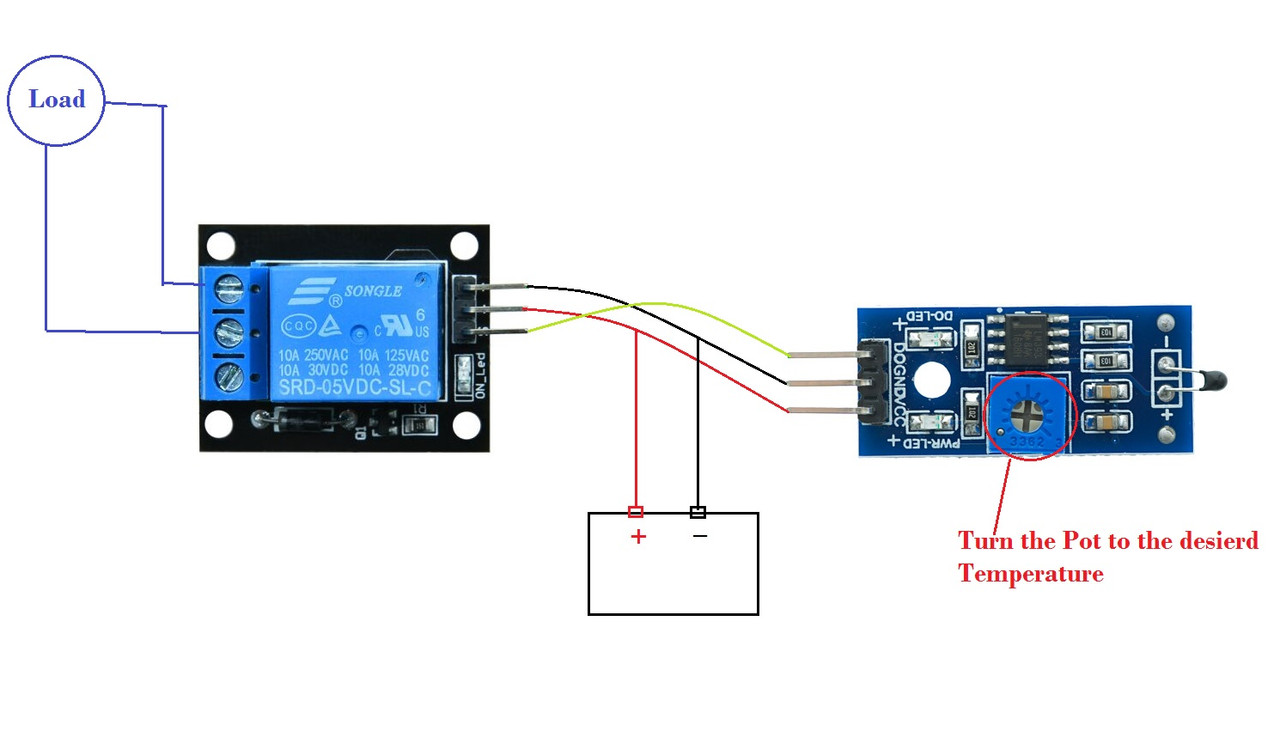
Connect the D0 pin to the signal input of a relay module. Connect GND to ground and VCC to five volts. Ensure that the relay and sensor module share the same ground. Both AC and DC loads can be connected through the relay.
Library
No library is required to use this sensor module.
Code
No code is required since this module can operate without a microcontroller.
Technical Details
- Resistance at twenty five degrees Celsius ten kilo ohm with one percent tolerance
- B value material constant three nine five zero with one percent tolerance
- Dissipation factor in air approximately seven point five milliwatt per kelvin
- Thermal time constant in air less than or equal to twenty seconds
- Thermistor temperature range from minus twenty degrees Celsius to eighty degrees Celsius
- Input voltage from three point three volts to five volts DC
- Module size thirty two millimeter by fourteen millimeter by five millimeter
Comparisons
Thermistors are inexpensive but have a non linear resistance to temperature relationship, which requires additional processing when used with software. Active sensors such as LM35 offer linear voltage output and higher accuracy but are more expensive. This module provides digital output through a Schmitt trigger circuit and can be used without a microcontroller. If analog output is required, the onboard potentiometer allows adjustment, but the module remains suitable for standalone temperature based control applications.
Features
- Economical thermistor based temperature sensing
- Supports analog and digital output
- Adjustable sensitivity using onboard potentiometer
- Two onboard LEDs for power indication and digital output status
- Lacquer coated thermistor disk for protection
- Tin coated copper leads for improved durability
- Onboard resistors with no need for external components
- Operating voltage range from three point three volts to five volts
- Digital switching output with logic zero and one
- Fixed mounting holes for easy installation
- Uses LM393 comparator
- Good stability and durability in environmental conditions
- High accuracy resistance and B constant
Principle of Work
Thermistors are temperature sensitive resistors whose resistance varies with temperature. In negative temperature coefficient thermistors, resistance decreases as temperature increases. These thermistors are manufactured from semiconducting materials such as metal oxides or ceramics. As temperature rises, the material releases more charge carriers, allowing increased current flow. This change in resistance is detected by the comparator circuit on the module to generate a digital output signal when a preset temperature threshold is reached.
Pinout of the Board
| Pin Name | Description |
|---|---|
| VCC | Power supply input from three point three volts to five volts |
| GND | Ground connection |
| D0 | Digital output signal from comparator |
Applications
- Domestic appliances such as refrigerators freezers cookers and fryers
- Temperature compensation circuits
- Temperature measurement systems
- Temperature control and protection circuits
Circuit
Connect the D0 pin to the signal input of a relay module. Connect GND to ground and VCC to five volts. Ensure that the relay and sensor module share the same ground. Both AC and DC loads can be connected through the relay.
Library
No library is required to use this sensor module.
Code
No code is required since this module can operate without a microcontroller.
Technical Details
- Resistance at twenty five degrees Celsius ten kilo ohm with one percent tolerance
- B value material constant three nine five zero with one percent tolerance
- Dissipation factor in air approximately seven point five milliwatt per kelvin
- Thermal time constant in air less than or equal to twenty seconds
- Thermistor temperature range from minus twenty degrees Celsius to eighty degrees Celsius
- Input voltage from three point three volts to five volts DC
- Module size thirty two millimeter by fourteen millimeter by five millimeter
Comparisons
Thermistors are inexpensive but have a non linear resistance to temperature relationship, which requires additional processing when used with software. Active sensors such as LM35 offer linear voltage output and higher accuracy but are more expensive. This module provides digital output through a Schmitt trigger circuit and can be used without a microcontroller. If analog output is required, the onboard potentiometer allows adjustment, but the module remains suitable for standalone temperature based control applications.