Features
- I2C communication support for easy data transfer
- Wide temperature measurement range from minus fifty five to one hundred twenty five degrees Celsius
- Supports temperature output in Celsius and Fahrenheit units
- Low power shutdown mode with very low current consumption
- Overtemperature output pin usable as interrupt or thermostat signal
- Supports multiple devices on the same I2C bus using address pins
- Can operate as a standalone thermostat
- Wide operating voltage range from two point seven volts to five point five volts
Principle of Work
The LM75 continuously senses ambient temperature using its internal temperature sensing circuitry. Measured temperature data is transmitted to an external microcontroller through the I2C interface. The module includes programmable temperature thresholds for overtemperature detection. When the temperature exceeds the defined limit the open drain overtemperature output is activated. Hysteresis control prevents rapid switching near the threshold. Address pins allow multiple LM75 devices to coexist on the same I2C bus without conflict.
Integration with MCU
- Temperature readings are requested by the MCU through the I2C interface
- Overtemperature and hysteresis thresholds can be configured by the MCU
- The MCU can respond to alerts by enabling cooling or generating warnings
- Multiple sensors can be managed using different I2C addresses
- The module operates directly from the MCU power supply
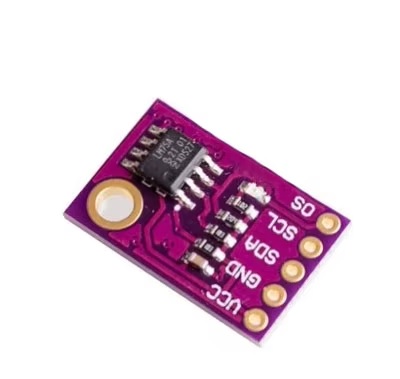
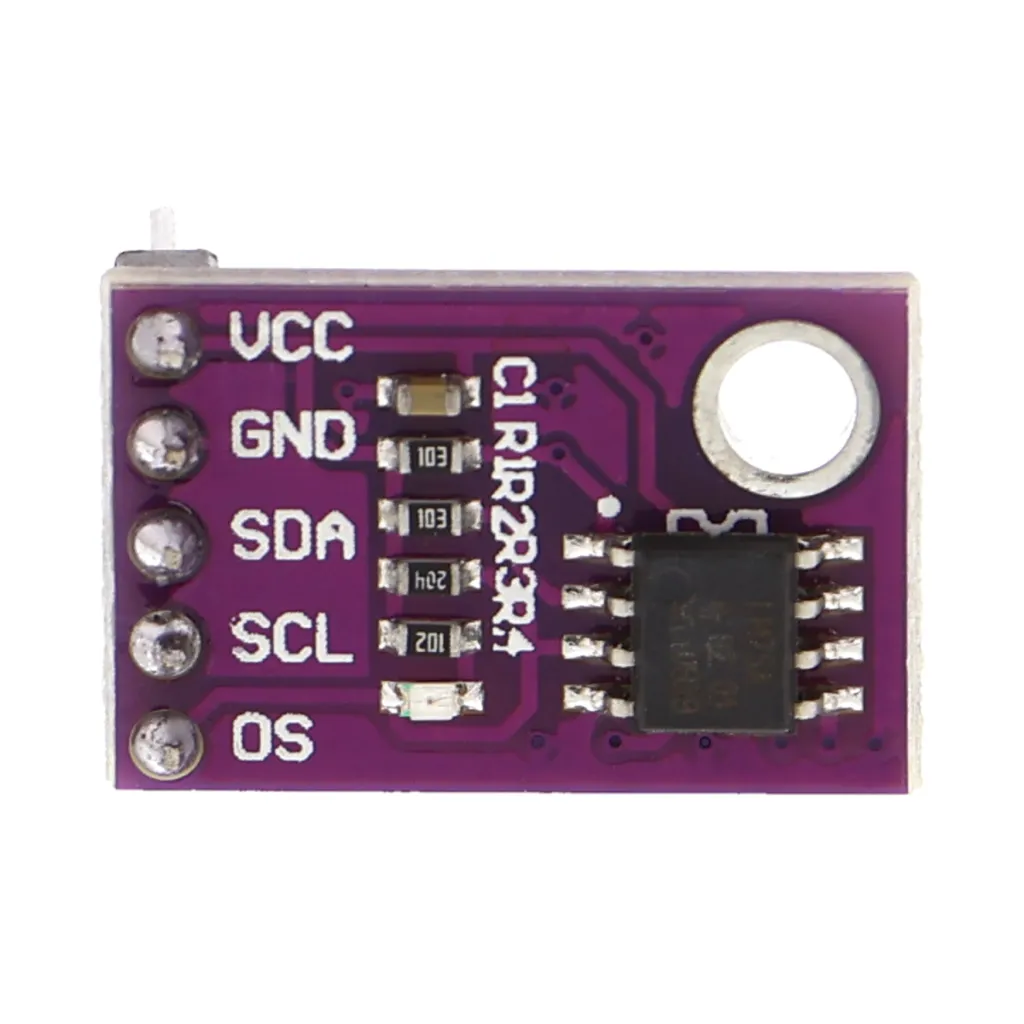
Pinout of the Board
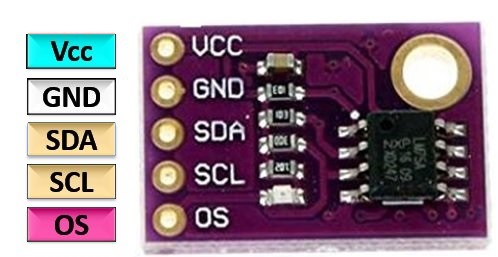
| Pin Name | Function |
|---|---|
| VCC | Positive power supply input |
| GND | Ground reference |
| SCL | I2C clock line with onboard pull up resistors |
| SDA | I2C data line with onboard pull up resistors |
| OS | Overtemperature shutdown output pin |
Applications
- Environmental temperature monitoring
- Thermal management in electronic systems
- Industrial automation temperature control
- HVAC systems
- Server rooms and data centers
- Automotive temperature sensing
- Energy efficient appliances
- Weather stations
- Medical and laboratory equipment
- Home automation systems
- Power electronics protection
- Agriculture and greenhouse monitoring
- Cold chain temperature management
Circuit
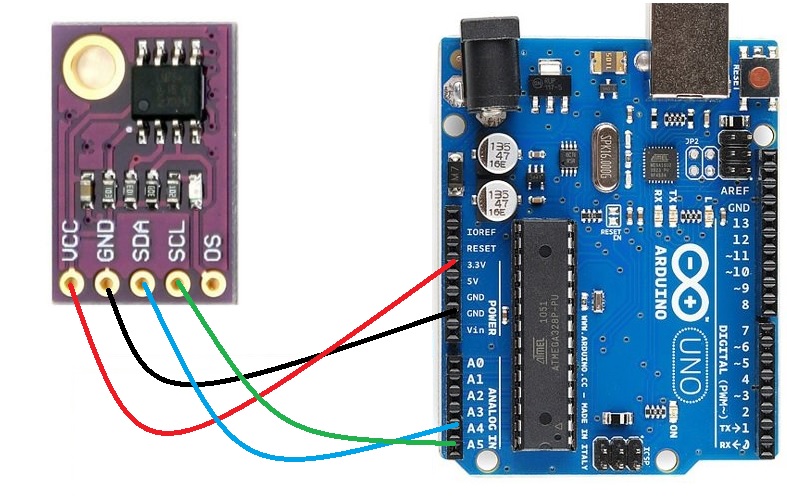
- Connect VCC to the three point three volt or five volt supply
- Connect GND to system ground
- Connect SDA to the microcontroller I2C data pin
- Connect SCL to the microcontroller I2C clock pin
Library
- Download the LM75 library from the official GitHub repository
- Install the library in the Arduino IDE using Add ZIP Library
Code
#include "Wire.h"
#include "lm75.h"

TempI2C_LM75 Temperature(0x48, TempI2C_LM75::nine_bits);

void setup() {
  Serial.begin(9600);
  Serial.println("Temperature Monitor");
}

void loop() {
  float tempCelsius = Temperature.getTemp();
  Serial.print("Temperature: ");
  Serial.print(tempCelsius);
  Serial.println(" C");
  delay(2000);
}
Technical Details
- Operating voltage from three point three volts to five volts
- Temperature range from minus fifty five to one hundred twenty five degrees Celsius
- Temperature conversion time one hundred milliseconds
- Typical supply current two hundred fifty microampere
- Maximum supply current one milliampere
- Overtemperature output sink current ten milliampere
- Resolution eight bits
- Default overtemperature limit eighty degrees Celsius
- Default hysteresis temperature seventy five degrees Celsius
Comparisons
Compared to the DHT11 sensor the LM75 provides higher accuracy and a much wider temperature range but does not measure humidity. The DHT11 is suitable for basic temperature and humidity monitoring while the LM75 is preferred for applications requiring precise temperature control industrial reliability and I2C communication.
Features
- I2C communication support for easy data transfer
- Wide temperature measurement range from minus fifty five to one hundred twenty five degrees Celsius
- Supports temperature output in Celsius and Fahrenheit units
- Low power shutdown mode with very low current consumption
- Overtemperature output pin usable as interrupt or thermostat signal
- Supports multiple devices on the same I2C bus using address pins
- Can operate as a standalone thermostat
- Wide operating voltage range from two point seven volts to five point five volts
Principle of Work
The LM75 continuously senses ambient temperature using its internal temperature sensing circuitry. Measured temperature data is transmitted to an external microcontroller through the I2C interface. The module includes programmable temperature thresholds for overtemperature detection. When the temperature exceeds the defined limit the open drain overtemperature output is activated. Hysteresis control prevents rapid switching near the threshold. Address pins allow multiple LM75 devices to coexist on the same I2C bus without conflict.
Integration with MCU
- Temperature readings are requested by the MCU through the I2C interface
- Overtemperature and hysteresis thresholds can be configured by the MCU
- The MCU can respond to alerts by enabling cooling or generating warnings
- Multiple sensors can be managed using different I2C addresses
- The module operates directly from the MCU power supply
Pinout of the Board
| Pin Name | Function |
|---|---|
| VCC | Positive power supply input |
| GND | Ground reference |
| SCL | I2C clock line with onboard pull up resistors |
| SDA | I2C data line with onboard pull up resistors |
| OS | Overtemperature shutdown output pin |
Applications
- Environmental temperature monitoring
- Thermal management in electronic systems
- Industrial automation temperature control
- HVAC systems
- Server rooms and data centers
- Automotive temperature sensing
- Energy efficient appliances
- Weather stations
- Medical and laboratory equipment
- Home automation systems
- Power electronics protection
- Agriculture and greenhouse monitoring
- Cold chain temperature management
Circuit
- Connect VCC to the three point three volt or five volt supply
- Connect GND to system ground
- Connect SDA to the microcontroller I2C data pin
- Connect SCL to the microcontroller I2C clock pin
Library
- Download the LM75 library from the official GitHub repository
- Install the library in the Arduino IDE using Add ZIP Library
Code
#include "Wire.h"
#include "lm75.h"

TempI2C_LM75 Temperature(0x48, TempI2C_LM75::nine_bits);

void setup() {
  Serial.begin(9600);
  Serial.println("Temperature Monitor");
}

void loop() {
  float tempCelsius = Temperature.getTemp();
  Serial.print("Temperature: ");
  Serial.print(tempCelsius);
  Serial.println(" C");
  delay(2000);
}
Technical Details
- Operating voltage from three point three volts to five volts
- Temperature range from minus fifty five to one hundred twenty five degrees Celsius
- Temperature conversion time one hundred milliseconds
- Typical supply current two hundred fifty microampere
- Maximum supply current one milliampere
- Overtemperature output sink current ten milliampere
- Resolution eight bits
- Default overtemperature limit eighty degrees Celsius
- Default hysteresis temperature seventy five degrees Celsius
Comparisons
Compared to the DHT11 sensor the LM75 provides higher accuracy and a much wider temperature range but does not measure humidity. The DHT11 is suitable for basic temperature and humidity monitoring while the LM75 is preferred for applications requiring precise temperature control industrial reliability and I2C communication.