Features
- AC output voltage range of 100V to 240V
- Maximum load current of 2A
- SPST-NO output configuration
- 5V DC control input
- Compact through-hole design
- Zero-cross turn-on for reduced switching noise and EMI
- Optical isolation between input and output
- No mechanical moving parts
- Long service life
- Suitable for frequent switching applications
Principle of Operation
The SSR uses an infrared LED on the input side and a photo-Triac on the output side. When a 5V DC control signal is applied, the infrared LED emits light. The light activates the photo-Triac, allowing current to flow through the AC load circuit.
The input and output are electrically isolated, so the microcontroller control circuit is separated from the high-voltage AC load. The zero-crossing function turns the AC output on near the zero-voltage point of the AC waveform, helping reduce switching noise and electrical interference.
Pinout
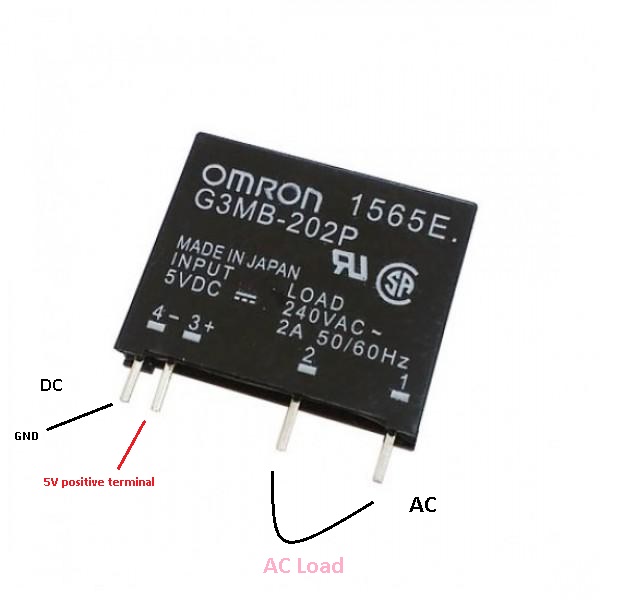
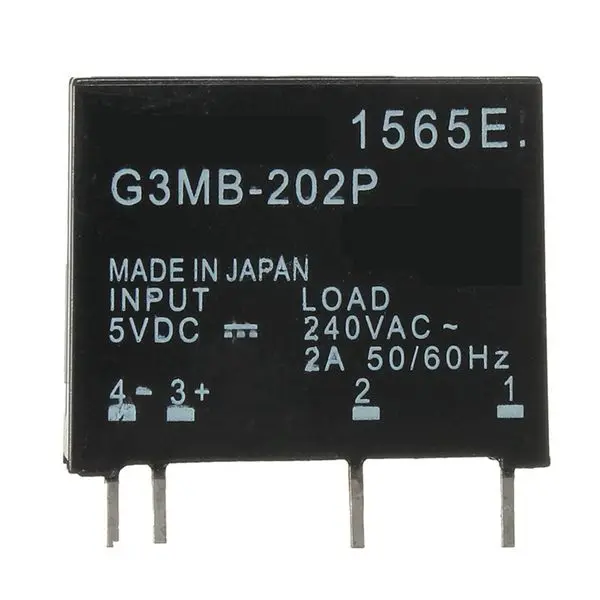
- Pin 1: AC load terminal
- Pin 2: AC load terminal
- Pin 3 (+): 5V DC positive input
- Pin 4 (-): Ground / 5V DC negative input
Wiring
Connect the 5V DC control input to the SSR input terminals. Connect the AC load in series with the output terminals of the SSR. When the control input is activated, the SSR switches the AC load ON.
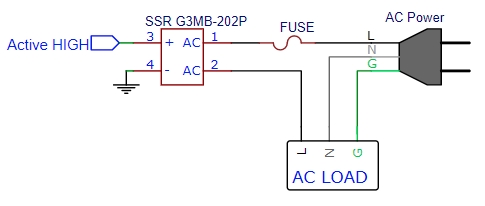
- Pin 3 (+): Connect to the microcontroller control output / 5V signal.
- Pin 4 (-): Connect to the control circuit ground.
- Pins 1 and 2: Connect in series with the AC load circuit.
Important: The output side can carry hazardous AC voltage. Disconnect the power before changing wiring and use suitable insulation, protection, and enclosure for the application.
Library
This SSR does not require a library. It can be controlled directly from a suitable digital output of an Arduino or other microcontroller.
Code
void setup() {
  pinMode(3, OUTPUT);
}

void loop() {
digitalWrite(3, HIGH);   // Load ON
delay(1000);

digitalWrite(3, LOW);    // Load OFF
delay(1000);
}
Applications
- Home automation
- AC lighting control
- Heater and temperature control
- Industrial control systems
- HVAC systems
- Power management
- Machinery and equipment control
- Ovens and heating elements
- Security systems and alarms
- Food processing equipment
Specifications
- Relay Type: Solid-State Relay
- Input Voltage: 5V DC
- Output Voltage: 100-240V AC
- Maximum Output Voltage: 264V
- Load Current: 2A
- Maximum Output Current: 2A
- Input Current: 50mA
- Isolation Voltage: 2.5kV
- Insulation Resistance: 1GΩ
- Operating Temperature: -30°C to 80°C
- Number of Pins: 4
- Throw Configuration: SPST
- Mounting: Through Hole
- Termination: PC Pin
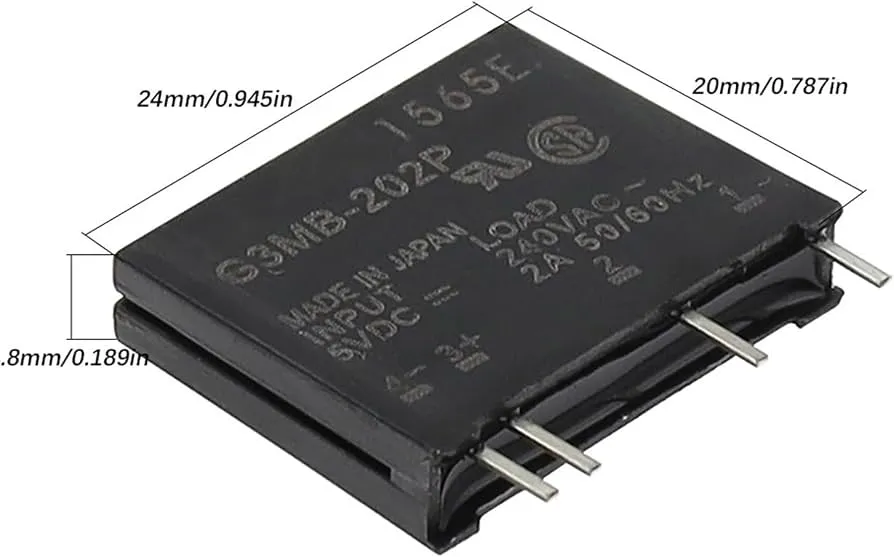
- Height: 20.6mm
- Length: 24.4mm
- Width: 5.59mm
Resources
Comparison
The G3MB-202P SSR and a 5V 10A mechanical relay can both be used for switching electrical loads, but they work differently.
- Switching Type: The G3MB-202P uses semiconductor components with no moving contacts, while a mechanical relay uses an electromagnetic coil and physical contacts.
- Switching Noise: The SSR operates without the clicking sound associated with mechanical relay contacts.
- Service Life: The SSR has no mechanical contacts that wear out through repeated switching.
- Switching Speed: SSRs are generally suitable for more frequent switching than mechanical relays.
- Load Type: The G3MB-202P is designed for AC loads only and cannot switch DC loads.
- Load Current: This G3MB-202P is rated for up to 2A, while a suitable 5V 10A mechanical relay can handle higher current within its specified ratings.
- Isolation: The G3MB-202P provides optical isolation between its control input and AC output.
- Applications: The SSR is suitable for quiet, frequent AC switching, while mechanical relays are useful for general-purpose switching and applications requiring higher current capacity.
Features
- AC output voltage range of 100V to 240V
- Maximum load current of 2A
- SPST-NO output configuration
- 5V DC control input
- Compact through-hole design
- Zero-cross turn-on for reduced switching noise and EMI
- Optical isolation between input and output
- No mechanical moving parts
- Long service life
- Suitable for frequent switching applications
Principle of Operation
The SSR uses an infrared LED on the input side and a photo-Triac on the output side. When a 5V DC control signal is applied, the infrared LED emits light. The light activates the photo-Triac, allowing current to flow through the AC load circuit.
The input and output are electrically isolated, so the microcontroller control circuit is separated from the high-voltage AC load. The zero-crossing function turns the AC output on near the zero-voltage point of the AC waveform, helping reduce switching noise and electrical interference.
Pinout
- Pin 1: AC load terminal
- Pin 2: AC load terminal
- Pin 3 (+): 5V DC positive input
- Pin 4 (-): Ground / 5V DC negative input
Wiring
Connect the 5V DC control input to the SSR input terminals. Connect the AC load in series with the output terminals of the SSR. When the control input is activated, the SSR switches the AC load ON.
- Pin 3 (+): Connect to the microcontroller control output / 5V signal.
- Pin 4 (-): Connect to the control circuit ground.
- Pins 1 and 2: Connect in series with the AC load circuit.
Important: The output side can carry hazardous AC voltage. Disconnect the power before changing wiring and use suitable insulation, protection, and enclosure for the application.
Library
This SSR does not require a library. It can be controlled directly from a suitable digital output of an Arduino or other microcontroller.
Code
void setup() {
  pinMode(3, OUTPUT);
}

void loop() {
digitalWrite(3, HIGH);   // Load ON
delay(1000);

digitalWrite(3, LOW);    // Load OFF
delay(1000);
}
Applications
- Home automation
- AC lighting control
- Heater and temperature control
- Industrial control systems
- HVAC systems
- Power management
- Machinery and equipment control
- Ovens and heating elements
- Security systems and alarms
- Food processing equipment
Specifications
- Relay Type: Solid-State Relay
- Input Voltage: 5V DC
- Output Voltage: 100-240V AC
- Maximum Output Voltage: 264V
- Load Current: 2A
- Maximum Output Current: 2A
- Input Current: 50mA
- Isolation Voltage: 2.5kV
- Insulation Resistance: 1GΩ
- Operating Temperature: -30°C to 80°C
- Number of Pins: 4
- Throw Configuration: SPST
- Mounting: Through Hole
- Termination: PC Pin
- Height: 20.6mm
- Length: 24.4mm
- Width: 5.59mm
Resources
Comparison
The G3MB-202P SSR and a 5V 10A mechanical relay can both be used for switching electrical loads, but they work differently.
- Switching Type: The G3MB-202P uses semiconductor components with no moving contacts, while a mechanical relay uses an electromagnetic coil and physical contacts.
- Switching Noise: The SSR operates without the clicking sound associated with mechanical relay contacts.
- Service Life: The SSR has no mechanical contacts that wear out through repeated switching.
- Switching Speed: SSRs are generally suitable for more frequent switching than mechanical relays.
- Load Type: The G3MB-202P is designed for AC loads only and cannot switch DC loads.
- Load Current: This G3MB-202P is rated for up to 2A, while a suitable 5V 10A mechanical relay can handle higher current within its specified ratings.
- Isolation: The G3MB-202P provides optical isolation between its control input and AC output.
- Applications: The SSR is suitable for quiet, frequent AC switching, while mechanical relays are useful for general-purpose switching and applications requiring higher current capacity.