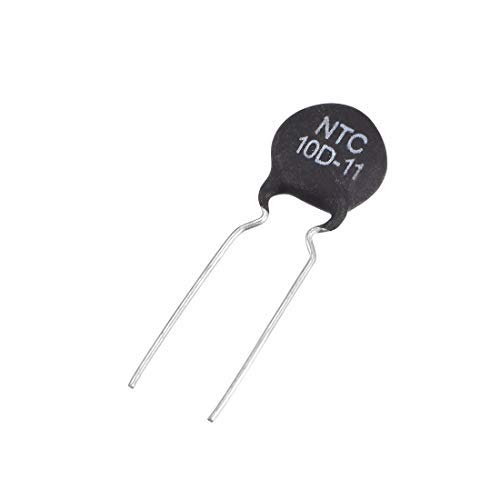
Features
- Long service life with high reliability
- Small size with strong surge current protection capability
- Instant response to surge current
- Wide operating temperature range
- Large material constant with low residual resistance
Principle of Work
Thermistors are temperature dependent resistors whose resistance changes with temperature. They are classified based on how resistance responds to temperature variation. In negative temperature coefficient thermistors resistance decreases as temperature increases. NTC thermistors are the most commonly used type.
NTC thermistors are manufactured by heating and compressing semiconducting materials such as metal oxides or ceramics. As temperature increases the semiconducting material releases more charge carriers which allows increased current flow and results in lower resistance. In ferric oxide based NTC thermistors electrons act as charge carriers while nickel oxide based thermistors rely on electron holes.
Types of Thermistor
- Positive temperature coefficient thermistor where resistance increases with temperature and decreases when temperature drops
- Negative temperature coefficient thermistor where resistance decreases with increasing temperature and increases when temperature drops
This module uses an NTC thermistor. The marking one zero three indicates a resistance of ten kilo ohms at normal temperature. To measure the resistance a voltage divider circuit is used. The output voltage of the divider is measured and the thermistor resistance is calculated using the voltage divider equation.
Vout equals Vin multiplied by R2 divided by R1 plus R2. Since Vin R1 and Vout are known the value of R2 which is the thermistor resistance can be calculated as R2 equals Vout multiplied by R1 divided by Vin minus Vout.
Pinout of the Board
The NTC thermistor connects to the circuit using a voltage divider configuration with a ten kilo ohm resistor.
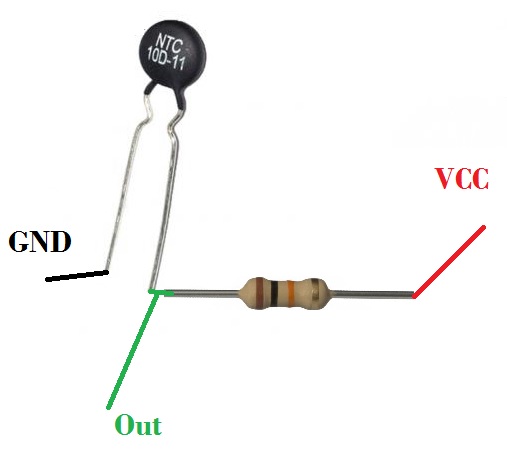
| NTC 10D 11 Pin | Description |
|---|---|
| Resistor side | VCC |
| Middle | Output |
| Other side of NTC | Ground |
Applications
- Domestic appliances such as refrigerators freezers cookers and fryers
- Industrial and telecommunication systems including process control heating ventilation air conditioning and fire alarms
- Automotive systems such as inlet air temperature control engine temperature monitoring and airbag electronics
- Temperature compensation measurement and control circuits
Circuit
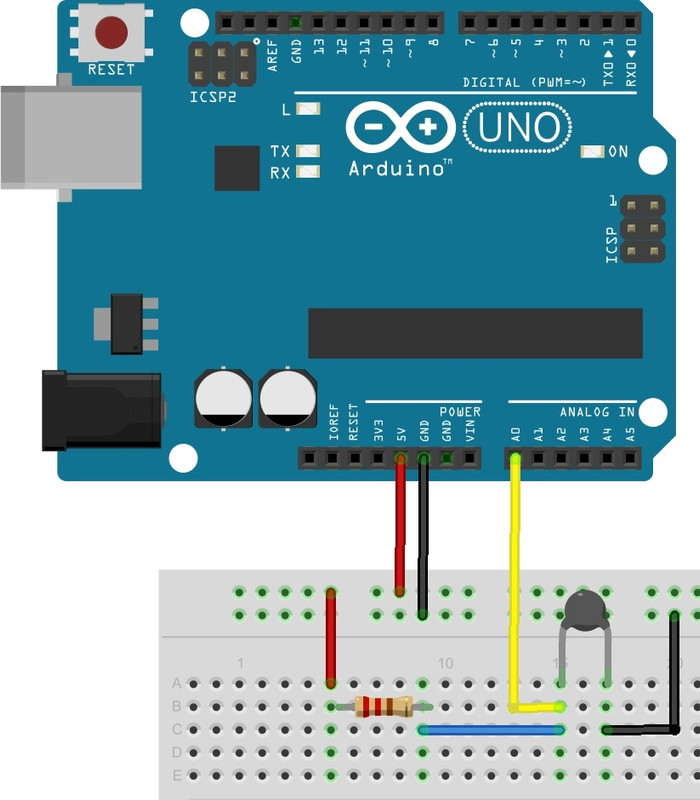
Connect the middle pin to analog pin A0 on Arduino connect one side of the NTC to ground and connect the resistor side to the five volt supply.
Library
No external library is required to use this sensor.
Code
#define ntc_pin A0
#define vd_power_pin 2
#define nominal_resistance 10000
#define nominal_temeprature 25
#define samplingrate 5
#define beta 3950
#define Rref 10000

int samples = 0;

void setup(void) {
  pinMode(vd_power_pin, OUTPUT);
  Serial.begin(9600);
}

void loop(void) {
  uint8_t i;
  float average;
  samples = 0;

  digitalWrite(vd_power_pin, HIGH);
  for (i = 0; i < samplingrate; i++) {
    samples += analogRead(ntc_pin);
    delay(10);
  }
  digitalWrite(vd_power_pin, LOW);

  average = samples / samplingrate;
  Serial.println();
  Serial.print("ADC readings ");
  Serial.println(average);

  average = 1023 / average - 1;
  average = Rref / average;
  Serial.print("Thermistor resistance ");
  Serial.println(average);

  float temperature;
  temperature = average / nominal_resistance;
  temperature = log(temperature);
  temperature /= beta;
  temperature += 1.0 / (nominal_temeprature + 273.15);
  temperature = 1.0 / temperature;
  temperature -= 273.15;

  Serial.print("Temperature ");
  Serial.print(temperature);
  Serial.println(" C");

  delay(2000);
}
Technical Details
- Model number NTC 10D 11
- Resistance at twenty five degrees Celsius ten kilo ohms
- B value material constant three nine five zero
- Thermal cooling time constant in air twenty seconds
- Operating temperature range minus forty to plus one hundred fifty
- Thermal dissipation constant seven milliwatts per degree
- Thermal time constant forty seven seconds
- Maximum steady state current three amperes
- Diameter eleven millimeters
- Color black
Comparisons
Thermistors are inexpensive but non linear devices which require additional software processing to calculate temperature accurately. Active sensors such as the LM35 are more expensive but provide a linear voltage to temperature relationship and are factory calibrated. The LM35 typically offers higher accuracy and does not require external calibration while thermistors must be calibrated against known temperature standards to achieve accurate measurements over a wide temperature range.
Features
- Long service life with high reliability
- Small size with strong surge current protection capability
- Instant response to surge current
- Wide operating temperature range
- Large material constant with low residual resistance
Principle of Work
Thermistors are temperature dependent resistors whose resistance changes with temperature. They are classified based on how resistance responds to temperature variation. In negative temperature coefficient thermistors resistance decreases as temperature increases. NTC thermistors are the most commonly used type.
NTC thermistors are manufactured by heating and compressing semiconducting materials such as metal oxides or ceramics. As temperature increases the semiconducting material releases more charge carriers which allows increased current flow and results in lower resistance. In ferric oxide based NTC thermistors electrons act as charge carriers while nickel oxide based thermistors rely on electron holes.
Types of Thermistor
- Positive temperature coefficient thermistor where resistance increases with temperature and decreases when temperature drops
- Negative temperature coefficient thermistor where resistance decreases with increasing temperature and increases when temperature drops
This module uses an NTC thermistor. The marking one zero three indicates a resistance of ten kilo ohms at normal temperature. To measure the resistance a voltage divider circuit is used. The output voltage of the divider is measured and the thermistor resistance is calculated using the voltage divider equation.
Vout equals Vin multiplied by R2 divided by R1 plus R2. Since Vin R1 and Vout are known the value of R2 which is the thermistor resistance can be calculated as R2 equals Vout multiplied by R1 divided by Vin minus Vout.
Pinout of the Board
The NTC thermistor connects to the circuit using a voltage divider configuration with a ten kilo ohm resistor.
| NTC 10D 11 Pin | Description |
|---|---|
| Resistor side | VCC |
| Middle | Output |
| Other side of NTC | Ground |
Applications
- Domestic appliances such as refrigerators freezers cookers and fryers
- Industrial and telecommunication systems including process control heating ventilation air conditioning and fire alarms
- Automotive systems such as inlet air temperature control engine temperature monitoring and airbag electronics
- Temperature compensation measurement and control circuits
Circuit
Connect the middle pin to analog pin A0 on Arduino connect one side of the NTC to ground and connect the resistor side to the five volt supply.
Library
No external library is required to use this sensor.
Code
#define ntc_pin A0
#define vd_power_pin 2
#define nominal_resistance 10000
#define nominal_temeprature 25
#define samplingrate 5
#define beta 3950
#define Rref 10000

int samples = 0;

void setup(void) {
  pinMode(vd_power_pin, OUTPUT);
  Serial.begin(9600);
}

void loop(void) {
  uint8_t i;
  float average;
  samples = 0;

  digitalWrite(vd_power_pin, HIGH);
  for (i = 0; i < samplingrate; i++) {
    samples += analogRead(ntc_pin);
    delay(10);
  }
  digitalWrite(vd_power_pin, LOW);

  average = samples / samplingrate;
  Serial.println();
  Serial.print("ADC readings ");
  Serial.println(average);

  average = 1023 / average - 1;
  average = Rref / average;
  Serial.print("Thermistor resistance ");
  Serial.println(average);

  float temperature;
  temperature = average / nominal_resistance;
  temperature = log(temperature);
  temperature /= beta;
  temperature += 1.0 / (nominal_temeprature + 273.15);
  temperature = 1.0 / temperature;
  temperature -= 273.15;

  Serial.print("Temperature ");
  Serial.print(temperature);
  Serial.println(" C");

  delay(2000);
}
Technical Details
- Model number NTC 10D 11
- Resistance at twenty five degrees Celsius ten kilo ohms
- B value material constant three nine five zero
- Thermal cooling time constant in air twenty seconds
- Operating temperature range minus forty to plus one hundred fifty
- Thermal dissipation constant seven milliwatts per degree
- Thermal time constant forty seven seconds
- Maximum steady state current three amperes
- Diameter eleven millimeters
- Color black
Comparisons
Thermistors are inexpensive but non linear devices which require additional software processing to calculate temperature accurately. Active sensors such as the LM35 are more expensive but provide a linear voltage to temperature relationship and are factory calibrated. The LM35 typically offers higher accuracy and does not require external calibration while thermistors must be calibrated against known temperature standards to achieve accurate measurements over a wide temperature range.