Features
- Compact design for space-limited projects
- Operating voltage: 5V; Clock speed: 16MHz
- Built-in bootloader for hassle-free programming
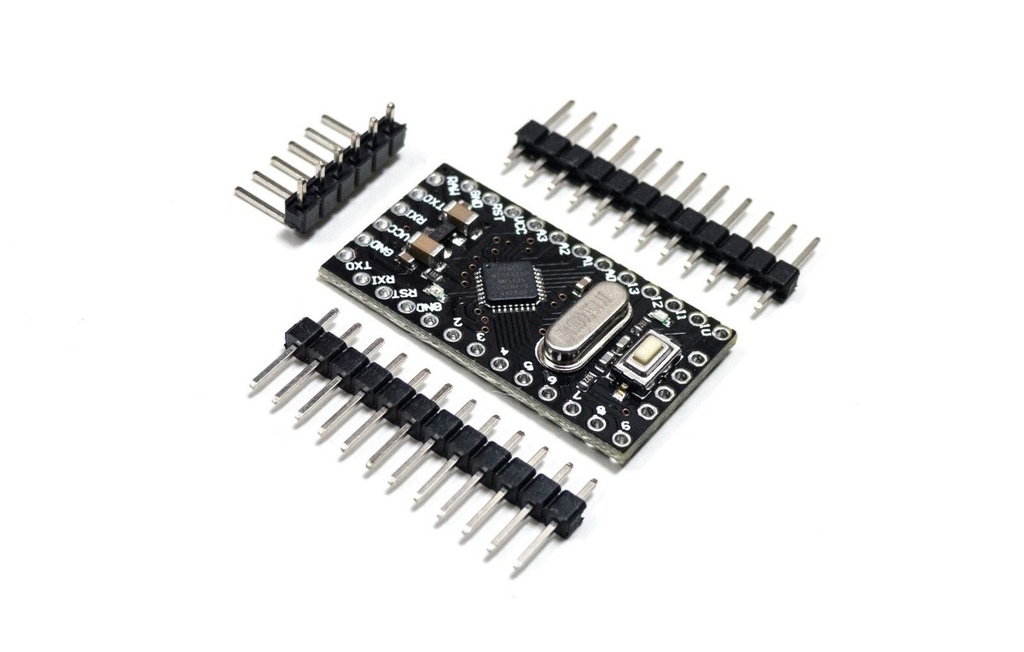
- Customizable connector options (no onboard USB/Serial Converter)
- 14 digital I/O pins, 6 PWM outputs
- 8 analog input pins, including A4 and A5 for I2C
- External power input: 5–12V (VCC or RAW pin)
- Stable 5V power supply via onboard regulator
- Memory: 32KB Flash, 2KB SRAM, 1KB EEPROM
- Compatible with Arduino IDE and standard libraries
Specifications
- Microcontroller: ATmega328P
- Operating Voltage: 5V
- Clock Speed: 16 MHz
- Digital I/O Pins: 14 (6 PWM capable)
- Analog Input Pins: 8
- Maximum DC Current per I/O Pin: 40 mA
- Total Maximum Current: 200 mA
- Flash Memory: 32KB
- SRAM: 2KB
- EEPROM: 1KB
- External Input Voltage: 5–12V
- PCB Size: 33mm x 18mm, Thickness: 0.8mm
- Weight: 3g
Principle of Work
The Arduino Pro Mini Black follows open-source hardware and software principles. Its hardware design is publicly available, allowing makers to replicate or customize it. It works seamlessly with the Arduino IDE, which enables easy writing, compiling, and uploading of code via an external Serial Converter. The onboard bootloader simplifies programming, while extensive library support allows integration with sensors, modules, and peripherals.
Pinout
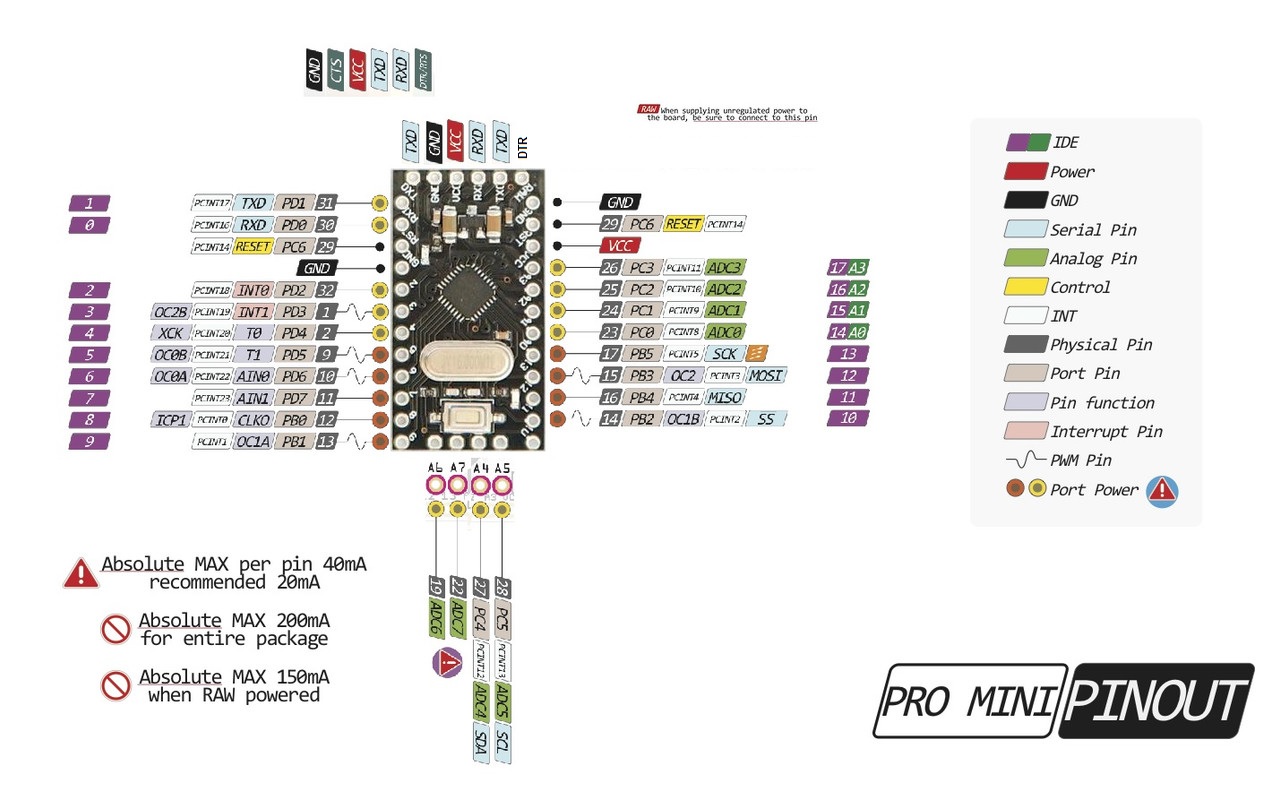
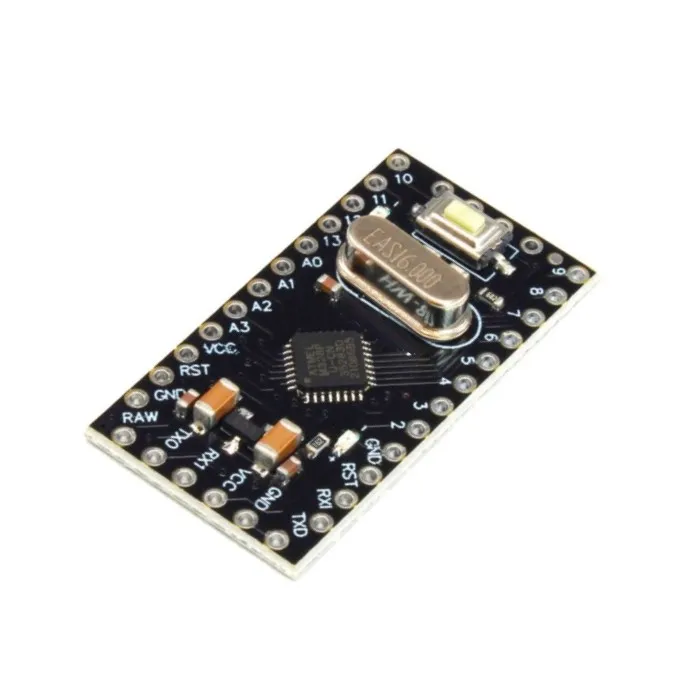
- Digital Pins: 14 pins (0–13, RX1/TX0) for I/O; 6 PWM pins (3, 5, 6, 9, 10, 11)
- Analog Pins: 8 pins (A0–A7); A4/A5 support I2C; first 6 analog pins can be used as interrupts
- Communication: Serial (TX/RX), I2C (A4/A5), SPI (10–13)
- External Interrupts: Pin 2 (INT0), Pin 3 (INT1)
Applications
- Robotics: motor, sensor, and actuator control
- IoT: sensor data collection and cloud integration
- Home Automation: lighting, temperature, security control
- Wearable Electronics: smartwatches, fitness trackers, interactive garments
- Environmental Monitoring: temperature, humidity, air quality, noise levels
- Data Logging: sensor data recording over time
- Educational Projects: electronics, programming, and robotics learning
- Prototyping: rapid testing of electronic designs
Connecting for First-Time Programming
Use an FTDI Basic Breakout to connect the programming header of the Pro Mini:
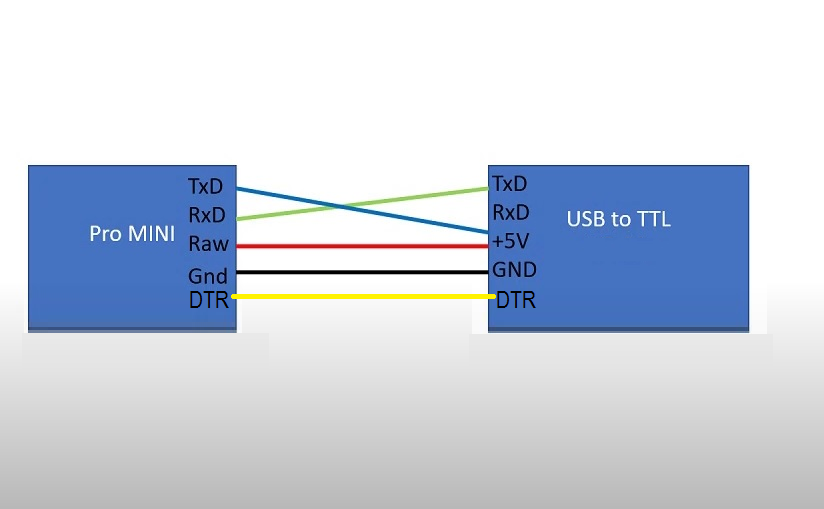
- Identify the programming header pins: GND, VCC, RXI, TXO, DTR.
- Use female-to-female Dupont cables to connect the FTDI converter to the Pro Mini.
- Install FTDI drivers if necessary and connect the FTDI converter to your computer.
Example Code (Blink LED)
// Pin assignment
const int LED_PIN = 13;

void setup() {
  pinMode(LED_PIN, OUTPUT); // Set LED pin as output
}

void loop() {
  digitalWrite(LED_PIN, HIGH); // Turn on LED
  delay(1000);                  // Wait 1 second
  digitalWrite(LED_PIN, LOW);  // Turn off LED
  delay(1000);                  // Wait 1 second
}
Technical Details
- Microcontroller: ATmega328P running at 16 MHz
- Max 200mA output
- External voltage input: 5–12V DC
- PCB dimensions: 33mm x 18mm x 3.5mm
- Weight: 3g
Comparison with Arduino Uno
| Feature | Arduino Pro Mini | Arduino Uno |
|---|---|---|
| Microcontroller | ATmega328P | ATmega328P |
| Operating Voltage | 5V | 5V |
| Clock Speed | 16 MHz | 16 MHz |
| Digital I/O Pins | 14 (6 PWM) | 14 (6 PWM) |
| Analog Input Pins | 8 | 8 |
| Flash Memory | 32KB | 32KB |
| SRAM | 2KB | 2KB |
| EEPROM | 1KB | 1KB |
Features
- Compact design for space-limited projects
- Operating voltage: 5V; Clock speed: 16MHz
- Built-in bootloader for hassle-free programming
- Customizable connector options (no onboard USB/Serial Converter)
- 14 digital I/O pins, 6 PWM outputs
- 8 analog input pins, including A4 and A5 for I2C
- External power input: 5–12V (VCC or RAW pin)
- Stable 5V power supply via onboard regulator
- Memory: 32KB Flash, 2KB SRAM, 1KB EEPROM
- Compatible with Arduino IDE and standard libraries
Specifications
- Microcontroller: ATmega328P
- Operating Voltage: 5V
- Clock Speed: 16 MHz
- Digital I/O Pins: 14 (6 PWM capable)
- Analog Input Pins: 8
- Maximum DC Current per I/O Pin: 40 mA
- Total Maximum Current: 200 mA
- Flash Memory: 32KB
- SRAM: 2KB
- EEPROM: 1KB
- External Input Voltage: 5–12V
- PCB Size: 33mm x 18mm, Thickness: 0.8mm
- Weight: 3g
Principle of Work
The Arduino Pro Mini Black follows open-source hardware and software principles. Its hardware design is publicly available, allowing makers to replicate or customize it. It works seamlessly with the Arduino IDE, which enables easy writing, compiling, and uploading of code via an external Serial Converter. The onboard bootloader simplifies programming, while extensive library support allows integration with sensors, modules, and peripherals.
Pinout
- Digital Pins: 14 pins (0–13, RX1/TX0) for I/O; 6 PWM pins (3, 5, 6, 9, 10, 11)
- Analog Pins: 8 pins (A0–A7); A4/A5 support I2C; first 6 analog pins can be used as interrupts
- Communication: Serial (TX/RX), I2C (A4/A5), SPI (10–13)
- External Interrupts: Pin 2 (INT0), Pin 3 (INT1)
Applications
- Robotics: motor, sensor, and actuator control
- IoT: sensor data collection and cloud integration
- Home Automation: lighting, temperature, security control
- Wearable Electronics: smartwatches, fitness trackers, interactive garments
- Environmental Monitoring: temperature, humidity, air quality, noise levels
- Data Logging: sensor data recording over time
- Educational Projects: electronics, programming, and robotics learning
- Prototyping: rapid testing of electronic designs
Connecting for First-Time Programming
Use an FTDI Basic Breakout to connect the programming header of the Pro Mini:
- Identify the programming header pins: GND, VCC, RXI, TXO, DTR.
- Use female-to-female Dupont cables to connect the FTDI converter to the Pro Mini.
- Install FTDI drivers if necessary and connect the FTDI converter to your computer.
Example Code (Blink LED)
// Pin assignment
const int LED_PIN = 13;

void setup() {
  pinMode(LED_PIN, OUTPUT); // Set LED pin as output
}

void loop() {
  digitalWrite(LED_PIN, HIGH); // Turn on LED
  delay(1000);                  // Wait 1 second
  digitalWrite(LED_PIN, LOW);  // Turn off LED
  delay(1000);                  // Wait 1 second
}
Technical Details
- Microcontroller: ATmega328P running at 16 MHz
- Max 200mA output
- External voltage input: 5–12V DC
- PCB dimensions: 33mm x 18mm x 3.5mm
- Weight: 3g
Comparison with Arduino Uno
| Feature | Arduino Pro Mini | Arduino Uno |
|---|---|---|
| Microcontroller | ATmega328P | ATmega328P |
| Operating Voltage | 5V | 5V |
| Clock Speed | 16 MHz | 16 MHz |
| Digital I/O Pins | 14 (6 PWM) | 14 (6 PWM) |
| Analog Input Pins | 8 | 8 |
| Flash Memory | 32KB | 32KB |
| SRAM | 2KB | 2KB |
| EEPROM | 1KB | 1KB |