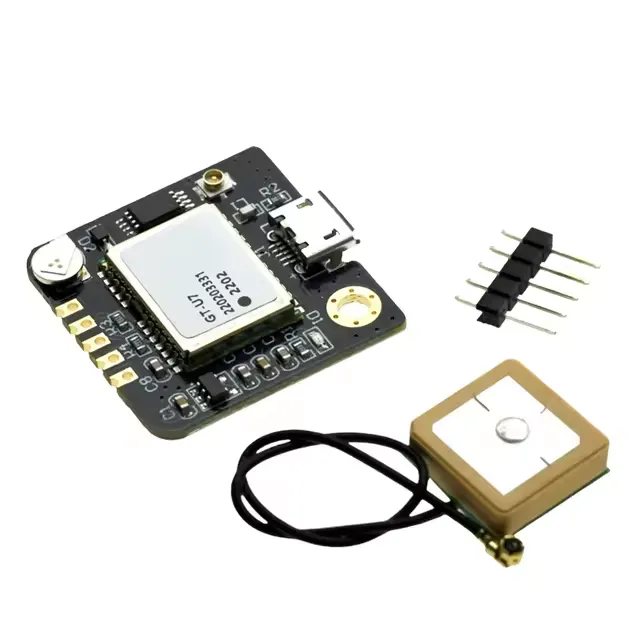
Features
- High Sensitivity: Receives GPS signals even in challenging environments.
- Low Power Consumption: Ensures extended operation without draining the power source.
- Miniaturization: Compact size with straight or patch installation options.
- High Tracking Sensitivity: Expands localization coverage, capable of precise positioning in narrow urban skies or dense jungle environments.
- Compatibility with 51 Single-Chip Arduino STM32 Routines: Simplifies development.
- USB Interface: Direct connection to a computer using a mobile phone data cable.
- No Need for Additional Serial Modules: Can function as a host computer serial port.
- Shared NEO-6M Chip: Ensures compatibility with existing codes and wiring.
Principle of Work
Internal Operation
- GPS Antenna: Built-in or external antenna receives satellite signals with timing and positional data.
- RF Front-End: Amplifies and filters incoming GPS signals for sensitivity and selectivity.
- Signal Processing: Decodes GPS signals and extracts satellite constellation data.
- Calculations: Determines precise position via trilateration using distances from multiple satellites.
- Data Output: Outputs GPS data in NMEA format for use with other devices.
Interaction with MCU (Microcontroller Unit)
- Serial Communication: Uses UART (TXD and RXD pins) to connect to MCU.
- Baud Rate Configuration: Default 9600 baud, configurable as needed.
- Data Parsing: MCU extracts latitude, longitude, altitude, and time from NMEA sentences.
- Custom Coding: Allows display, logging, or transmission of GPS data.
- Integration with Other Sensors: Can combine GPS with other sensor data for advanced applications.
- Power Supply: Operates on 3.6V to 5V for reliable operation.
Pinout of the Module
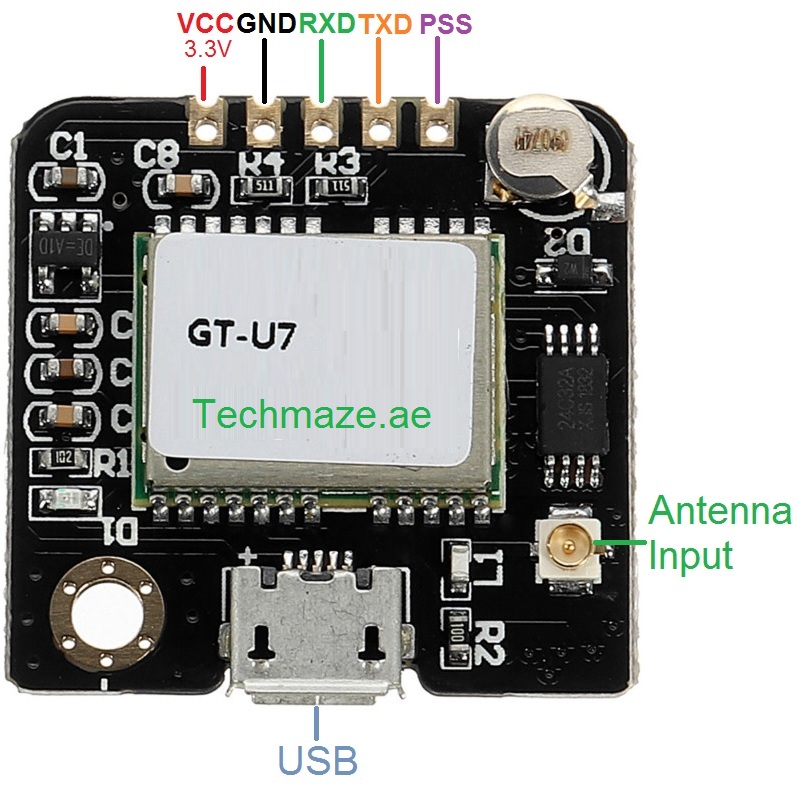
| Pin | Function | Description |
|---|---|---|
| PPS | Pulse per second | Indicates one pulse per second, used for precise timing and synchronization. |
| TXD | Data Transmission Pin | Sends data from the module to an external device such as MCU or computer. |
| RXD | Data Reception Pin | Receives data from an external device such as MCU or GPS antenna. |
| GND | Ground | Reference point for the circuit, providing common ground for all components. |
| VCC | Power Voltage | 3.6 to 5.5 Volts. Provides stable power for reliable operation. |
Applications
- Vehicle Tracking and Fleet Management
- Handheld Devices and PDAs
- Vehicle Monitoring Systems (speed, mileage, route history)
- Mobile Phones for navigation and geotagging
- Cameras and Camcorders for geotagging media files
- Shared Bikes and Scooters location tracking
- Shared Mobile Power Devices tracking
- Environmental Monitoring and Research
- Precision Agriculture for planting, irrigation, and harvesting optimization
- Wildlife Tracking for conservation studies
- Geocaching games
- Emergency Response for precise location identification
- Marine Navigation when paired with suitable software
Circuit

| GT-U7 Pin | Arduino Uno Pin |
|---|---|
| TXD | 2 (RX) |
| RXD | 3 (TX) |
| GND | GND |
| VCC | 5V |
Library & Code
The library is already installed in the Arduino IDE. The following code configures the Arduino to communicate with the GT-U7 GPS module via software serial, reads NMEA sentences, and prints GPS data to the serial monitor:
#include "SoftwareSerial.h"

// Define the software serial object
SoftwareSerial gpsSerial(2, 3); // RX, TX (Connect GT-U7 RX to Arduino TX and GT-U7 TX to Arduino RX)

void setup() {
  // Start the software serial communication
  gpsSerial.begin(9600);
  // Start the serial communication with the computer
  Serial.begin(9600);
}

void loop() {
  if (gpsSerial.available()) {
    char c = gpsSerial.read();
    // Check if the character received is the start of a NMEA sentence
    if (c == '$') {
      String sentence = gpsSerial.readStringUntil('\n');
      // Check if the sentence starts with "GPGGA" (GPS fix data)
      if (sentence.startsWith("$GPGGA")) {
        // Print the GPS data to the serial monitor
        Serial.println(sentence);
      }
    }
  }
}
Technical Details
- Size: 27.6 x 26.6 mm
- Working Voltage: 3.6V - 5V (or direct USB supply)
- Default Baud Rate: 9600 (modifiable)
- Antenna Interface: IPEX (active antenna included)
- Onboard Rechargeable Button Cell
- Onboard E2PROM for parameter storage
- NMEA Output Format compatible with NEO-6M
Comparisons with NEO-6M
Differences
- Sensitivity and Tracking: GT-U7 has high sensitivity for challenging GPS environments.
- Miniaturization: GT-U7 measures 27.6 x 26.6 mm, smaller than typical NEO-6M modules.
- USB Interface: GT-U7 allows direct computer connection via USB.
- E2PROM: Onboard storage for parameters, which may not exist in all NEO-6M modules.
Similarities
- Chip Compatibility: Both use NEO-6M chip.
- Working Voltage: 3.6V to 5V range supported.
- Baud Rate: Default 9600, configurable.
- NMEA Output Format: Both compatible with NMEA standard.
Features
- High Sensitivity: Receives GPS signals even in challenging environments.
- Low Power Consumption: Ensures extended operation without draining the power source.
- Miniaturization: Compact size with straight or patch installation options.
- High Tracking Sensitivity: Expands localization coverage, capable of precise positioning in narrow urban skies or dense jungle environments.
- Compatibility with 51 Single-Chip Arduino STM32 Routines: Simplifies development.
- USB Interface: Direct connection to a computer using a mobile phone data cable.
- No Need for Additional Serial Modules: Can function as a host computer serial port.
- Shared NEO-6M Chip: Ensures compatibility with existing codes and wiring.
Principle of Work
Internal Operation
- GPS Antenna: Built-in or external antenna receives satellite signals with timing and positional data.
- RF Front-End: Amplifies and filters incoming GPS signals for sensitivity and selectivity.
- Signal Processing: Decodes GPS signals and extracts satellite constellation data.
- Calculations: Determines precise position via trilateration using distances from multiple satellites.
- Data Output: Outputs GPS data in NMEA format for use with other devices.
Interaction with MCU (Microcontroller Unit)
- Serial Communication: Uses UART (TXD and RXD pins) to connect to MCU.
- Baud Rate Configuration: Default 9600 baud, configurable as needed.
- Data Parsing: MCU extracts latitude, longitude, altitude, and time from NMEA sentences.
- Custom Coding: Allows display, logging, or transmission of GPS data.
- Integration with Other Sensors: Can combine GPS with other sensor data for advanced applications.
- Power Supply: Operates on 3.6V to 5V for reliable operation.
Pinout of the Module
| Pin | Function | Description |
|---|---|---|
| PPS | Pulse per second | Indicates one pulse per second, used for precise timing and synchronization. |
| TXD | Data Transmission Pin | Sends data from the module to an external device such as MCU or computer. |
| RXD | Data Reception Pin | Receives data from an external device such as MCU or GPS antenna. |
| GND | Ground | Reference point for the circuit, providing common ground for all components. |
| VCC | Power Voltage | 3.6 to 5.5 Volts. Provides stable power for reliable operation. |
Applications
- Vehicle Tracking and Fleet Management
- Handheld Devices and PDAs
- Vehicle Monitoring Systems (speed, mileage, route history)
- Mobile Phones for navigation and geotagging
- Cameras and Camcorders for geotagging media files
- Shared Bikes and Scooters location tracking
- Shared Mobile Power Devices tracking
- Environmental Monitoring and Research
- Precision Agriculture for planting, irrigation, and harvesting optimization
- Wildlife Tracking for conservation studies
- Geocaching games
- Emergency Response for precise location identification
- Marine Navigation when paired with suitable software
Circuit
| GT-U7 Pin | Arduino Uno Pin |
|---|---|
| TXD | 2 (RX) |
| RXD | 3 (TX) |
| GND | GND |
| VCC | 5V |
Library & Code
The library is already installed in the Arduino IDE. The following code configures the Arduino to communicate with the GT-U7 GPS module via software serial, reads NMEA sentences, and prints GPS data to the serial monitor:
#include "SoftwareSerial.h"

// Define the software serial object
SoftwareSerial gpsSerial(2, 3); // RX, TX (Connect GT-U7 RX to Arduino TX and GT-U7 TX to Arduino RX)

void setup() {
  // Start the software serial communication
  gpsSerial.begin(9600);
  // Start the serial communication with the computer
  Serial.begin(9600);
}

void loop() {
  if (gpsSerial.available()) {
    char c = gpsSerial.read();
    // Check if the character received is the start of a NMEA sentence
    if (c == '$') {
      String sentence = gpsSerial.readStringUntil('\n');
      // Check if the sentence starts with "GPGGA" (GPS fix data)
      if (sentence.startsWith("$GPGGA")) {
        // Print the GPS data to the serial monitor
        Serial.println(sentence);
      }
    }
  }
}
Technical Details
- Size: 27.6 x 26.6 mm
- Working Voltage: 3.6V - 5V (or direct USB supply)
- Default Baud Rate: 9600 (modifiable)
- Antenna Interface: IPEX (active antenna included)
- Onboard Rechargeable Button Cell
- Onboard E2PROM for parameter storage
- NMEA Output Format compatible with NEO-6M
Comparisons with NEO-6M
Differences
- Sensitivity and Tracking: GT-U7 has high sensitivity for challenging GPS environments.
- Miniaturization: GT-U7 measures 27.6 x 26.6 mm, smaller than typical NEO-6M modules.
- USB Interface: GT-U7 allows direct computer connection via USB.
- E2PROM: Onboard storage for parameters, which may not exist in all NEO-6M modules.
Similarities
- Chip Compatibility: Both use NEO-6M chip.
- Working Voltage: 3.6V to 5V range supported.
- Baud Rate: Default 9600, configurable.
- NMEA Output Format: Both compatible with NMEA standard.