- All products
- Development Boards
- Wemos
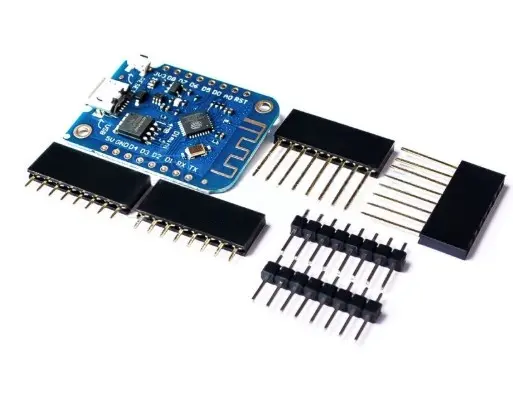
- D1 Mini Pro ESP8266 WiFi Board - (Wemos Compatible)
- Wemos
Features:
- ESP8266-based board with Wi-Fi capabilities
- Compact and lightweight design
- Micro USB interface for power and programming
- OTA (Over-The-Air) and serial programming supported
- 11 digital GPIO pins and 1 analog input
- Supports both Arduino and Lua programming environments
- Compatible with a wide range of Wemos D1 Mini shields
Specifications:
- Processor: L106 32-bit microprocessor core based on Tensilica Xtensa Diamond Standard 106Micro, running at 80 MHz (up to 160 MHz)
- RAM:
- 32 KB instruction RAM
- 32 KB instruction cache RAM
- 80 KB user-data RAM
- 16 KB ETS system-data RAM
- Flash Memory: External QSPI flash (typically 512 KB to 4 MB, up to 16 MB supported)
- Wi-Fi: IEEE 802.11 b/g/n with integrated TR switch, balun, LNA, power amplifier, and matching network
- Security: Supports WEP, WPA/WPA2 authentication, or open networks
- GPIO: 16 general-purpose I/O pins
- Interfaces:
- SPI
- I²C (software implementation)
- I²S with DMA (shared with GPIO)
- UART on dedicated pins + transmit-only UART on GPIO2
- ADC: 10-bit successive approximation ADC
Pinout:
The D1 Mini has 11 digital I/O pins (D0–D10) and one analog input (A0). The pins are labeled on the board and support various functions including PWM, I2C, SPI, and interrupts.
Installing the Board in Arduino IDE:
- Open Arduino IDE
- Go to File > Preferences
- In the “Additional Boards Manager URLs” field, paste the following URL:
http://arduino.esp8266.com/stable/package_esp8266com_index.json - Click OK
- Go to Tools > Board > Boards Manager
- Search for “ESP8266” and install the esp8266 by ESP8266 Community
- Select the board “LOLIN(WEMOS) D1 R2 & mini” from the Tools menu
Getting Started Tutorials:
Applications:
- IoT projects
- Home automation
- Wireless sensors
- Remote control systems
- Data logging and monitoring
Features:
- ESP8266-based board with Wi-Fi capabilities
- Compact and lightweight design
- Micro USB interface for power and programming
- OTA (Over-The-Air) and serial programming supported
- 11 digital GPIO pins and 1 analog input
- Supports both Arduino and Lua programming environments
- Compatible with a wide range of Wemos D1 Mini shields
Specifications:
- Processor: L106 32-bit microprocessor core based on Tensilica Xtensa Diamond Standard 106Micro, running at 80 MHz (up to 160 MHz)
- RAM:
- 32 KB instruction RAM
- 32 KB instruction cache RAM
- 80 KB user-data RAM
- 16 KB ETS system-data RAM
- Flash Memory: External QSPI flash (typically 512 KB to 4 MB, up to 16 MB supported)
- Wi-Fi: IEEE 802.11 b/g/n with integrated TR switch, balun, LNA, power amplifier, and matching network
- Security: Supports WEP, WPA/WPA2 authentication, or open networks
- GPIO: 16 general-purpose I/O pins
- Interfaces:
- SPI
- I²C (software implementation)
- I²S with DMA (shared with GPIO)
- UART on dedicated pins + transmit-only UART on GPIO2
- ADC: 10-bit successive approximation ADC
Pinout:
The D1 Mini has 11 digital I/O pins (D0–D10) and one analog input (A0). The pins are labeled on the board and support various functions including PWM, I2C, SPI, and interrupts.
Installing the Board in Arduino IDE:
- Open Arduino IDE
- Go to File > Preferences
- In the “Additional Boards Manager URLs” field, paste the following URL:
http://arduino.esp8266.com/stable/package_esp8266com_index.json - Click OK
- Go to Tools > Board > Boards Manager
- Search for “ESP8266” and install the esp8266 by ESP8266 Community
- Select the board “LOLIN(WEMOS) D1 R2 & mini” from the Tools menu
Getting Started Tutorials:
Applications:
- IoT projects
- Home automation
- Wireless sensors
- Remote control systems
- Data logging and monitoring