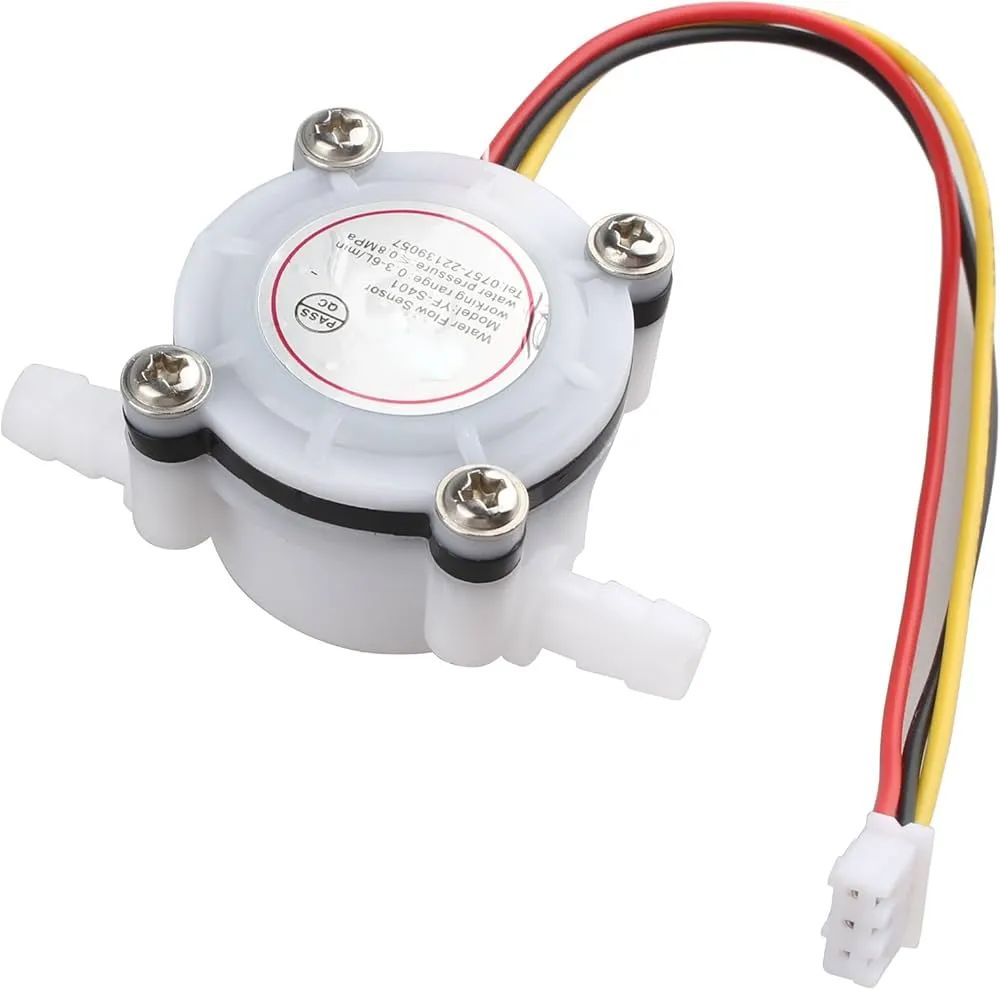
Features:
- Stainless steel ball impeller for enhanced durability and wear resistance
- Integrated Hall effect sensor for precise flow detection
- Leak-proof design with stress-applied sealing ring
- Encapsulated internal components to prevent moisture damage and aging
- Compact and lightweight structure for easy installation
- Low power consumption suitable for embedded systems
- Stable pulse output proportional to water flow rate
- Designed for vertical installation (tilt angle < 5°)
- Compatible with microcontrollers like Arduino and ESP-based boards
Principle of Work:
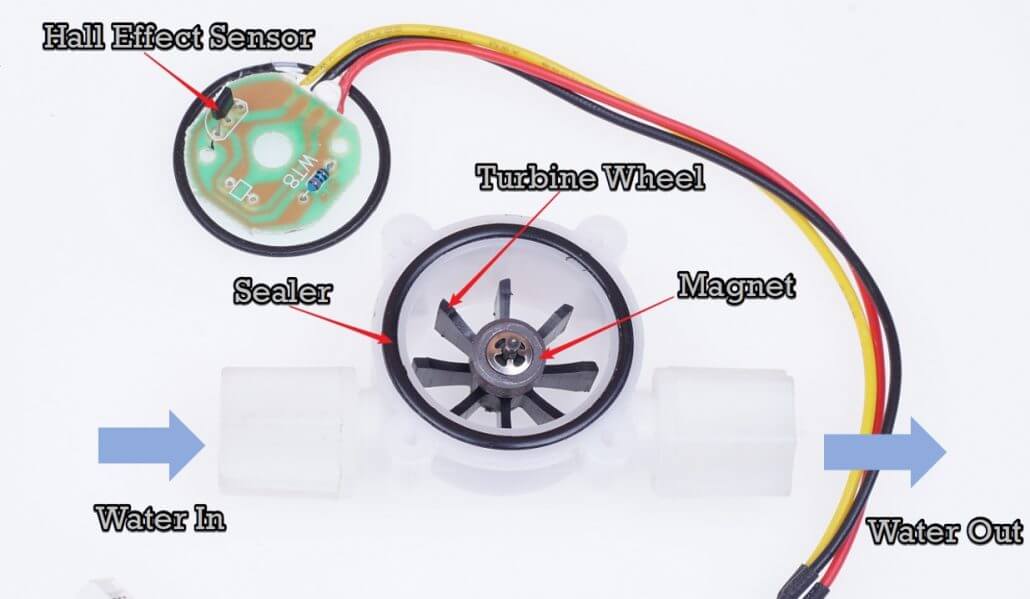
When water flows through the sensor, it rotates the internal impeller. Each rotation triggers the Hall effect sensor to generate a pulse signal. The output signal is a square wave where the frequency corresponds to the flow rate.
By counting the number of pulses over time, a microcontroller can calculate the flow rate (L/min) or total volume of water passed through the sensor. This makes it suitable for both real-time monitoring and cumulative measurement applications.
Pinout:
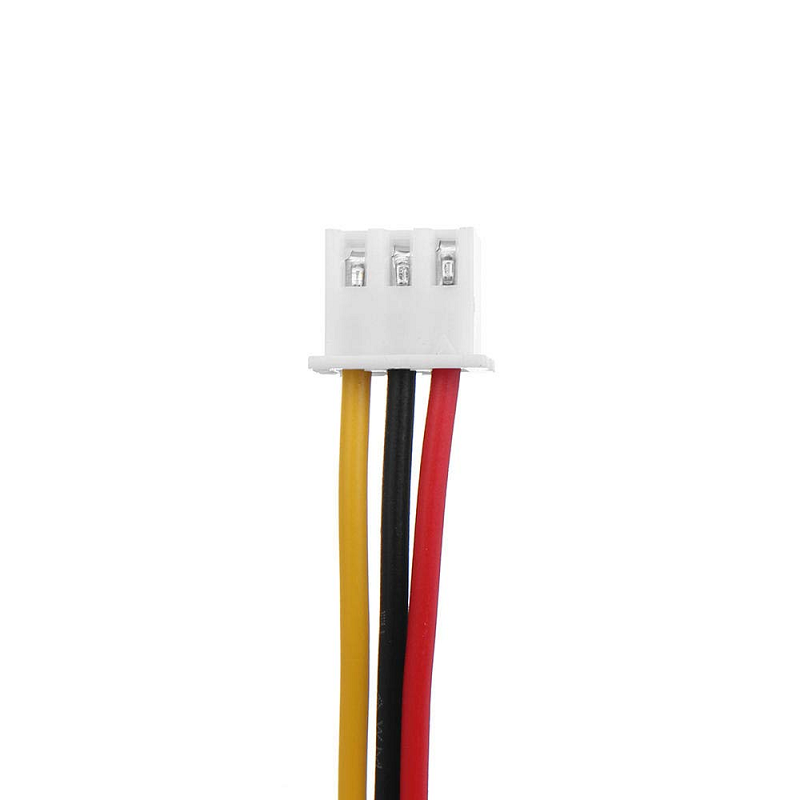
- VCC Red: Power supply (DC 4.5V – 5V)
- Signal Yellow: Pulse output signal proportional to flow rate
- GND Black: Ground
Applications:
- Water flow monitoring systems
- Smart irrigation and agriculture
- Water dispensers and vending machines
- Industrial liquid measurement systems
- Home automation and IoT water tracking
- Cooling systems and fluid control applications
Circuit:

- Connect VCC to 5V supply
- Connect GND to system ground
- Connect Signal pin to a digital input pin on the microcontroller
- Use interrupt-capable pins for accurate pulse counting
Code:
volatile int flowCount = 0;

void flow() {
  flowCount++;
}

void setup() {
  Serial.begin(9600);
  pinMode(2, INPUT);
  attachInterrupt(digitalPinToInterrupt(2), flow, RISING);
}

void loop() {
  flowCount = 0;
  interrupts();
  delay(1000); // Measure for 1 second
  noInterrupts();

  // Example conversion (depends on sensor calibration)
  float flowRate = flowCount / 7.5; // L/min approximation

  Serial.print("Flow Rate: ");
  Serial.print(flowRate);
  Serial.println(" L/min");
}
Technical Details:
- Flow Range: 0.3 – 6 L/min
- Working Voltage: DC 5V (range 5V – 18V)
- Minimum Operating Voltage: 4.5V
- Maximum Current: 15mA (at 5V)
- Load Capacity: ≤10mA
- Water Pressure: ≤0.8 MPa
- Operating Temperature: ≤80°C
- Operating Humidity: 35% – 90% RH (no condensation)
- Storage Temperature: -25°C to +80°C
- Storage Humidity: 25% – 95% RH
- Dimensions: Approx. 5.8 × 3.4 × 2.7 cm
- Outlet Diameter: Outer ~7mm, Inner ~3mm
Comparisons:
Compared to mechanical flow meters, this sensor provides digital output, making it easier to integrate with microcontrollers and IoT systems. Compared to high-end industrial flow sensors, it is more compact and cost-effective, making it ideal for small-scale and DIY applications, though with slightly lower precision.
Features:
- Stainless steel ball impeller for enhanced durability and wear resistance
- Integrated Hall effect sensor for precise flow detection
- Leak-proof design with stress-applied sealing ring
- Encapsulated internal components to prevent moisture damage and aging
- Compact and lightweight structure for easy installation
- Low power consumption suitable for embedded systems
- Stable pulse output proportional to water flow rate
- Designed for vertical installation (tilt angle < 5°)
- Compatible with microcontrollers like Arduino and ESP-based boards
Principle of Work:
When water flows through the sensor, it rotates the internal impeller. Each rotation triggers the Hall effect sensor to generate a pulse signal. The output signal is a square wave where the frequency corresponds to the flow rate.
By counting the number of pulses over time, a microcontroller can calculate the flow rate (L/min) or total volume of water passed through the sensor. This makes it suitable for both real-time monitoring and cumulative measurement applications.
Pinout:
- VCC Red: Power supply (DC 4.5V – 5V)
- Signal Yellow: Pulse output signal proportional to flow rate
- GND Black: Ground
Applications:
- Water flow monitoring systems
- Smart irrigation and agriculture
- Water dispensers and vending machines
- Industrial liquid measurement systems
- Home automation and IoT water tracking
- Cooling systems and fluid control applications
Circuit:
- Connect VCC to 5V supply
- Connect GND to system ground
- Connect Signal pin to a digital input pin on the microcontroller
- Use interrupt-capable pins for accurate pulse counting
Code:
volatile int flowCount = 0;

void flow() {
  flowCount++;
}

void setup() {
  Serial.begin(9600);
  pinMode(2, INPUT);
  attachInterrupt(digitalPinToInterrupt(2), flow, RISING);
}

void loop() {
  flowCount = 0;
  interrupts();
  delay(1000); // Measure for 1 second
  noInterrupts();

  // Example conversion (depends on sensor calibration)
  float flowRate = flowCount / 7.5; // L/min approximation

  Serial.print("Flow Rate: ");
  Serial.print(flowRate);
  Serial.println(" L/min");
}
Technical Details:
- Flow Range: 0.3 – 6 L/min
- Working Voltage: DC 5V (range 5V – 18V)
- Minimum Operating Voltage: 4.5V
- Maximum Current: 15mA (at 5V)
- Load Capacity: ≤10mA
- Water Pressure: ≤0.8 MPa
- Operating Temperature: ≤80°C
- Operating Humidity: 35% – 90% RH (no condensation)
- Storage Temperature: -25°C to +80°C
- Storage Humidity: 25% – 95% RH
- Dimensions: Approx. 5.8 × 3.4 × 2.7 cm
- Outlet Diameter: Outer ~7mm, Inner ~3mm
Comparisons:
Compared to mechanical flow meters, this sensor provides digital output, making it easier to integrate with microcontrollers and IoT systems. Compared to high-end industrial flow sensors, it is more compact and cost-effective, making it ideal for small-scale and DIY applications, though with slightly lower precision.