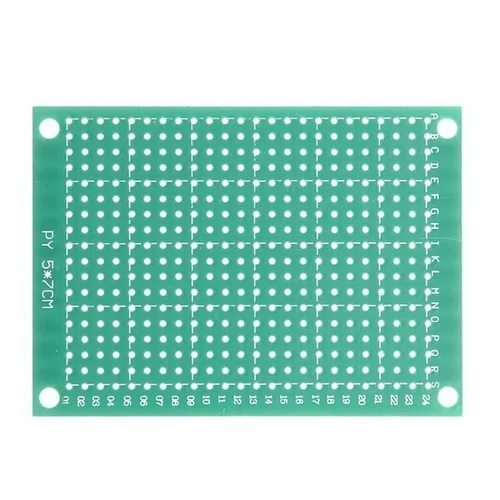
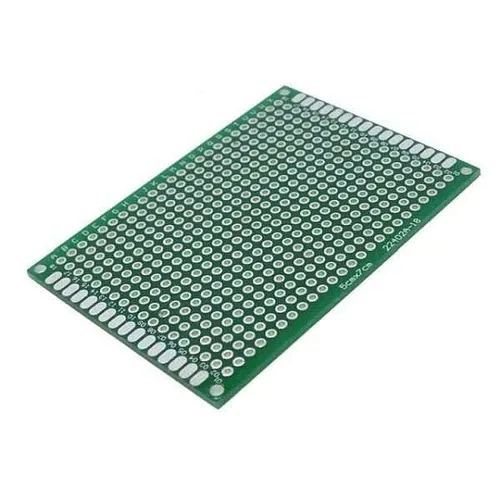
To use the board, start by gathering all required components such as resistors, capacitors, and ICs, along with soldering tools including a soldering iron, solder wire, and flux. Plan your circuit layout in advance, either on paper or using design software, to determine component placement and connections. Insert component leads through the holes, solder them to the copper pads on the back of the board, and follow your planned layout carefully. After soldering, trim excess leads, inspect for solder bridges or cold joints, and test the circuit to ensure proper operation.
Features
- Ideal for DIY electronics and prototyping projects
- Suitable for point-to-point soldering
- Allows easy placement of through-hole components
- Supports custom circuit layouts
- Reusable for testing and development
Specifications
- Dimension: 5x7cm
- Material: Copper PCB
- Hole Pitch: Standard 2.54mm
- Quantity: 1 piece
Applications
- DIY electronics projects
- Circuit prototyping and testing
- Educational electronics experiments
- Hobbyist and maker projects
- Temporary circuit development
To use the board, start by gathering all required components such as resistors, capacitors, and ICs, along with soldering tools including a soldering iron, solder wire, and flux. Plan your circuit layout in advance, either on paper or using design software, to determine component placement and connections. Insert component leads through the holes, solder them to the copper pads on the back of the board, and follow your planned layout carefully. After soldering, trim excess leads, inspect for solder bridges or cold joints, and test the circuit to ensure proper operation.
Features
- Ideal for DIY electronics and prototyping projects
- Suitable for point-to-point soldering
- Allows easy placement of through-hole components
- Supports custom circuit layouts
- Reusable for testing and development
Specifications
- Dimension: 5x7cm
- Material: Copper PCB
- Hole Pitch: Standard 2.54mm
- Quantity: 1 piece
Applications
- DIY electronics projects
- Circuit prototyping and testing
- Educational electronics experiments
- Hobbyist and maker projects
- Temporary circuit development