Features
- Affordable and dependable standard servo
- Compatible with Arduino Servo library
- Smooth operation using bushing type bearings
- Good torque for light to medium duty applications
- Fast and accurate positioning
- Compact standard size design
- Lightweight construction reduces project load
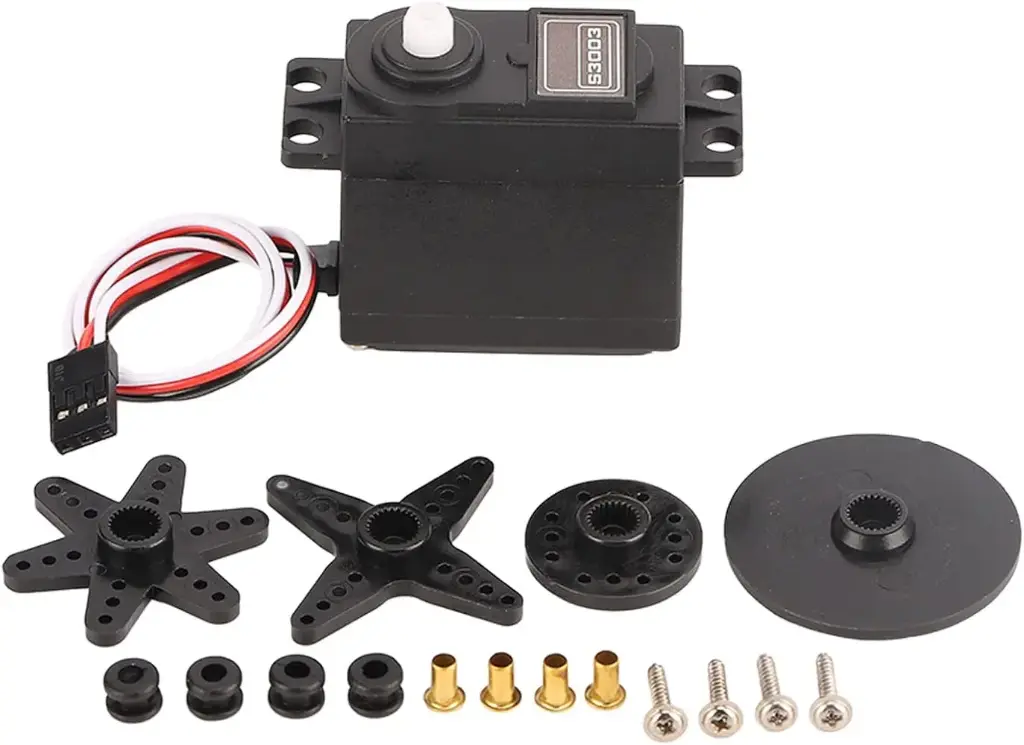
- Flexible 150mm connector wire for easy installation
Principle of Work
The S3003 servo operates using Pulse Width Modulation PWM. A control signal is sent to the servo in the form of pulses. The pulse width determines the target angle of the servo shaft. An internal potentiometer provides feedback of the current shaft position to the control circuit. The servo continuously adjusts its position until the measured angle matches the commanded angle ensuring accurate and stable motion.
Pinout of the Motor
- GND Ground wire usually brown or black
- VCC Power wire usually red 4.8V to 6V
- Signal Control wire usually yellow or white
Power and Wiring Notes

The S3003 servo can be powered directly from the Arduino 5V pin for light loads. For better stability or multiple servos, an external 5V power supply is recommended. Always connect the Arduino ground to the external power supply ground to ensure a proper signal reference.
Applications
- Educational and learning projects
- Small robotic arms and mechanisms
- RC cars boats and simple aircraft
- Pan tilt camera systems
- Automation and positioning tasks
Arduino Circuit

The servo signal wire is connected to Arduino pin 9. Power and ground are connected to 5V and GND, respectively. i, whichtter to connect the power to an external source for the Arduino's sake because it might sink so much current what makes the Arduino regulator run at high temperature
Library
No additional libraries are required. The Servo library is included by default with the Arduino IDE.
Arduino Example Code
#include <Servo.h>
Servo servoMotor;
void setup() {
 servoMotor.attach(9);
}
void loop() {
 servoMotor.write(0);
 delay(1000);
 servoMotor.write(90);
 delay(1000);
 servoMotor.write(180);
 delay(1000);
}
Specifications
- Bearings Bushing type
- Torque 44 oz in 3.2 kg cm at 4.8V
- Torque 57 oz in 4.1 kg cm at 6.0V
- Speed 0.23 sec per 60 degrees at 4.8V
- Operating Voltage 4.8V to 6.0V
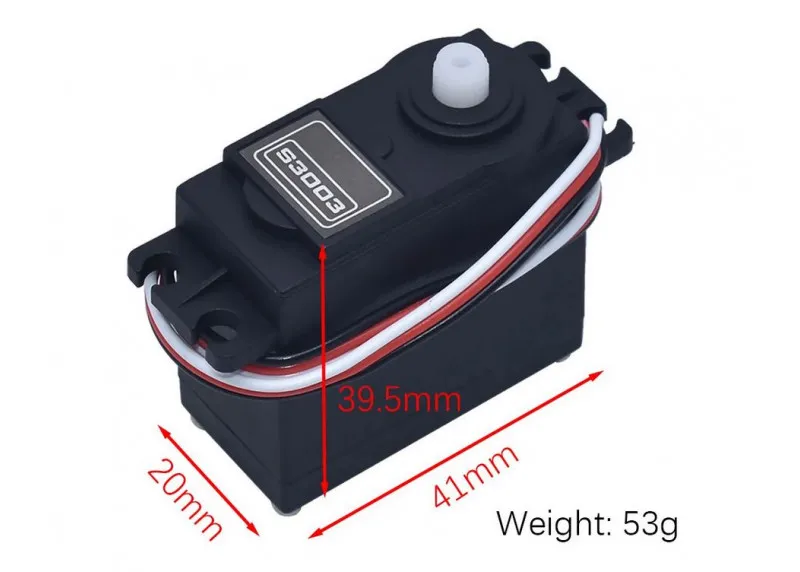
- Dimensions 40 x 20 x 44 mm
- Connector Wire Length 150mm
- Weight 37.2g
Additional Notes
The S3003 is ideal for projects where cost efficiency and reliability are required. While it does not provide the high torque of metal gear servos, it offers long life, smooth motion, and excellent value for standard duty applications.
Features
- Affordable and dependable standard servo
- Compatible with Arduino Servo library
- Smooth operation using bushing type bearings
- Good torque for light to medium duty applications
- Fast and accurate positioning
- Compact standard size design
- Lightweight construction reduces project load
- Flexible 150mm connector wire for easy installation
Principle of Work
The S3003 servo operates using Pulse Width Modulation PWM. A control signal is sent to the servo in the form of pulses. The pulse width determines the target angle of the servo shaft. An internal potentiometer provides feedback of the current shaft position to the control circuit. The servo continuously adjusts its position until the measured angle matches the commanded angle ensuring accurate and stable motion.
Pinout of the Motor
- GND Ground wire usually brown or black
- VCC Power wire usually red 4.8V to 6V
- Signal Control wire usually yellow or white
Power and Wiring Notes
The S3003 servo can be powered directly from the Arduino 5V pin for light loads. For better stability or multiple servos, an external 5V power supply is recommended. Always connect the Arduino ground to the external power supply ground to ensure a proper signal reference.
Applications
- Educational and learning projects
- Small robotic arms and mechanisms
- RC cars boats and simple aircraft
- Pan tilt camera systems
- Automation and positioning tasks
Arduino Circuit
The servo signal wire is connected to Arduino pin 9. Power and ground are connected to 5V and GND, respectively. i, whichtter to connect the power to an external source for the Arduino's sake because it might sink so much current what makes the Arduino regulator run at high temperature
Library
No additional libraries are required. The Servo library is included by default with the Arduino IDE.
Arduino Example Code
#include <Servo.h>
Servo servoMotor;
void setup() {
 servoMotor.attach(9);
}
void loop() {
 servoMotor.write(0);
 delay(1000);
 servoMotor.write(90);
 delay(1000);
 servoMotor.write(180);
 delay(1000);
}
Specifications
- Bearings Bushing type
- Torque 44 oz in 3.2 kg cm at 4.8V
- Torque 57 oz in 4.1 kg cm at 6.0V
- Speed 0.23 sec per 60 degrees at 4.8V
- Operating Voltage 4.8V to 6.0V
- Dimensions 40 x 20 x 44 mm
- Connector Wire Length 150mm
- Weight 37.2g
Additional Notes
The S3003 is ideal for projects where cost efficiency and reliability are required. While it does not provide the high torque of metal gear servos, it offers long life, smooth motion, and excellent value for standard duty applications.