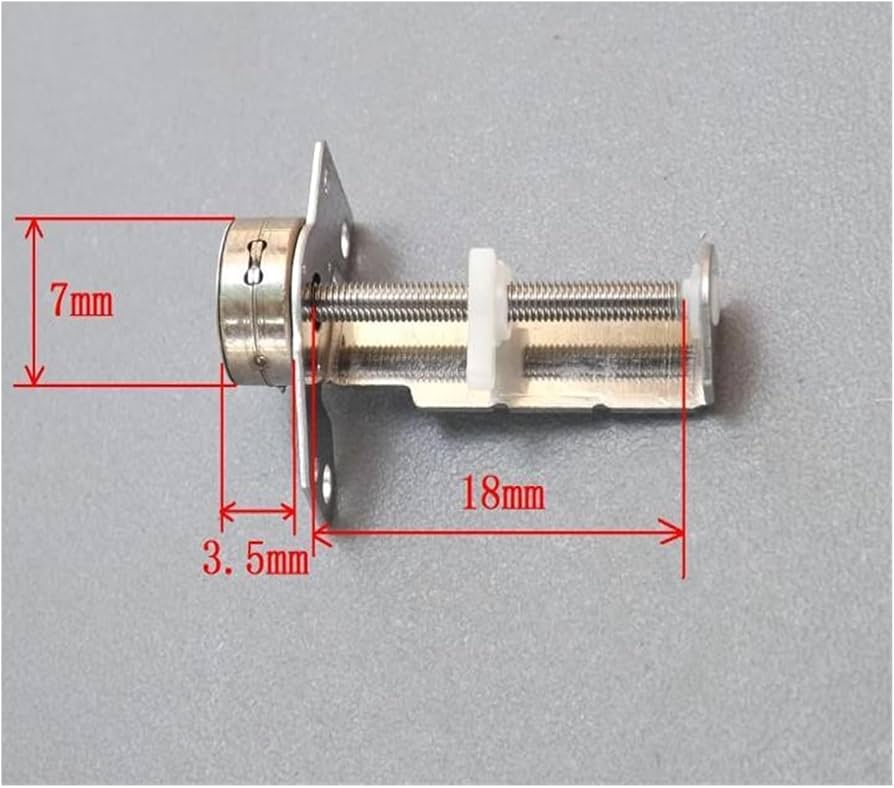
Features & Specifications:
- Designed for camera micro sliding tables
- Suitable for DIY projects requiring precise movement
- 2-phase, 4-wire stepper motor
- Phase Resistance: 30 ohms
- Voltage Range: 3V - 5V
Arduino Integration Using ULN2003 Driver:
This motor can be easily controlled via a ULN2003 driver module, which simplifies wiring and reduces current draw from the Arduino. Connect the stepper motor wires to the ULN2003 input terminals, and connect the ULN2003 control pins to Arduino digital pins.
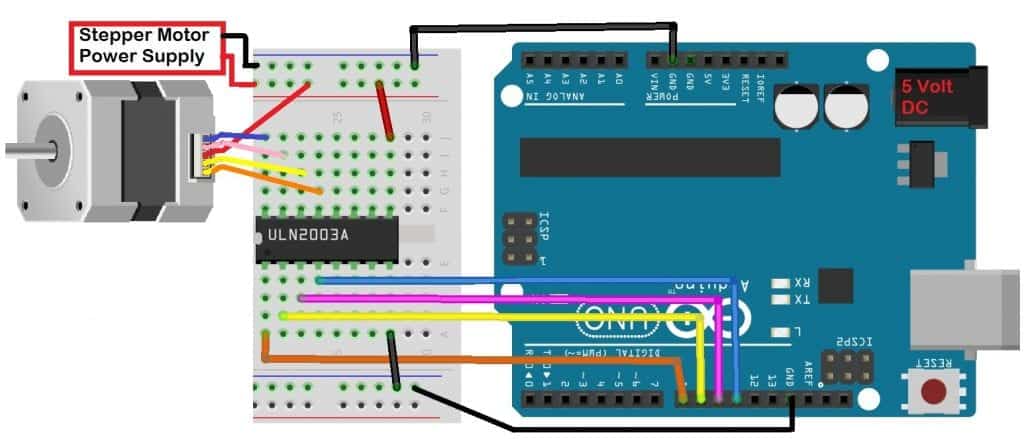
// Stepper Motor Driving with ULN2003 (Single Direction)
#include "Stepper.h"
const int stepsPerRevolution = 204; // Depends on the stepper motor

// Connect ULN2003 IN1, IN2, IN3, IN4 to Arduino pins 8, 9, 10, 11
Stepper stepper(stepsPerRevolution, 8, 10, 9, 11);

void setup() {
  stepper.setSpeed(10); // Set speed in RPM
}

void loop() {
  stepper.step(stepsPerRevolution); // Rotate one full revolution
  delay(500);
}
Using a driver module like ULN2003 or A4988 allows smoother operation, protection for the Arduino, and precise step control. For microstepping with an A4988 or DRV8834, connect the motor to the driver, provide logic-level signals (Step and Direction) from Arduino, and adjust the microstepping pins as needed.
Features & Specifications:
- Designed for camera micro sliding tables
- Suitable for DIY projects requiring precise movement
- 2-phase, 4-wire stepper motor
- Phase Resistance: 30 ohms
- Voltage Range: 3V - 5V
Arduino Integration Using ULN2003 Driver:
This motor can be easily controlled via a ULN2003 driver module, which simplifies wiring and reduces current draw from the Arduino. Connect the stepper motor wires to the ULN2003 input terminals, and connect the ULN2003 control pins to Arduino digital pins.
// Stepper Motor Driving with ULN2003 (Single Direction)
#include "Stepper.h"
const int stepsPerRevolution = 204; // Depends on the stepper motor

// Connect ULN2003 IN1, IN2, IN3, IN4 to Arduino pins 8, 9, 10, 11
Stepper stepper(stepsPerRevolution, 8, 10, 9, 11);

void setup() {
  stepper.setSpeed(10); // Set speed in RPM
}

void loop() {
  stepper.step(stepsPerRevolution); // Rotate one full revolution
  delay(500);
}
Using a driver module like ULN2003 or A4988 allows smoother operation, protection for the Arduino, and precise step control. For microstepping with an A4988 or DRV8834, connect the motor to the driver, provide logic-level signals (Step and Direction) from Arduino, and adjust the microstepping pins as needed.