Features
- Integrated signal conditioning block for ECG and biopotential measurements
- Extracts, amplifies, and filters very small biopotential signals
- Built in operational amplifier with three pole low pass filter for noise reduction
- LED indicator for visual heart rhythm detection
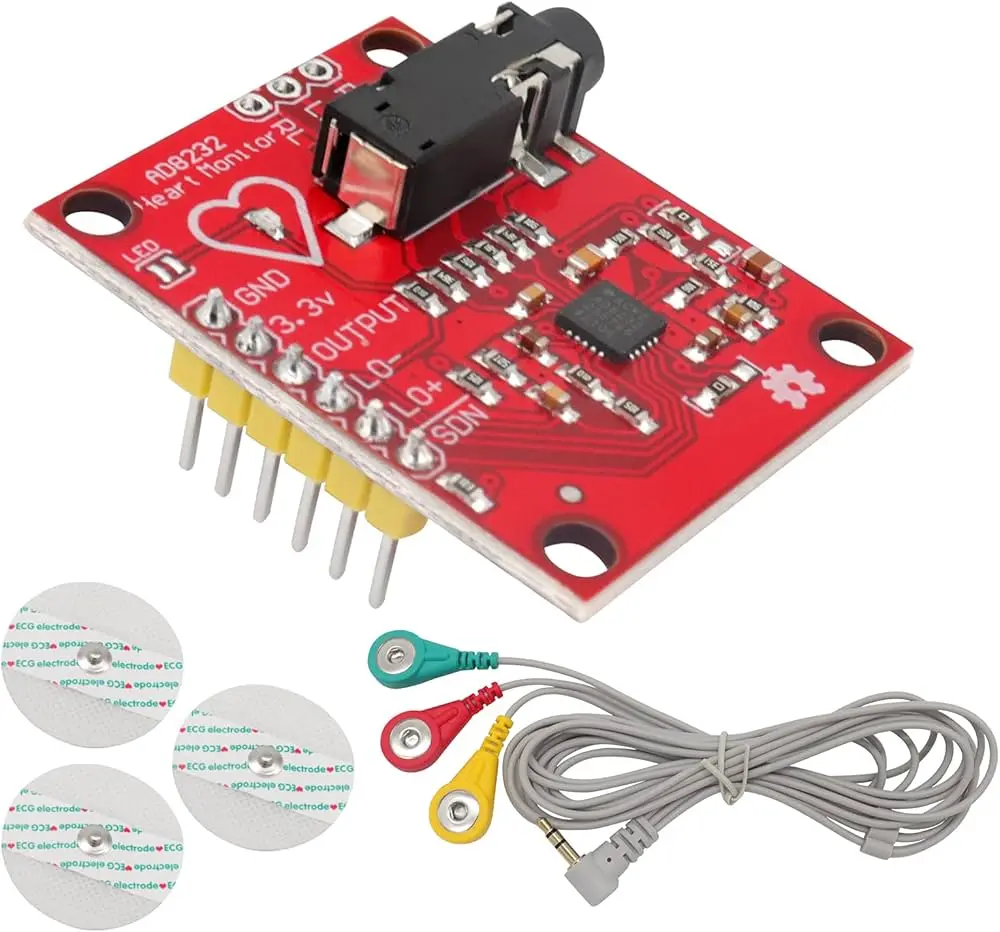
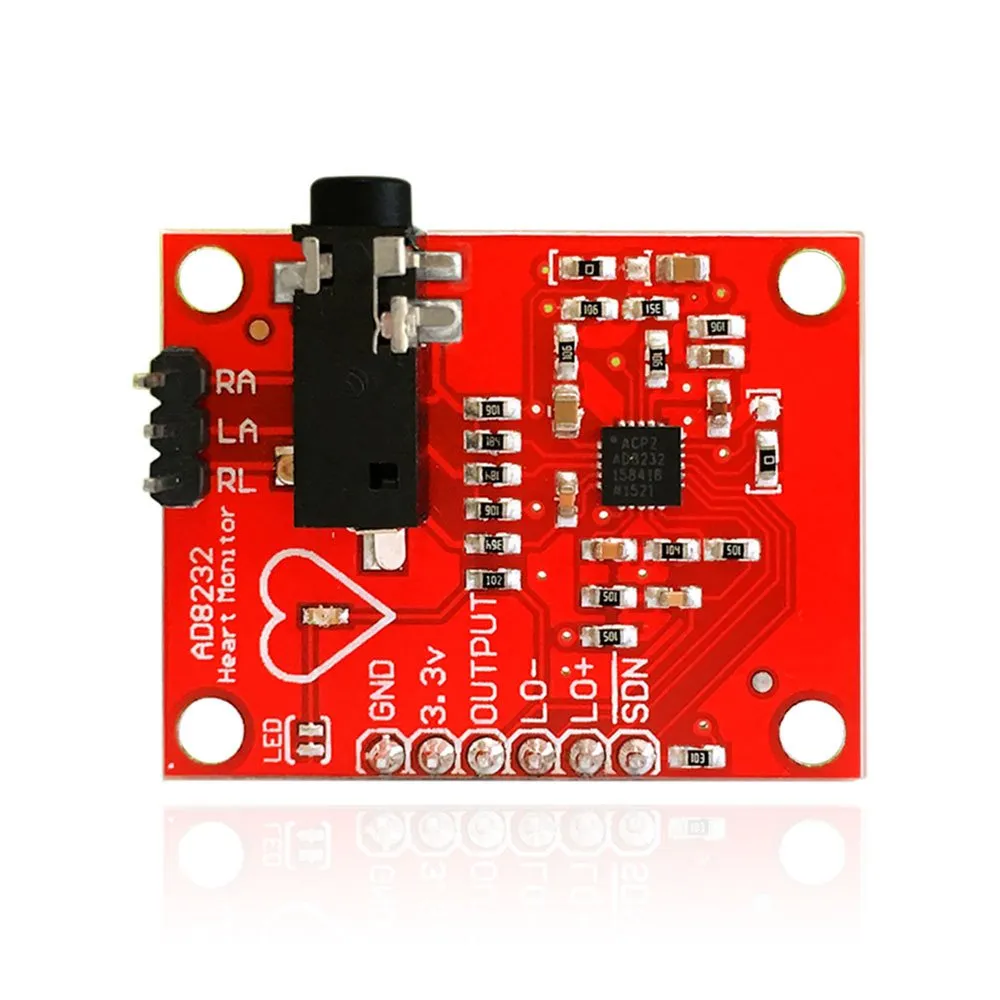
- Breakout pins for easy connection to Arduino and other development boards
- Supports fitness monitoring, portable ECG devices, and remote health monitoring
- Suitable for gaming peripherals and bioelectric signal experiments
Specifications
- Common Mode Rejection Ratio: 80 dB dc to 60 Hz
- Electrode Configuration: Two or three electrode support
- Single Supply Operation: 2.0V to 3.5V
- Board Size: 3.5 cm x 3 cm
- Rated Temperature Range: 0 to 70 degrees Celsius
- Working Temperature Range: -40 to 85 degrees Celsius
Pin Configuration
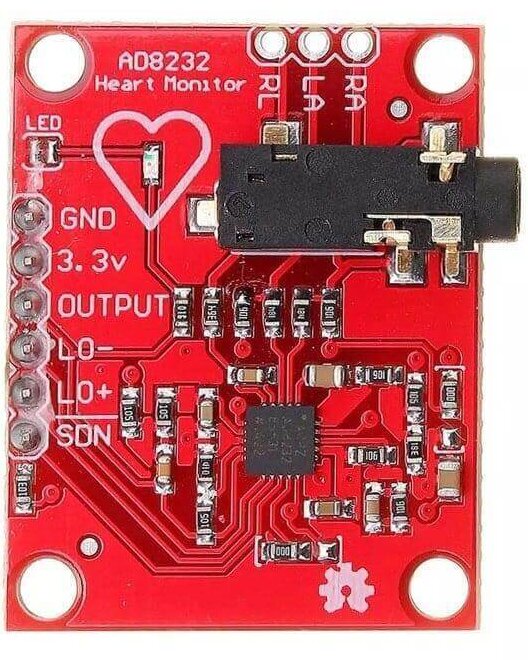
| Board Label | Pin Function | Arduino Connection |
|---|---|---|
| GND | Ground | GND |
| 3.3V | 3.3V Power Supply | 3.3V |
| OUTPUT | Analog ECG Signal Output | A0 |
| LO- | Leads Off Detect Negative | Digital Pin 11 |
| LO+ | Leads Off Detect Positive | Digital Pin 10 |
Arduino Wiring:
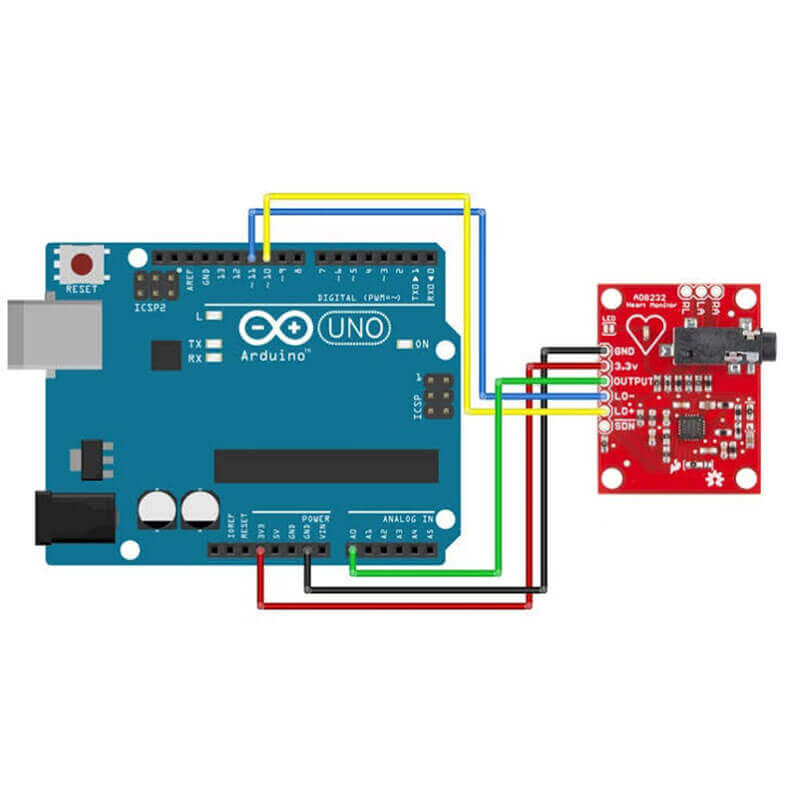
The AD8232 outputs an analog ECG signal that can be read directly using an Arduino analog input pin. The LO+ and LO- pins are used to detect whether the electrodes are properly connected to the body. If an electrode is disconnected, these pins will go HIGH.
// AD8232 ECG Sensor Simple Arduino Code

const int ecgPin = A0;
const int loPlus = 10;
const int loMinus = 11;

void setup() {
  Serial.begin(9600);
  pinMode(loPlus, INPUT);
  pinMode(loMinus, INPUT);
}

void loop() {
  if ((digitalRead(loPlus) == 1) || (digitalRead(loMinus) == 1)) {
    Serial.println("Leads Off");
  } else {
    int ecgValue = analogRead(ecgPin);
    Serial.println(ecgValue);
  }
  delay(5);
}
This code continuously reads the ECG signal from the AD8232 module and sends the data to the Serial Monitor or Serial Plotter. For best visualization, use the Arduino Serial Plotter and ensure proper electrode placement on the body.
Applications
- Heart rate monitoring systems
- Portable ECG devices
- Fitness and health tracking projects
- Remote medical monitoring
- Bioelectric signal experiments
- Educational and research projects
Features
- Integrated signal conditioning block for ECG and biopotential measurements
- Extracts, amplifies, and filters very small biopotential signals
- Built in operational amplifier with three pole low pass filter for noise reduction
- LED indicator for visual heart rhythm detection
- Breakout pins for easy connection to Arduino and other development boards
- Supports fitness monitoring, portable ECG devices, and remote health monitoring
- Suitable for gaming peripherals and bioelectric signal experiments
Specifications
- Common Mode Rejection Ratio: 80 dB dc to 60 Hz
- Electrode Configuration: Two or three electrode support
- Single Supply Operation: 2.0V to 3.5V
- Board Size: 3.5 cm x 3 cm
- Rated Temperature Range: 0 to 70 degrees Celsius
- Working Temperature Range: -40 to 85 degrees Celsius
Pin Configuration
| Board Label | Pin Function | Arduino Connection |
|---|---|---|
| GND | Ground | GND |
| 3.3V | 3.3V Power Supply | 3.3V |
| OUTPUT | Analog ECG Signal Output | A0 |
| LO- | Leads Off Detect Negative | Digital Pin 11 |
| LO+ | Leads Off Detect Positive | Digital Pin 10 |
Arduino Wiring:
The AD8232 outputs an analog ECG signal that can be read directly using an Arduino analog input pin. The LO+ and LO- pins are used to detect whether the electrodes are properly connected to the body. If an electrode is disconnected, these pins will go HIGH.
// AD8232 ECG Sensor Simple Arduino Code

const int ecgPin = A0;
const int loPlus = 10;
const int loMinus = 11;

void setup() {
  Serial.begin(9600);
  pinMode(loPlus, INPUT);
  pinMode(loMinus, INPUT);
}

void loop() {
  if ((digitalRead(loPlus) == 1) || (digitalRead(loMinus) == 1)) {
    Serial.println("Leads Off");
  } else {
    int ecgValue = analogRead(ecgPin);
    Serial.println(ecgValue);
  }
  delay(5);
}
This code continuously reads the ECG signal from the AD8232 module and sends the data to the Serial Monitor or Serial Plotter. For best visualization, use the Arduino Serial Plotter and ensure proper electrode placement on the body.
Applications
- Heart rate monitoring systems
- Portable ECG devices
- Fitness and health tracking projects
- Remote medical monitoring
- Bioelectric signal experiments
- Educational and research projects