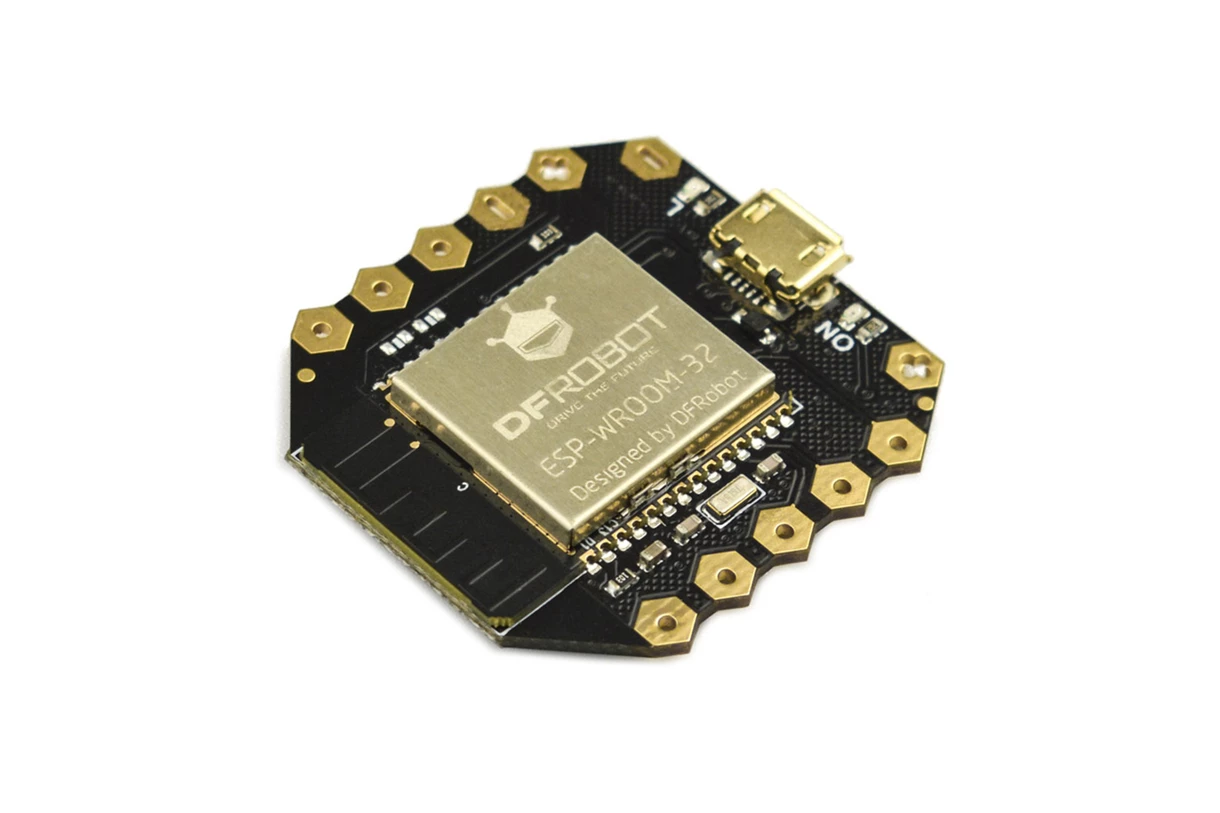
ESP32 Beetle Microcontroller DFRobot - DFR0575
The Beetle-ESP32 Microcontroller is a compact development board designed for electronic engineering enthusiasts and DIY enthusiasts. With WiFi and Bluetooth capabilities, this condensed version of the FireBeetle-ESP32 measures just 1.38" x 1.34". Equipped with four analog ports, four digital ports, UART interfaces, and I2C interfaces, it offers a versatile solution for a wide range of projects. The perfect replacement for the FireBeetle-ESP32, it empowers users with enhanced functionality and flexibility.
Package Includes:
- 1x Beetle-ESP32 Microcontroller Board
Features:
- Effortless programming and debugging are enabled through the Micro USB interface.
- Large-scale gold-plated I/O ports for easy wiring or sewing onto fabric.
- Powered by a dual-core Tensilica LX6 CPU at 240 MHz.
- 16 MB Flash memory and 520 KB SRAM.
- Built-in Bluetooth 4.2 and WiFi modules.
- Four analog ports and four digital ports with UART and I2C interfaces.
- Convenient soldering panels and hole-shaped leads.
- Labeled power leads: 3V3/VIN (+) and GND (-).
- Compact size for space-saving designs.
- Multiple digital interfaces: D2, D3, D4, D7 and analog A0–A3.
- Includes 1 I2C interface and 1 serial port.
Principle of Work:
The Beetle microcontroller works like Arduino, running programs uploaded through the Arduino IDE. It interacts with sensors, motors, lights, and more using its I/O pins. Arduino’s open-source ecosystem provides tutorials, libraries, and examples suitable for both beginners and advanced users.
Benefits of Pins, WiFi, and Bluetooth:
- Pins: The four analog and four digital pins allow connection to sensors, actuators, UART, and I2C devices.
- WiFi: Enables IoT applications, cloud communication, remote monitoring, and internet connectivity.
- Bluetooth: Allows wireless communication with phones, tablets, and other modules for remote control or data transfer.
Applications:
- Sensor Integration
- Actuator Control
- Internet Connectivity
- Wireless Communication
Pinout of the Board:
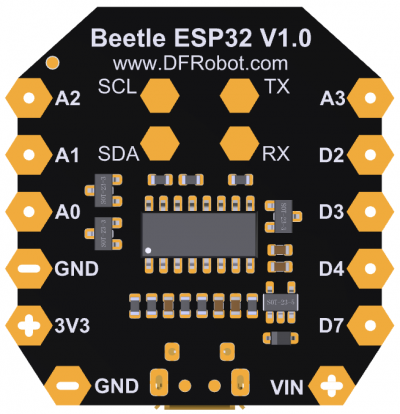
VIN | Power Input
GND | Ground
A0 | Analog Input
A1 | Analog Input
A2 | Analog Input
A3 | Analog Input
D2 | Digital I/O
D3 | Digital I/O
D4 | Digital I/O
D7 | Digital I/O
SCL | I2C Clock
SDA | I2C Data
RX | Serial Receive
TX | Serial Transmit
Pin Functions:
- 8 Digital I/O Pins
- 4 Analog Pins
- PWM Output Pins
- UART: RX/TX
- SPI: MOSI/MISO
- I2C: SDA/SCL
- Power Pins: VCC, GND, VIN
Applications:
- Health and Security Systems
- Wireless Keyboard
- Industrial Automation
- Embedded Systems
- Student Projects
- Automatic Pill Dispenser
- Water Level Meter
- IoT Projects
Circuit:
No circuit needed; we will blink the onboard LED.
Connecting the Board:
- Connect Beetle BLE to PC via USB
- Download and install CH340 driver
- Open Arduino IDE
- Add ESP32 Boards Manager URL
- Select FireBeetle ESP32 board
- Select COM port
- Upload your program
Code:
// Blink LED on pin D9
void setup() {
  pinMode(D9, OUTPUT);
}

void loop() {
  digitalWrite(D9, HIGH);
  delay(1000);
  digitalWrite(D9, LOW);
  delay(1000);
}
Explanation:
- setup(): Runs once, sets D9 as output.
- loop(): Turns LED on/off every second.
Technical Details:
- USB Voltage: 5.0V
- VIN: 3.5–6.5V
- CPU: Tensilica LX6 Dual-Core
- Clock: 240 MHz
- WiFi: 802.11 b/g/n
- Bluetooth: v4.2
- Crystal: 40 MHz + 32.768 kHz
- Dimensions: 35×34 mm
Comparisons:
Beetle-ESP32: compact, easy wiring, Micro USB, gold-plated ports.
NodeMCU ESP32: larger board, more connectors, same wireless capabilities, multi-language support.
Features:
- Effortless programming and debugging are enabled through the Micro USB interface.
- Large-scale gold-plated I/O ports for easy wiring or sewing onto fabric.
- Powered by a dual-core Tensilica LX6 CPU at 240 MHz.
- 16 MB Flash memory and 520 KB SRAM.
- Built-in Bluetooth 4.2 and WiFi modules.
- Four analog ports and four digital ports with UART and I2C interfaces.
- Convenient soldering panels and hole-shaped leads.
- Labeled power leads: 3V3/VIN (+) and GND (-).
- Compact size for space-saving designs.
- Multiple digital interfaces: D2, D3, D4, D7 and analog A0–A3.
- Includes 1 I2C interface and 1 serial port.
Principle of Work:
The Beetle microcontroller works like Arduino, running programs uploaded through the Arduino IDE. It interacts with sensors, motors, lights, and more using its I/O pins. Arduino’s open-source ecosystem provides tutorials, libraries, and examples suitable for both beginners and advanced users.
Benefits of Pins, WiFi, and Bluetooth:
- Pins: The four analog and four digital pins allow connection to sensors, actuators, UART, and I2C devices.
- WiFi: Enables IoT applications, cloud communication, remote monitoring, and internet connectivity.
- Bluetooth: Allows wireless communication with phones, tablets, and other modules for remote control or data transfer.
Applications:
- Sensor Integration
- Actuator Control
- Internet Connectivity
- Wireless Communication
Pinout of the Board:
VIN | Power Input
GND | Ground
A0 | Analog Input
A1 | Analog Input
A2 | Analog Input
A3 | Analog Input
D2 | Digital I/O
D3 | Digital I/O
D4 | Digital I/O
D7 | Digital I/O
SCL | I2C Clock
SDA | I2C Data
RX | Serial Receive
TX | Serial Transmit
Pin Functions:
- 8 Digital I/O Pins
- 4 Analog Pins
- PWM Output Pins
- UART: RX/TX
- SPI: MOSI/MISO
- I2C: SDA/SCL
- Power Pins: VCC, GND, VIN
Applications:
- Health and Security Systems
- Wireless Keyboard
- Industrial Automation
- Embedded Systems
- Student Projects
- Automatic Pill Dispenser
- Water Level Meter
- IoT Projects
Circuit:
No circuit needed; we will blink the onboard LED.
Connecting the Board:
- Connect Beetle BLE to PC via USB
- Download and install CH340 driver
- Open Arduino IDE
- Add ESP32 Boards Manager URL
- Select FireBeetle ESP32 board
- Select COM port
- Upload your program
Code:
// Blink LED on pin D9
void setup() {
  pinMode(D9, OUTPUT);
}

void loop() {
  digitalWrite(D9, HIGH);
  delay(1000);
  digitalWrite(D9, LOW);
  delay(1000);
}
Explanation:
- setup(): Runs once, sets D9 as output.
- loop(): Turns LED on/off every second.
Technical Details:
- USB Voltage: 5.0V
- VIN: 3.5–6.5V
- CPU: Tensilica LX6 Dual-Core
- Clock: 240 MHz
- WiFi: 802.11 b/g/n
- Bluetooth: v4.2
- Crystal: 40 MHz + 32.768 kHz
- Dimensions: 35×34 mm
Comparisons:
Beetle-ESP32: compact, easy wiring, Micro USB, gold-plated ports.
NodeMCU ESP32: larger board, more connectors, same wireless capabilities, multi-language support.