Features:
- 4WD (four-wheel drive) robotic car chassis
- Simple mechanical structure for easy assembly
- Durable acrylic platform
- Four DC motors for strong driving power
- Good directional control and stability
- Expandable design for adding sensors and modules
- Includes speed encoder for motion feedback
- Supports closed-loop speed and distance control systems
- Compatible with Arduino, ESP32, and other development boards
- Ideal for DIY robotics and educational projects
Principle of Work:
The robot car uses four DC geared motors, typically grouped into left and right sides. Each side (two motors) is controlled together using a motor driver. By controlling the direction and speed of the left and right motor groups independently, the robot can move forward, backward, and turn. When both sides move forward, the robot moves straight. When one side moves forward and the other backward, the robot rotates in place. Speed control can be achieved using PWM signals from the microcontroller. The encoder can optionally provide feedback to measure speed and distance for more advanced control systems.
Mechanical Layout:
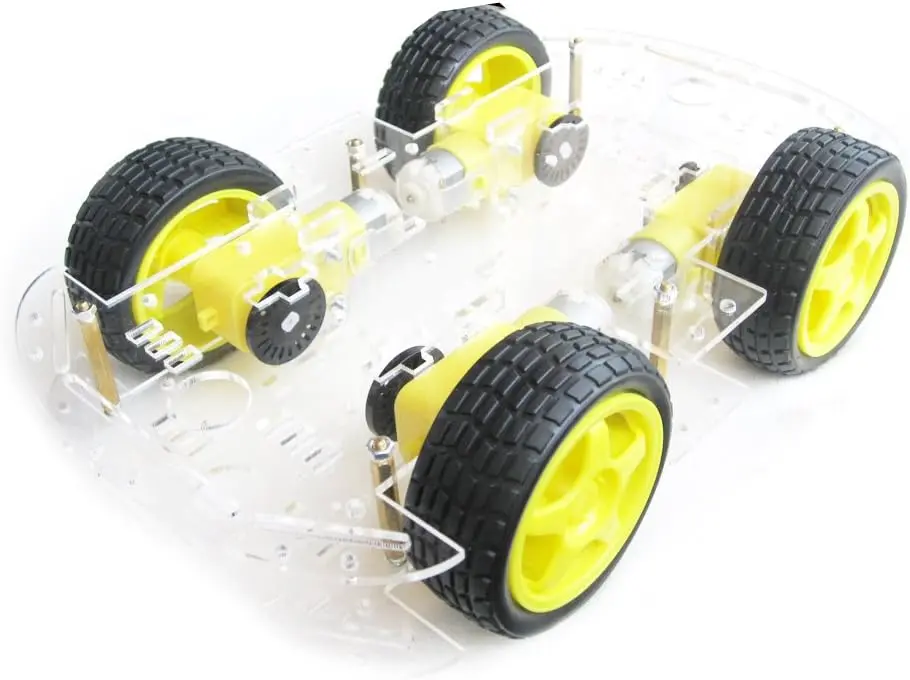
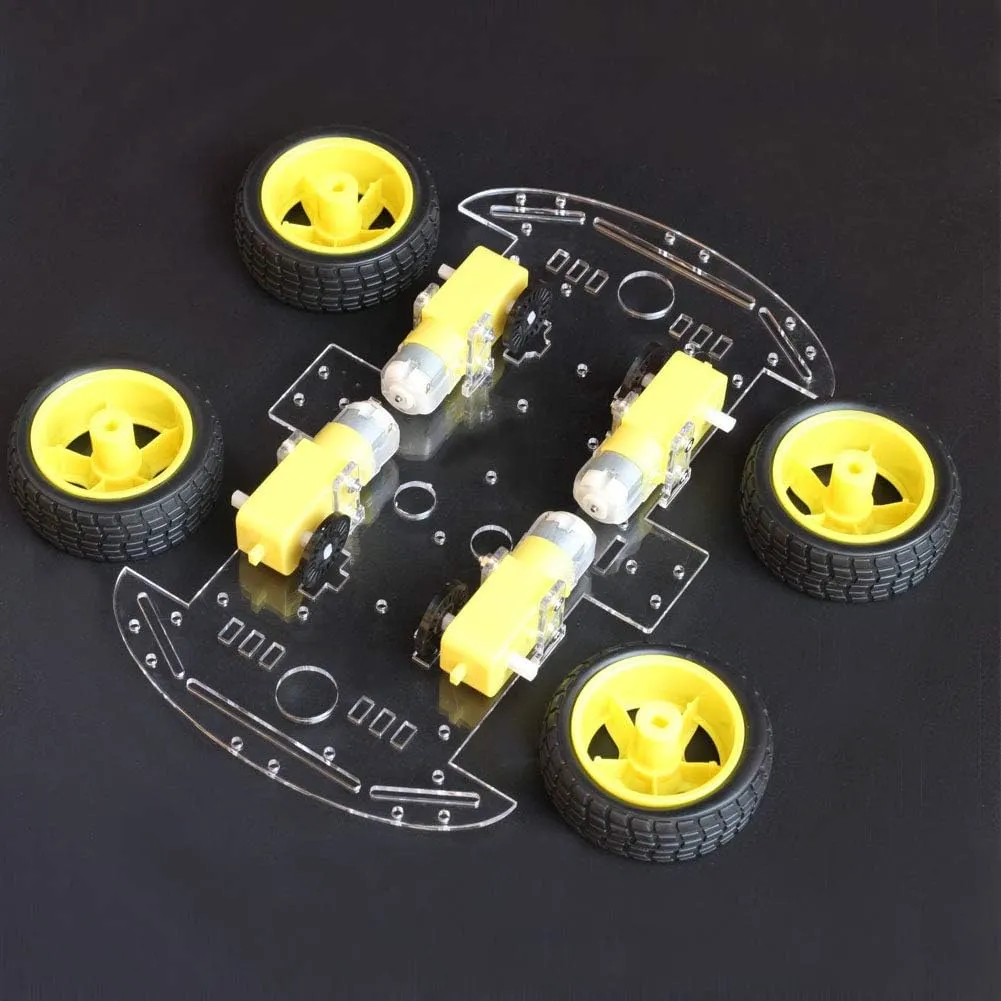
- Acrylic Chassis: Main structural base
- 4 × DC Motors: Two motors per side (left & right)
- Wheels: Provide movement and traction
- Encoder Disk: Measures rotation
Applications:
- DIY robotics projects
- Line-following robots
- Obstacle avoidance robots
- Remote control cars
- Autonomous navigation systems
- STEM education
Circuit (4WD using L298N Driver):

The 4 motors are grouped into two channels using an H-bridge motor driver (like L298N):
- Left Side Motors (2 motors in parallel): Connect to OUT1 & OUT2
- Right Side Motors (2 motors in parallel): Connect to OUT3 & OUT4
- IN1, IN2: Control LEFT motors direction
- IN3, IN4: Control RIGHT motors direction
- ENA: Speed control for LEFT motors (PWM)
- ENB: Speed control for RIGHT motors (PWM)
- 12V: Battery input
- GND: Common ground with Arduino
Connecting with Arduino First Time
- Connect IN1 → Pin 7
- Connect IN2 → Pin 6
- Connect IN3 → Pin 5
- Connect IN4 → Pin 4
- Connect ENA → Jumper
- Connect ENB → Jumper
- Connect motor driver GND → Arduino GND
- Power motors using external battery (7–12V)
Code (4WD Control):
int IN1 = 7;
int IN2 = 6;
int IN3 = 5;
int IN4 = 4;


void setup() {
  pinMode(IN1, OUTPUT);
  pinMode(IN2, OUTPUT);
  pinMode(IN3, OUTPUT);
  pinMode(IN4, OUTPUT);

}

void loop() {

  // Move Forward
  digitalWrite(IN1, HIGH);
  digitalWrite(IN2, LOW);
  digitalWrite(IN3, HIGH);
  digitalWrite(IN4, LOW);
  delay(2000);

  // Stop
  digitalWrite(IN1, LOW);
  digitalWrite(IN2, LOW);
  digitalWrite(IN3, LOW);
  digitalWrite(IN4, LOW);
  delay(1000);

  // Move Backward
  digitalWrite(IN1, LOW);
  digitalWrite(IN2, HIGH);
  digitalWrite(IN3, LOW);
  digitalWrite(IN4, HIGH);
  delay(2000);

  // Turn Right
  digitalWrite(IN1, HIGH);
  digitalWrite(IN2, LOW);
  digitalWrite(IN3, LOW);
  digitalWrite(IN4, HIGH);
  delay(1500);

  // Turn Left
  digitalWrite(IN1, LOW);
  digitalWrite(IN2, HIGH);
  digitalWrite(IN3, HIGH);
  digitalWrite(IN4, LOW);
  delay(1500);
}
Technical Details:
- Car Dimensions: 260 mm × 140 mm
- Material: Acrylic
- Wheel Diameter: 70 mm
- Weight: 564 g
- Drive Type: 4WD
- Motor Type: DC geared motors
- Control Method: Dual-channel motor driver (L298N)
Resources:
Comparisons:
- Better Stability: 4 motors provide balanced movement
- Higher Torque: More power than 2WD systems
- Improved Control: Independent left/right control
- Expandable: Supports advanced robotics features
- Versatile: Suitable for beginners and advanced users
Features:
- 4WD (four-wheel drive) robotic car chassis
- Simple mechanical structure for easy assembly
- Durable acrylic platform
- Four DC motors for strong driving power
- Good directional control and stability
- Expandable design for adding sensors and modules
- Includes speed encoder for motion feedback
- Supports closed-loop speed and distance control systems
- Compatible with Arduino, ESP32, and other development boards
- Ideal for DIY robotics and educational projects
Principle of Work:
The robot car uses four DC geared motors, typically grouped into left and right sides. Each side (two motors) is controlled together using a motor driver. By controlling the direction and speed of the left and right motor groups independently, the robot can move forward, backward, and turn. When both sides move forward, the robot moves straight. When one side moves forward and the other backward, the robot rotates in place. Speed control can be achieved using PWM signals from the microcontroller. The encoder can optionally provide feedback to measure speed and distance for more advanced control systems.
Mechanical Layout:
- Acrylic Chassis: Main structural base
- 4 × DC Motors: Two motors per side (left & right)
- Wheels: Provide movement and traction
- Encoder Disk: Measures rotation
Applications:
- DIY robotics projects
- Line-following robots
- Obstacle avoidance robots
- Remote control cars
- Autonomous navigation systems
- STEM education
Circuit (4WD using L298N Driver):
The 4 motors are grouped into two channels using an H-bridge motor driver (like L298N):
- Left Side Motors (2 motors in parallel): Connect to OUT1 & OUT2
- Right Side Motors (2 motors in parallel): Connect to OUT3 & OUT4
- IN1, IN2: Control LEFT motors direction
- IN3, IN4: Control RIGHT motors direction
- ENA: Speed control for LEFT motors (PWM)
- ENB: Speed control for RIGHT motors (PWM)
- 12V: Battery input
- GND: Common ground with Arduino
Connecting with Arduino First Time
- Connect IN1 → Pin 7
- Connect IN2 → Pin 6
- Connect IN3 → Pin 5
- Connect IN4 → Pin 4
- Connect ENA → Jumper
- Connect ENB → Jumper
- Connect motor driver GND → Arduino GND
- Power motors using external battery (7–12V)
Code (4WD Control):
int IN1 = 7;
int IN2 = 6;
int IN3 = 5;
int IN4 = 4;


void setup() {
  pinMode(IN1, OUTPUT);
  pinMode(IN2, OUTPUT);
  pinMode(IN3, OUTPUT);
  pinMode(IN4, OUTPUT);

}

void loop() {

  // Move Forward
  digitalWrite(IN1, HIGH);
  digitalWrite(IN2, LOW);
  digitalWrite(IN3, HIGH);
  digitalWrite(IN4, LOW);
  delay(2000);

  // Stop
  digitalWrite(IN1, LOW);
  digitalWrite(IN2, LOW);
  digitalWrite(IN3, LOW);
  digitalWrite(IN4, LOW);
  delay(1000);

  // Move Backward
  digitalWrite(IN1, LOW);
  digitalWrite(IN2, HIGH);
  digitalWrite(IN3, LOW);
  digitalWrite(IN4, HIGH);
  delay(2000);

  // Turn Right
  digitalWrite(IN1, HIGH);
  digitalWrite(IN2, LOW);
  digitalWrite(IN3, LOW);
  digitalWrite(IN4, HIGH);
  delay(1500);

  // Turn Left
  digitalWrite(IN1, LOW);
  digitalWrite(IN2, HIGH);
  digitalWrite(IN3, HIGH);
  digitalWrite(IN4, LOW);
  delay(1500);
}
Technical Details:
- Car Dimensions: 260 mm × 140 mm
- Material: Acrylic
- Wheel Diameter: 70 mm
- Weight: 564 g
- Drive Type: 4WD
- Motor Type: DC geared motors
- Control Method: Dual-channel motor driver (L298N)
Resources:
Comparisons:
- Better Stability: 4 motors provide balanced movement
- Higher Torque: More power than 2WD systems
- Improved Control: Independent left/right control
- Expandable: Supports advanced robotics features
- Versatile: Suitable for beginners and advanced users