Features:
- Runs JavaScript directly on the microcontroller
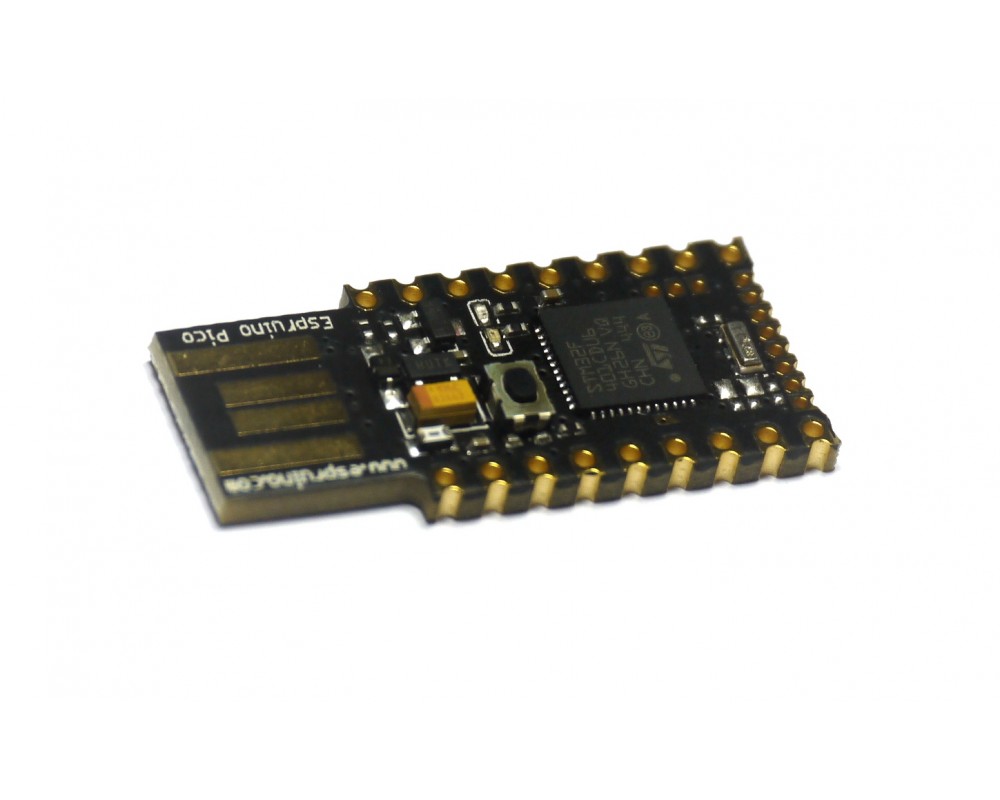
- Compact size: 33 mm × 15 mm
- 22 GPIO pins with multiple functionalities
- 9 analog inputs and up to 21 PWM outputs
- Supports UART, SPI, and I2C communication
- All GPIOs are 5V tolerant (Arduino compatible)
- Built-in USB Type-A connector
- Two onboard LEDs and one user button
- Ultra-low power consumption (sleep current < 0.05 mA)
- Onboard voltage regulator (3.5V – 16V input)
- Integrated FET for driving high-current loads
- Supports live variable inspection and modification during runtime
Specifications:
- Microcontroller: STM32F401CDU6 (ARM Cortex-M4)
- Flash Memory: 384 KB
- RAM: 96 KB
- GPIO: 22 pins
- Analog Inputs: 9
- PWM Channels: Up to 21
- Communication Interfaces: UART, SPI, I2C
- USB: Built-in USB Type-A
- Operating Voltage: 3.3V logic
- Input Voltage: 3.5V – 16V
- Current Consumption (Sleep): < 0.05 mA
- Board Dimensions: 33 mm × 15 mm
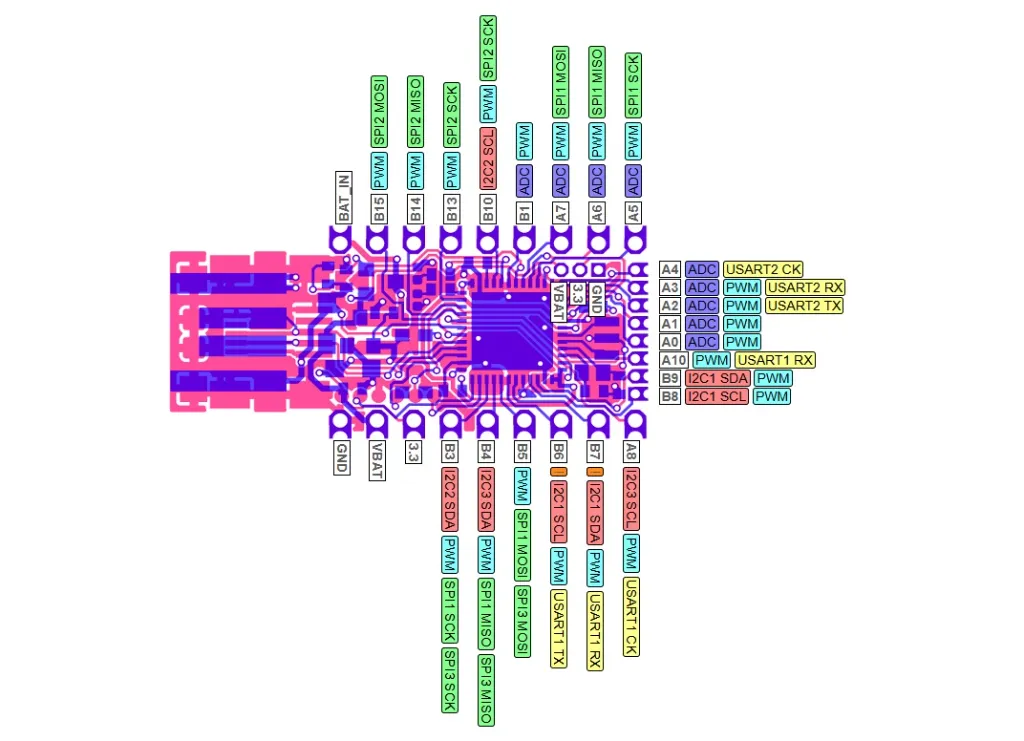
Pinout of the Module:
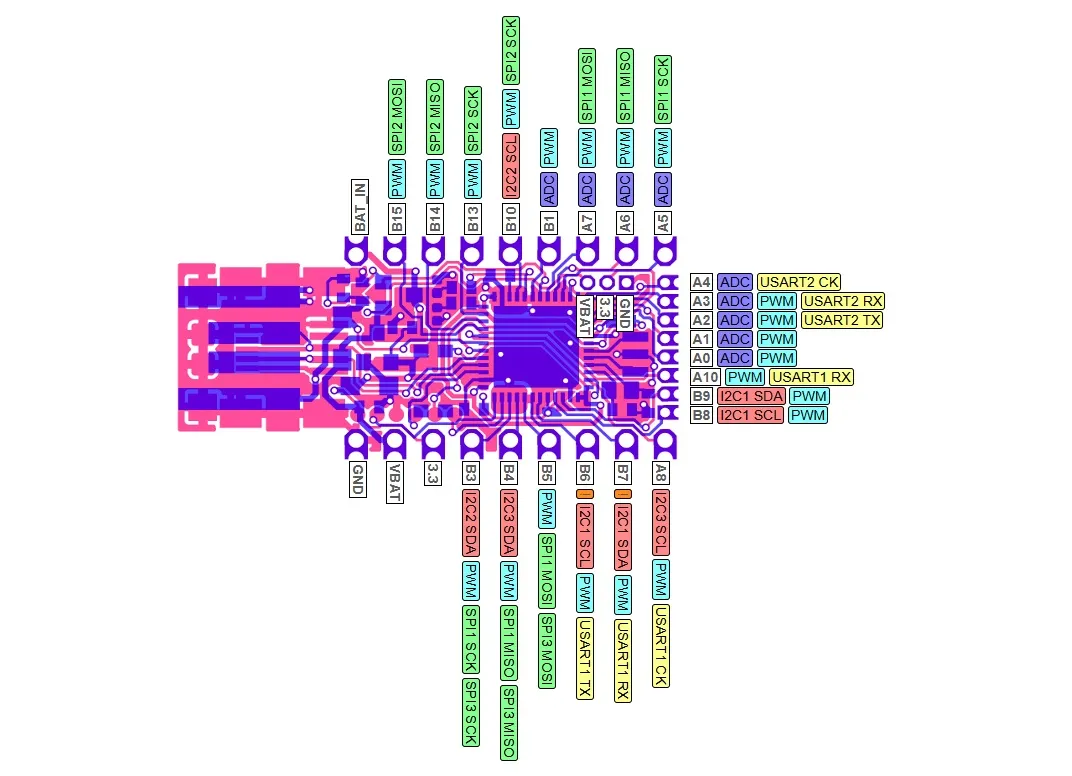
- Purple boxes show pins that are used for other functionality on the board. You should avoid using these unless you know that the marked device is not used.
- ! boxes contain extra information about the pin. Hover your mouse over them to see it.
- 3.3v boxes mark pins that are not 5v tolerant (they only take inputs from 0 - 3.3v, not 0 - 5v).
- 3.3 is a 3.3v output from the on-board Voltage regulator.
- GND is ground (0v).
- VBAT is the battery voltage output (see the Espruino Board Reference).
- ADC is an Analog to Digital Converter (for reading analog voltages)
- PWM is for Pulse Width Modulation. This creates analog voltages from a digital output by sending a series of pulses.
- SPI is the 3 wire Serial Peripheral Interface.
- USART is a 2 wire peripheral for Serial Data.
- I2C is the 2 wire Inter-Integrated Circuit bus.
Applications:
- Rapid prototyping with JavaScript
- Wearable and portable electronics
- IoT and sensor-based projects
- Educational programming and embedded learning
- Low-power battery-operated systems
Circuit:
The board can be powered directly via the USB connector or through the VIN pin (3.5V–16V). GPIO pins can be connected to sensors, actuators, or communication modules. The onboard FET allows driving higher current loads when needed.
Connecting with Espruino Pico for the First Time:
- Plug the board directly into a USB port
- Open a serial terminal or use the Web IDE
- Select the correct COM port
- Start typing JavaScript code and upload
- Interact with the board in real-time
Code Example (JavaScript Blink):
// Blink LED on pin LED1 setInterval(function() { digitalToggle(LED1); }, 500);
Web IDE Setup (Espruino):
Using the Online IDE:
- Connect the board via USB
- Select the device from the IDE
- Write and upload JavaScript code directly
Alternative (Serial Terminal):
- Use any serial terminal (e.g., PuTTY)
- Connect to the correct COM port
- Type and execute JavaScript commands interactively
Important Notes:
- This is the unpinned version (headers not soldered)
- GPIO pins are 5V tolerant but operate at 3.3V logic
- Code is stored on the device even after power-off
- Extremely low power consumption makes it suitable for long-term battery use
Resources:
Features:
- Runs JavaScript directly on the microcontroller
- Compact size: 33 mm × 15 mm
- 22 GPIO pins with multiple functionalities
- 9 analog inputs and up to 21 PWM outputs
- Supports UART, SPI, and I2C communication
- All GPIOs are 5V tolerant (Arduino compatible)
- Built-in USB Type-A connector
- Two onboard LEDs and one user button
- Ultra-low power consumption (sleep current < 0.05 mA)
- Onboard voltage regulator (3.5V – 16V input)
- Integrated FET for driving high-current loads
- Supports live variable inspection and modification during runtime
Specifications:
- Microcontroller: STM32F401CDU6 (ARM Cortex-M4)
- Flash Memory: 384 KB
- RAM: 96 KB
- GPIO: 22 pins
- Analog Inputs: 9
- PWM Channels: Up to 21
- Communication Interfaces: UART, SPI, I2C
- USB: Built-in USB Type-A
- Operating Voltage: 3.3V logic
- Input Voltage: 3.5V – 16V
- Current Consumption (Sleep): < 0.05 mA
- Board Dimensions: 33 mm × 15 mm
Pinout of the Module:
- Purple boxes show pins that are used for other functionality on the board. You should avoid using these unless you know that the marked device is not used.
- ! boxes contain extra information about the pin. Hover your mouse over them to see it.
- 3.3v boxes mark pins that are not 5v tolerant (they only take inputs from 0 - 3.3v, not 0 - 5v).
- 3.3 is a 3.3v output from the on-board Voltage regulator.
- GND is ground (0v).
- VBAT is the battery voltage output (see the Espruino Board Reference).
- ADC is an Analog to Digital Converter (for reading analog voltages)
- PWM is for Pulse Width Modulation. This creates analog voltages from a digital output by sending a series of pulses.
- SPI is the 3 wire Serial Peripheral Interface.
- USART is a 2 wire peripheral for Serial Data.
- I2C is the 2 wire Inter-Integrated Circuit bus.
Applications:
- Rapid prototyping with JavaScript
- Wearable and portable electronics
- IoT and sensor-based projects
- Educational programming and embedded learning
- Low-power battery-operated systems
Circuit:
The board can be powered directly via the USB connector or through the VIN pin (3.5V–16V). GPIO pins can be connected to sensors, actuators, or communication modules. The onboard FET allows driving higher current loads when needed.
Connecting with Espruino Pico for the First Time:
- Plug the board directly into a USB port
- Open a serial terminal or use the Web IDE
- Select the correct COM port
- Start typing JavaScript code and upload
- Interact with the board in real-time
Code Example (JavaScript Blink):
// Blink LED on pin LED1 setInterval(function() { digitalToggle(LED1); }, 500); Web IDE Setup (Espruino):
Using the Online IDE:
- Connect the board via USB
- Select the device from the IDE
- Write and upload JavaScript code directly
Alternative (Serial Terminal):
- Use any serial terminal (e.g., PuTTY)
- Connect to the correct COM port
- Type and execute JavaScript commands interactively
Important Notes:
- This is the unpinned version (headers not soldered)
- GPIO pins are 5V tolerant but operate at 3.3V logic
- Code is stored on the device even after power-off
- Extremely low power consumption makes it suitable for long-term battery use