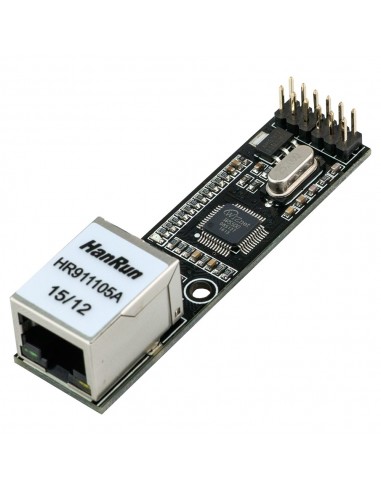
Features:
- Advanced W5500 Ethernet Chip with integrated TCP/IP stack
- SPI Interface for easy communication with microcontrollers
- 32KB Internal Buffer Memory for efficient data handling
- Supports up to 8 Simultaneous Socket Connections
- Compatible with Arduino (AVR), STM32, and ARM-based boards
- Supports 10/100 Base-T/TX Ethernet standards
- Operates at 3.3V logic with 5V tolerant I/O
- 8 Independent Socket Channels for parallel communication
- Compact PCB Design for easy integration into projects
Principle of Work:
The W5500 module works by handling all Ethernet communication through its built-in TCP/IP stack. The microcontroller communicates with the module via SPI, sending and receiving data packets. The W5500 processes network protocols such as TCP, UDP, IP, and ARP internally, reducing the workload on the microcontroller. Each of its 8 sockets can independently manage a network connection, enabling multiple simultaneous communications such as serving web pages or sending sensor data to servers.
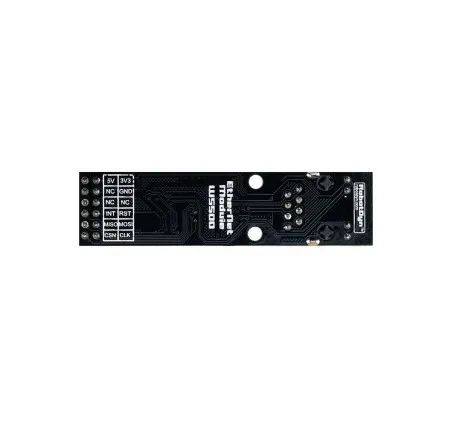
Pinout:
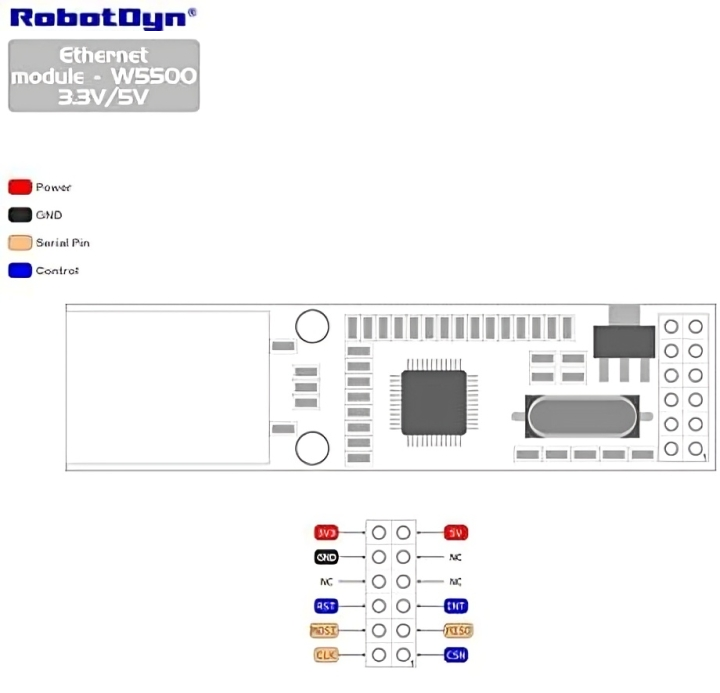
- VCC: Power supply (3.3V)
- GND: Ground
- MOSI: SPI Master Out Slave In
- MISO: SPI Master In Slave Out
- SCK: SPI Clock
- CS: Chip Select (configurable)
- RST: Reset pin
- INT: Interrupt pin (optional)
Connections with Arduino UNO:
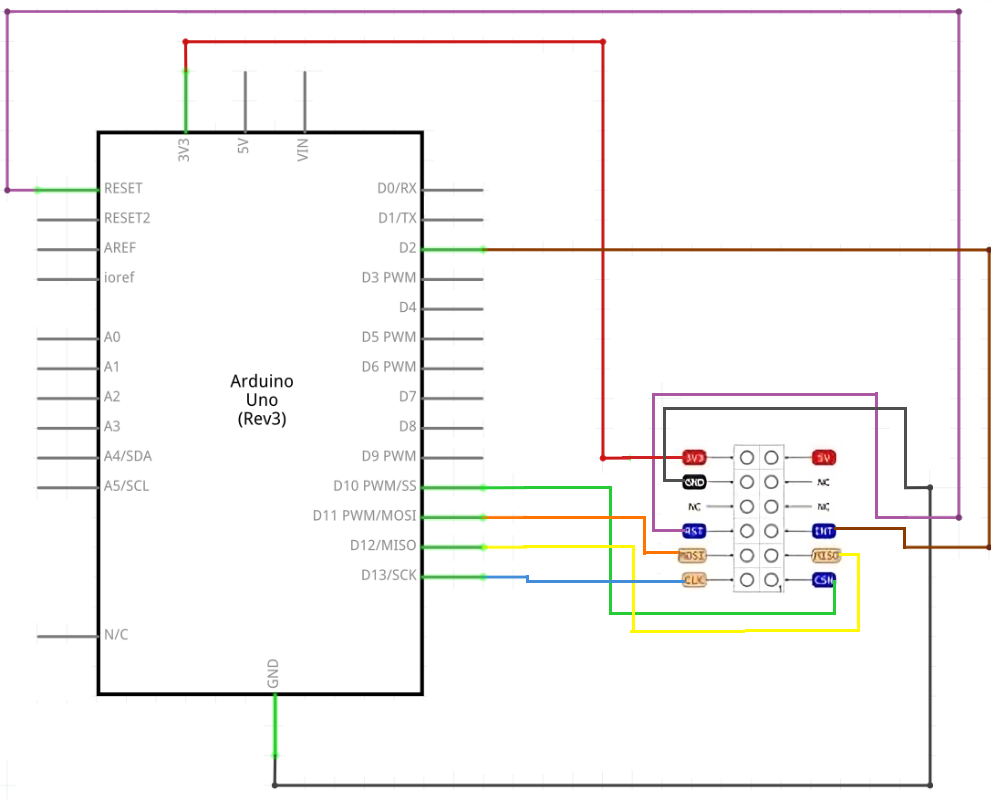
- VCC → 3.3V
- GND → GND
- MOSI → Pin 11
- MISO → Pin 12
- SCK → Pin 13
- CS → Pin 10 (or configurable, e.g., Pin 2 in some examples)
- RST → Optional reset pin
Library:
Applications:
- IoT Projects: Connect devices to cloud platforms and web servers.
- Home Automation: Enable remote monitoring and control systems.
- Industrial Automation: Facilitate communication between machines and controllers.
- Data Logging: Send and store data over Ethernet networks.
- Prototyping: Quickly build and test network-enabled embedded systems.
Circuit:
The module connects to the microcontroller using the SPI interface. Proper wiring of MOSI, MISO, SCK, and CS pins is required, along with stable power supply. Optional interrupt and reset pins can be used for advanced control.
Code:
 #include "SPI.h"
#include "Ethernet.h"
byte mac[] = { 0xDE, 0xAD, 0xBE, 0xEF, 0xFE, 0xED };
IPAddress ip(192, 168, 1, 177);
EthernetServer server(80);
void setup() {
Ethernet.begin(mac, ip);
server.begin();
}
void loop() {
EthernetClient client = server.available();
if (client) {
client.println("Hello from W5500!");
client.stop();
}
}
Technical Details:
- Ethernet Bandwidth: 10/100 Base-T/TX
- Internal Buffer Memory: 32KB
- Operating Voltage: 3.3V (5V tolerant I/O)
- Number of Sockets: 8
- Interface: SPI
- Ethernet Port: RJ45
- PCB Size: 17.5 x 68 mm
Resources:
Comparisons:
Compared to older Ethernet modules like the W5100, the W5500 offers double the internal buffer memory (32KB vs 16KB) and supports up to 8 simultaneous connections, improving performance in multi-client environments. It also reduces the processing load on the microcontroller thanks to its more efficient hardware TCP/IP stack, making it a superior choice for modern IoT and networking applications.
Features:
- Advanced W5500 Ethernet Chip with integrated TCP/IP stack
- SPI Interface for easy communication with microcontrollers
- 32KB Internal Buffer Memory for efficient data handling
- Supports up to 8 Simultaneous Socket Connections
- Compatible with Arduino (AVR), STM32, and ARM-based boards
- Supports 10/100 Base-T/TX Ethernet standards
- Operates at 3.3V logic with 5V tolerant I/O
- 8 Independent Socket Channels for parallel communication
- Compact PCB Design for easy integration into projects
Principle of Work:
The W5500 module works by handling all Ethernet communication through its built-in TCP/IP stack. The microcontroller communicates with the module via SPI, sending and receiving data packets. The W5500 processes network protocols such as TCP, UDP, IP, and ARP internally, reducing the workload on the microcontroller. Each of its 8 sockets can independently manage a network connection, enabling multiple simultaneous communications such as serving web pages or sending sensor data to servers.
Pinout:
- VCC: Power supply (3.3V)
- GND: Ground
- MOSI: SPI Master Out Slave In
- MISO: SPI Master In Slave Out
- SCK: SPI Clock
- CS: Chip Select (configurable)
- RST: Reset pin
- INT: Interrupt pin (optional)
Connections with Arduino UNO:
- VCC → 3.3V
- GND → GND
- MOSI → Pin 11
- MISO → Pin 12
- SCK → Pin 13
- CS → Pin 10 (or configurable, e.g., Pin 2 in some examples)
- RST → Optional reset pin
Library:
Applications:
- IoT Projects: Connect devices to cloud platforms and web servers.
- Home Automation: Enable remote monitoring and control systems.
- Industrial Automation: Facilitate communication between machines and controllers.
- Data Logging: Send and store data over Ethernet networks.
- Prototyping: Quickly build and test network-enabled embedded systems.
Circuit:
The module connects to the microcontroller using the SPI interface. Proper wiring of MOSI, MISO, SCK, and CS pins is required, along with stable power supply. Optional interrupt and reset pins can be used for advanced control.
Code:
 #include "SPI.h"
#include "Ethernet.h"
byte mac[] = { 0xDE, 0xAD, 0xBE, 0xEF, 0xFE, 0xED };
IPAddress ip(192, 168, 1, 177);
EthernetServer server(80);
void setup() {
Ethernet.begin(mac, ip);
server.begin();
}
void loop() {
EthernetClient client = server.available();
if (client) {
client.println("Hello from W5500!");
client.stop();
}
}
Technical Details:
- Ethernet Bandwidth: 10/100 Base-T/TX
- Internal Buffer Memory: 32KB
- Operating Voltage: 3.3V (5V tolerant I/O)
- Number of Sockets: 8
- Interface: SPI
- Ethernet Port: RJ45
- PCB Size: 17.5 x 68 mm
Resources:
Comparisons:
Compared to older Ethernet modules like the W5100, the W5500 offers double the internal buffer memory (32KB vs 16KB) and supports up to 8 simultaneous connections, improving performance in multi-client environments. It also reduces the processing load on the microcontroller thanks to its more efficient hardware TCP/IP stack, making it a superior choice for modern IoT and networking applications.