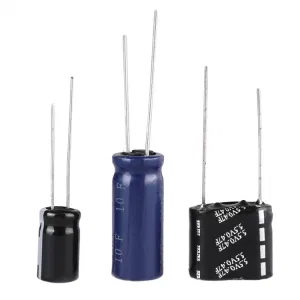
Features
- Capacitance 5 Farad
- Rated voltage 5 Volt
- Tolerance 20 percent
- High pulse power capability
- Low equivalent series resistance
- Low leakage current
- Cylindrical package design
Typical Applications
- Hold up power supplies
- Energy harvesting systems
- Battery backup circuits
- Pulse power applications
- Extended battery life solutions
Mechanical Dimensions
- Length 25 mm
- Width 12 mm
- Height 22 mm
Soldering Recommendations
When soldering supercapacitors to a printed circuit board the temperature and exposure time applied to the capacitor body can negatively affect performance. Only the capacitor leads should be soldered.
- Do not immerse the capacitor body in solder
- Avoid any contact between the capacitor body and molten solder
- Ensure the capacitor body does not touch the PCB or nearby components during soldering
- Excessive heat may cause case damage or reduced capacitor lifetime
Hand Soldering Guidelines
Keep sufficient distance between the capacitor body and the soldering iron tip. The soldering iron must never touch the capacitor body as this can permanently damage the component and alter its electrical characteristics.
- Maximum soldering iron temperature 350 degree Celsius
- Maximum contact time less than 4 seconds per lead
- Avoid repeated heating cycles on the terminals
Notes
Excessive heat transfer from the terminals to the capacitor body during soldering may significantly reduce performance and operating life. Proper soldering practices are essential for reliable operation.
Features
- Capacitance 5 Farad
- Rated voltage 5 Volt
- Tolerance 20 percent
- High pulse power capability
- Low equivalent series resistance
- Low leakage current
- Cylindrical package design
Typical Applications
- Hold up power supplies
- Energy harvesting systems
- Battery backup circuits
- Pulse power applications
- Extended battery life solutions
Mechanical Dimensions
- Length 25 mm
- Width 12 mm
- Height 22 mm
Soldering Recommendations
When soldering supercapacitors to a printed circuit board the temperature and exposure time applied to the capacitor body can negatively affect performance. Only the capacitor leads should be soldered.
- Do not immerse the capacitor body in solder
- Avoid any contact between the capacitor body and molten solder
- Ensure the capacitor body does not touch the PCB or nearby components during soldering
- Excessive heat may cause case damage or reduced capacitor lifetime
Hand Soldering Guidelines
Keep sufficient distance between the capacitor body and the soldering iron tip. The soldering iron must never touch the capacitor body as this can permanently damage the component and alter its electrical characteristics.
- Maximum soldering iron temperature 350 degree Celsius
- Maximum contact time less than 4 seconds per lead
- Avoid repeated heating cycles on the terminals
Notes
Excessive heat transfer from the terminals to the capacitor body during soldering may significantly reduce performance and operating life. Proper soldering practices are essential for reliable operation.