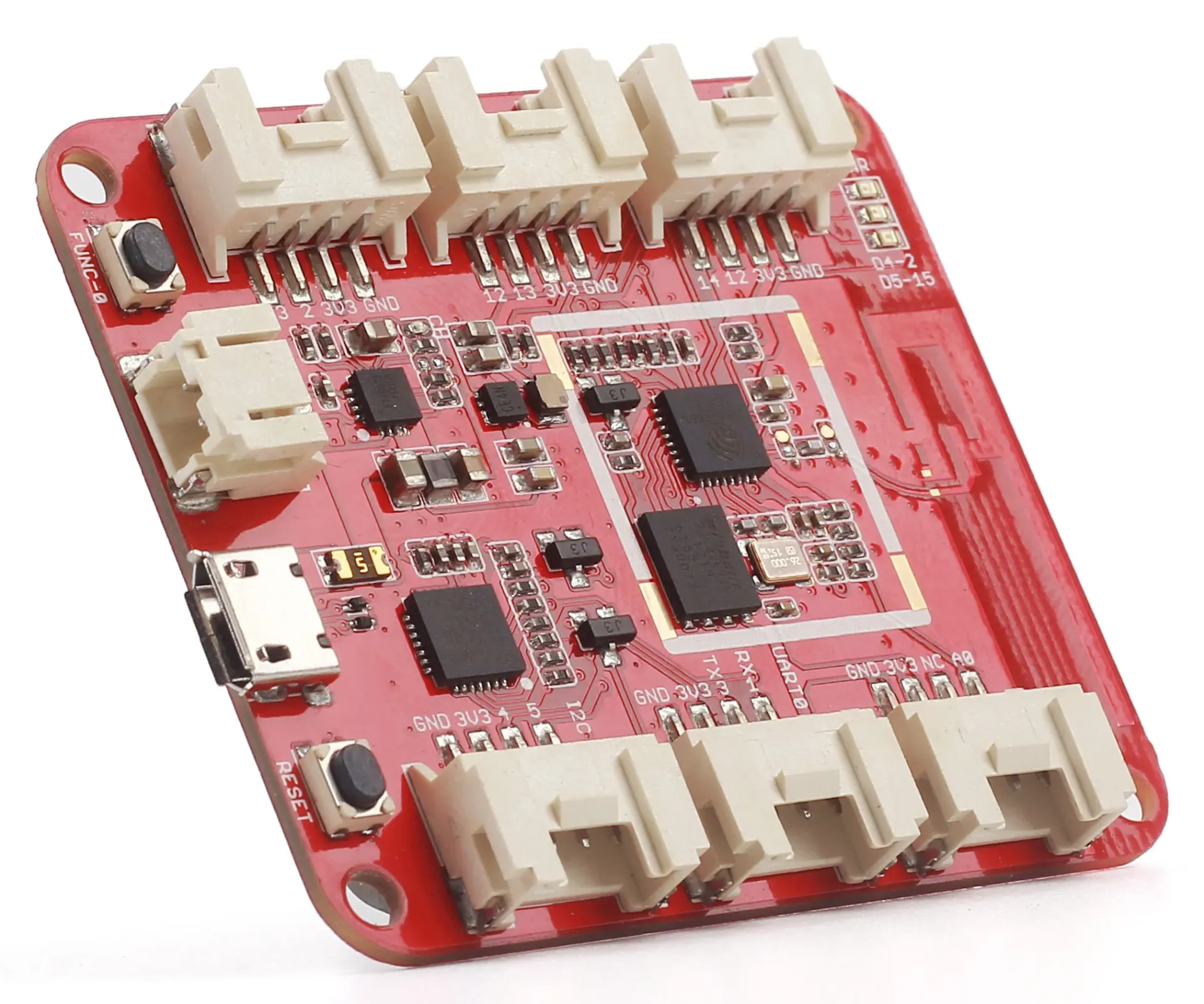
Features:
- No hardware programming, soldering, or breadboard required
- ESP8266-based Wi-Fi SoC for wireless connectivity
- Plug-and-play support for Grove modules
- Mobile app configuration (Android & iOS)
- Cloud-based compiling and OTA firmware updates
- Converts connected modules into RESTful APIs
- Supports a wide range of Grove sensors and actuators
- Built-in LiPo battery charging support
- Secure Wi-Fi communication (WEP/TKIP/AES)
- Compact and easy-to-integrate design

Principle of Work:

The Wio Link operates by connecting Grove modules directly to its onboard ports, which interface with the ESP8266 microcontroller. After configuration via the mobile app, each module is mapped to a virtual API endpoint.
When a command is sent from the mobile app or a web service, the cloud platform communicates with the Wio Link over Wi-Fi. The board processes the request, interacts with the connected module, and returns the result. This approach removes the need for embedded programming and simplifies IoT system development.
Pinout:

- Digital Port 0: GPIO14
- Digital Port 1: GPIO12
- Digital Port 2: GPIO13
- Analog Port: A3
- UART Port: TX/RX (Pin 1 & Pin 3)
- I2C Port: SCL/SDA (Pin 4 & Pin 5)
- Micro USB: Power supply and communication
- Battery Connector: JST 2.0 for LiPo battery
- Reset Button: Resets the device
- Configure Button: Used for setup
Applications:
- Smart home automation
- Environmental monitoring systems
- IoT prototyping and development
- Wireless sensor networks
- Educational IoT projects
- Web-based device control
Technical Details:
- Microcontroller: ESP8266
- Flash Memory: 4MB (W25Q32B)
- Wi-Fi Protocol: 802.11 b/g/n
- Wi-Fi Security: WEP/TKIP/AES
- Operating Voltage: 3.3V
- Input Voltage (USB): 5V
- Input Voltage (Battery): 3.4V – 4.2V
- Output Current: Up to 1000mA
- Charge Current: Up to 500mA
- DC Current per I/O Pin: 12mA
- Crystal Frequency: 26MHz
- Grove Connectors: 6
- Dimensions: 55mm × 48mm
Resorces:
Comparisons:
Compared to traditional development boards like Arduino or standard ESP8266 modules, the Wio Link simplifies IoT development by eliminating manual wiring and programming. It provides a plug-and-play solution with cloud integration, making it faster to deploy projects.
Compared to other IoT platforms, it stands out with its RESTful API-based approach and mobile app control, allowing users to quickly create connected applications without deep technical knowledge.
Features:
- No hardware programming, soldering, or breadboard required
- ESP8266-based Wi-Fi SoC for wireless connectivity
- Plug-and-play support for Grove modules
- Mobile app configuration (Android & iOS)
- Cloud-based compiling and OTA firmware updates
- Converts connected modules into RESTful APIs
- Supports a wide range of Grove sensors and actuators
- Built-in LiPo battery charging support
- Secure Wi-Fi communication (WEP/TKIP/AES)
- Compact and easy-to-integrate design
Principle of Work:
The Wio Link operates by connecting Grove modules directly to its onboard ports, which interface with the ESP8266 microcontroller. After configuration via the mobile app, each module is mapped to a virtual API endpoint.
When a command is sent from the mobile app or a web service, the cloud platform communicates with the Wio Link over Wi-Fi. The board processes the request, interacts with the connected module, and returns the result. This approach removes the need for embedded programming and simplifies IoT system development.
Pinout:
- Digital Port 0: GPIO14
- Digital Port 1: GPIO12
- Digital Port 2: GPIO13
- Analog Port: A3
- UART Port: TX/RX (Pin 1 & Pin 3)
- I2C Port: SCL/SDA (Pin 4 & Pin 5)
- Micro USB: Power supply and communication
- Battery Connector: JST 2.0 for LiPo battery
- Reset Button: Resets the device
- Configure Button: Used for setup
Applications:
- Smart home automation
- Environmental monitoring systems
- IoT prototyping and development
- Wireless sensor networks
- Educational IoT projects
- Web-based device control
Technical Details:
- Microcontroller: ESP8266
- Flash Memory: 4MB (W25Q32B)
- Wi-Fi Protocol: 802.11 b/g/n
- Wi-Fi Security: WEP/TKIP/AES
- Operating Voltage: 3.3V
- Input Voltage (USB): 5V
- Input Voltage (Battery): 3.4V – 4.2V
- Output Current: Up to 1000mA
- Charge Current: Up to 500mA
- DC Current per I/O Pin: 12mA
- Crystal Frequency: 26MHz
- Grove Connectors: 6
- Dimensions: 55mm × 48mm
Resorces:
Comparisons:
Compared to traditional development boards like Arduino or standard ESP8266 modules, the Wio Link simplifies IoT development by eliminating manual wiring and programming. It provides a plug-and-play solution with cloud integration, making it faster to deploy projects.
Compared to other IoT platforms, it stands out with its RESTful API-based approach and mobile app control, allowing users to quickly create connected applications without deep technical knowledge.