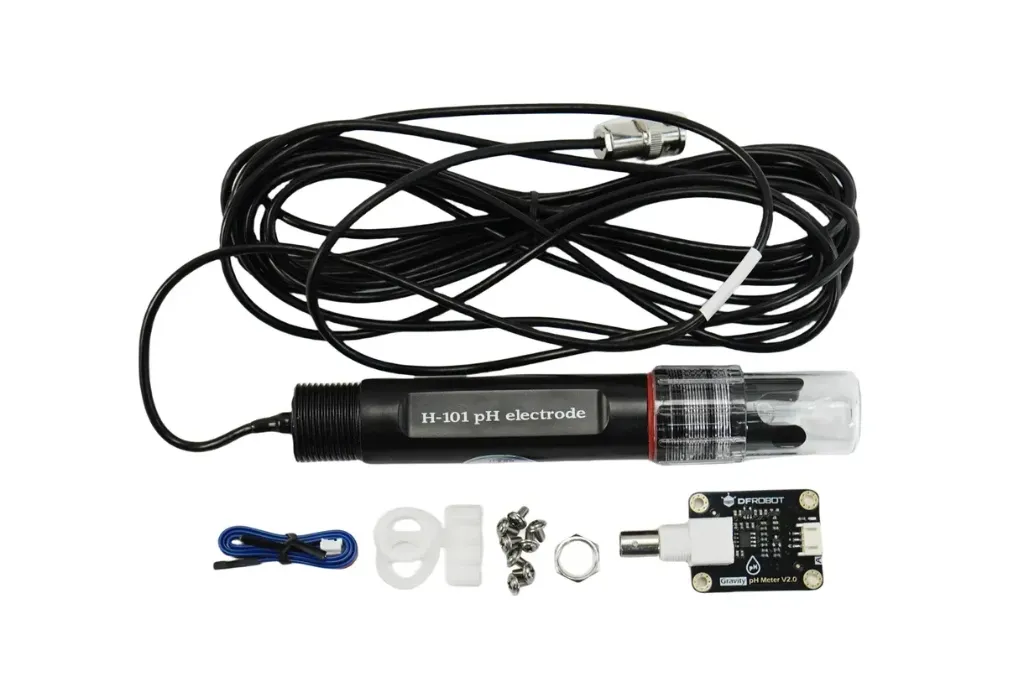
Features
- Upgraded V2 Hardware: Includes an onboard voltage regulator supporting a 3.3V to 5.5V input supply.
- 3.3V and 5V Compatibility: Suitable for both 3.3V and 5V microcontroller platforms.
- Hardware Signal Filtering: Active hardware filtering helps reduce signal noise and measurement jitter for more stable analog readings.
- Industrial-Grade pH Probe: Designed for long-term use and continuous water-quality monitoring.
- PTFE Membrane: The probe incorporates a PTFE membrane designed to resist clogging during extended operation.
- Wide Measurement Range: Measures pH values from 0 to 14.
- Analog Output: Provides a 0 to 3.0V analog output signal that can be read by a compatible ADC.
- BNC Probe Connection: Uses a waterproof BNC-style connector for convenient probe connection.
- Two-Point Calibration: Supports calibration using standard pH 4.0 and pH 7.0 buffer solutions.
- Open-Source Support: Can be integrated into custom monitoring systems using compatible software libraries and microcontrollers.
Principle of Operation
A pH electrode measures the electrical potential generated by the difference in hydrogen-ion activity between the sample solution and the electrode's reference system. The pH interface board conditions this very small electrical signal and converts it into an analog voltage suitable for measurement by a microcontroller ADC.
The V2 interface board incorporates power regulation and hardware signal filtering to provide a cleaner and more stable output signal. The connected controller reads the analog voltage and converts the measured value into a pH reading using the appropriate calibration parameters.
Because pH electrodes can vary slightly from one probe to another, calibration is required for accurate measurements. A common two-point calibration procedure uses standard pH 4.0 and pH 7.0 buffer solutions.
Calibration
Proper calibration is essential for obtaining reliable pH measurements. The probe should be calibrated using known standard buffer solutions before precision measurements are performed.
| Calibration Point | Purpose |
|---|---|
| pH 7.0 | Neutral reference point and primary calibration point. |
| pH 4.0 | Acidic reference point used for two-point calibration and slope adjustment. |
For best results, use fresh calibration solutions and rinse the electrode appropriately between calibration points to avoid cross-contamination.
Applications
- Water quality monitoring
- Aquaponics systems
- Aquaculture systems
- Hydroponics and nutrient-water monitoring
- Environmental water testing
- Laboratory and educational experiments
- IoT water-quality monitoring systems
- Arduino pH monitoring projects
- ESP32 water-quality monitoring projects
- Raspberry Pi data-logging systems
- Long-term online pH monitoring
Pinout and Connections

| Connection | Description |
|---|---|
| VCC | 3.3V to 5.5V DC power input. |
| GND | Ground connection to the microcontroller. |
| PO / Analog Output | Analog pH measurement output, approximately 0 to 3.0V. |
| BNC | Connection for the supplied pH electrode. |
Wiring
The pH interface board can be connected directly to a compatible microcontroller using its power and analog output connections.

| pH Meter Pro V2 | Arduino / Microcontroller |
|---|---|
| VCC | 3.3V or 5V compatible supply |
| GND | GND |
| Analog Output | Compatible analog input / ADC pin |
| BNC | pH Probe |
The analog output of the SEN0169-V2 can be connected to an Arduino analog input. The Arduino reads the output voltage using its ADC and converts the calibrated voltage into a corresponding pH value.
When developing a pH monitoring application, it is recommended to perform calibration first and then apply the calibration parameters in the software. The measured pH can be displayed on an LCD/OLED, logged to an SD card, or transmitted through Wi-Fi or other communication interfaces.
Technical Specifications
| Specification | Details |
|---|---|
| Brand / Manufacturer | DFRobot |
| Product Series | Gravity |
| Model Number | SEN0169-V2 |
| Sensor Type | Analog pH Sensor |
| Measurement Range | 0 to 14 pH |
| Measurement Accuracy | ±0.1 pH at 25°C |
| Operating Voltage | 3.3V to 5.5V DC |
| Output Signal | Analog |
| Output Voltage Range | 0 to 3.0V |
| Probe Connector | BNC |
| Calibration | Two-point calibration using pH 4.0 and pH 7.0 buffers |
Important Maintenance Notes
- Always calibrate the probe before precision measurements.
- Use appropriate standard buffer solutions for calibration.
- Rinse the electrode between different solutions to reduce contamination.
- Do not allow the electronic interface board to come into contact with water.
- Store and maintain the pH electrode according to the manufacturer's recommended storage procedure.
- The stated accuracy is dependent on calibration, temperature, probe condition, and the characteristics of the measured solution.
Resources
- Product Wiki
- [Read the 2026 Hydroponic Monitoring Guide] — Expert tips on sensor selection and system design.
- [Explore Smart Hydroponics Projects] — See how others integrated this sensor into their setup.
- [Get Troubleshooting Help] — Search technical discussions and fixes for this pH sensor.
Features
- Upgraded V2 Hardware: Includes an onboard voltage regulator supporting a 3.3V to 5.5V input supply.
- 3.3V and 5V Compatibility: Suitable for both 3.3V and 5V microcontroller platforms.
- Hardware Signal Filtering: Active hardware filtering helps reduce signal noise and measurement jitter for more stable analog readings.
- Industrial-Grade pH Probe: Designed for long-term use and continuous water-quality monitoring.
- PTFE Membrane: The probe incorporates a PTFE membrane designed to resist clogging during extended operation.
- Wide Measurement Range: Measures pH values from 0 to 14.
- Analog Output: Provides a 0 to 3.0V analog output signal that can be read by a compatible ADC.
- BNC Probe Connection: Uses a waterproof BNC-style connector for convenient probe connection.
- Two-Point Calibration: Supports calibration using standard pH 4.0 and pH 7.0 buffer solutions.
- Open-Source Support: Can be integrated into custom monitoring systems using compatible software libraries and microcontrollers.
Principle of Operation
A pH electrode measures the electrical potential generated by the difference in hydrogen-ion activity between the sample solution and the electrode's reference system. The pH interface board conditions this very small electrical signal and converts it into an analog voltage suitable for measurement by a microcontroller ADC.
The V2 interface board incorporates power regulation and hardware signal filtering to provide a cleaner and more stable output signal. The connected controller reads the analog voltage and converts the measured value into a pH reading using the appropriate calibration parameters.
Because pH electrodes can vary slightly from one probe to another, calibration is required for accurate measurements. A common two-point calibration procedure uses standard pH 4.0 and pH 7.0 buffer solutions.
Calibration
Proper calibration is essential for obtaining reliable pH measurements. The probe should be calibrated using known standard buffer solutions before precision measurements are performed.
| Calibration Point | Purpose |
|---|---|
| pH 7.0 | Neutral reference point and primary calibration point. |
| pH 4.0 | Acidic reference point used for two-point calibration and slope adjustment. |
For best results, use fresh calibration solutions and rinse the electrode appropriately between calibration points to avoid cross-contamination.
Applications
- Water quality monitoring
- Aquaponics systems
- Aquaculture systems
- Hydroponics and nutrient-water monitoring
- Environmental water testing
- Laboratory and educational experiments
- IoT water-quality monitoring systems
- Arduino pH monitoring projects
- ESP32 water-quality monitoring projects
- Raspberry Pi data-logging systems
- Long-term online pH monitoring
Pinout and Connections
| Connection | Description |
|---|---|
| VCC | 3.3V to 5.5V DC power input. |
| GND | Ground connection to the microcontroller. |
| PO / Analog Output | Analog pH measurement output, approximately 0 to 3.0V. |
| BNC | Connection for the supplied pH electrode. |
Wiring
The pH interface board can be connected directly to a compatible microcontroller using its power and analog output connections.
| pH Meter Pro V2 | Arduino / Microcontroller |
|---|---|
| VCC | 3.3V or 5V compatible supply |
| GND | GND |
| Analog Output | Compatible analog input / ADC pin |
| BNC | pH Probe |
The analog output of the SEN0169-V2 can be connected to an Arduino analog input. The Arduino reads the output voltage using its ADC and converts the calibrated voltage into a corresponding pH value.
When developing a pH monitoring application, it is recommended to perform calibration first and then apply the calibration parameters in the software. The measured pH can be displayed on an LCD/OLED, logged to an SD card, or transmitted through Wi-Fi or other communication interfaces.
Technical Specifications
| Specification | Details |
|---|---|
| Brand / Manufacturer | DFRobot |
| Product Series | Gravity |
| Model Number | SEN0169-V2 |
| Sensor Type | Analog pH Sensor |
| Measurement Range | 0 to 14 pH |
| Measurement Accuracy | ±0.1 pH at 25°C |
| Operating Voltage | 3.3V to 5.5V DC |
| Output Signal | Analog |
| Output Voltage Range | 0 to 3.0V |
| Probe Connector | BNC |
| Calibration | Two-point calibration using pH 4.0 and pH 7.0 buffers |
Important Maintenance Notes
- Always calibrate the probe before precision measurements.
- Use appropriate standard buffer solutions for calibration.
- Rinse the electrode between different solutions to reduce contamination.
- Do not allow the electronic interface board to come into contact with water.
- Store and maintain the pH electrode according to the manufacturer's recommended storage procedure.
- The stated accuracy is dependent on calibration, temperature, probe condition, and the characteristics of the measured solution.