Features
- 26 TOPS AI Performance: Delivers up to 26 tera-operations per second of AI inference performance.
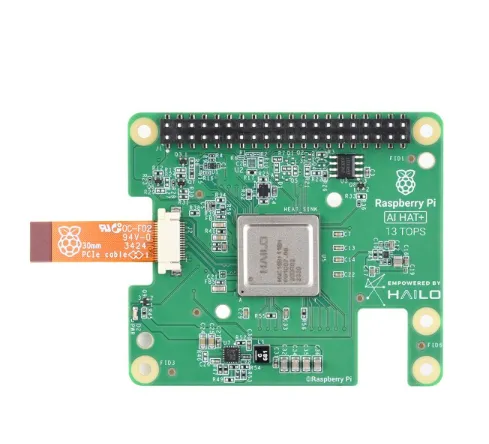
- Built-In Hailo-8 Accelerator: Integrates the Hailo-8 neural network accelerator directly onto the AI HAT+ PCB.
- Designed for Raspberry Pi 5: Specifically developed as an AI accelerator add-on for Raspberry Pi 5.
- PCIe Gen 3 Connectivity: Uses the Raspberry Pi 5's PCIe interface to provide high-speed communication between the host computer and AI accelerator.
- Edge AI Processing: Performs supported AI inference locally without requiring a remote cloud service.
- Computer Vision Acceleration: Suitable for object detection, image segmentation, pose estimation, and other neural-network-based vision applications.
- Multiple AI Networks: The 26 TOPS version can run larger networks faster and is better suited to running multiple neural networks simultaneously than the 13 TOPS version.
- Camera Software Integration: Integrates with Raspberry Pi's camera software stack and supported rpicam-apps and Picamera2 workflows.
- HAT+ Standard: Conforms to the Raspberry Pi HAT+ specification.
- Compact Integrated Design: The Hailo accelerator is mounted directly on the main PCB, eliminating the separate M.2 accelerator module used by the older AI Kit.
- Low-Latency AI: Local processing helps reduce the latency associated with sending camera or sensor data to remote servers.
Principle of Operation
The Raspberry Pi AI HAT+ adds a dedicated Hailo-8 Neural Processing Unit to a Raspberry Pi 5. Instead of requiring the Raspberry Pi CPU to perform all neural-network calculations, supported AI models can be offloaded to the Hailo accelerator.
The Raspberry Pi 5 communicates with the AI HAT+ through the PCIe Gen 3 interface. The host system supplies input data and AI models to the accelerator, while the Hailo-8 performs the computationally intensive neural-network inference operations.
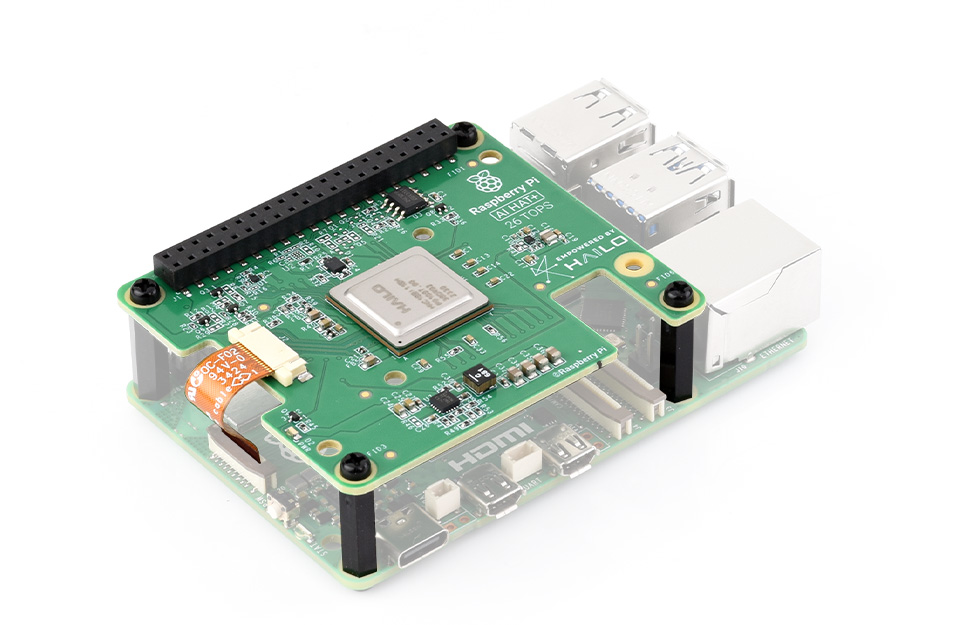
This architecture allows the Raspberry Pi 5 to remain available for other application tasks while the dedicated NPU handles supported AI inference workloads. Raspberry Pi OS can automatically detect the Hailo accelerator when the required software components are installed and configured.
AI Capabilities
| AI Workload | Example Application |
|---|---|
| Object Detection | Detect people, vehicles, products, animals, tools, and other objects in camera images. |
| Image Segmentation | Identify and classify individual regions or objects within an image. |
| Pose Estimation | Track human body positions and key points for interactive and robotics applications. |
| Computer Vision | Build real-time camera-based AI applications and vision processing systems. |
| Multiple Models | Run multiple supported neural-network workloads concurrently. |
Applications
- Artificial intelligence and machine learning projects
- Real-time object detection
- Computer vision systems
- AI-powered security cameras
- Smart surveillance systems
- People and vehicle detection
- Robotics and autonomous systems
- Industrial process monitoring
- Quality inspection systems
- Smart home automation
- Retail and inventory monitoring
- Gesture and pose recognition
- Edge AI and IoT applications
- Educational AI and computer vision projects
Hardware Interface
| Interface | Description |
|---|---|
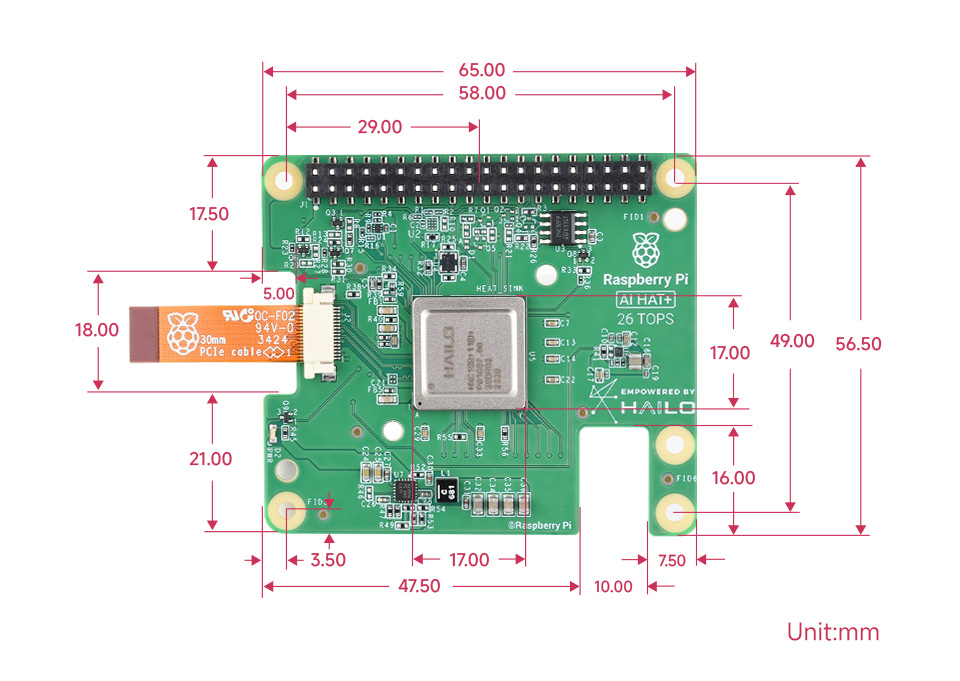
| PCIe | High-speed connection between the Raspberry Pi 5 and the Hailo-8 accelerator. |
| GPIO Header | 16mm stacking header allows the AI HAT+ to be mounted above the Raspberry Pi 5 while maintaining GPIO access. |
| Hailo-8 | Integrated neural network inference accelerator providing up to 26 TOPS. |
Installation and Wiring
The Raspberry Pi AI HAT+ is installed on top of a compatible Raspberry Pi 5 using the supplied stacking hardware. The accelerator communicates with the Raspberry Pi through its PCIe interface.
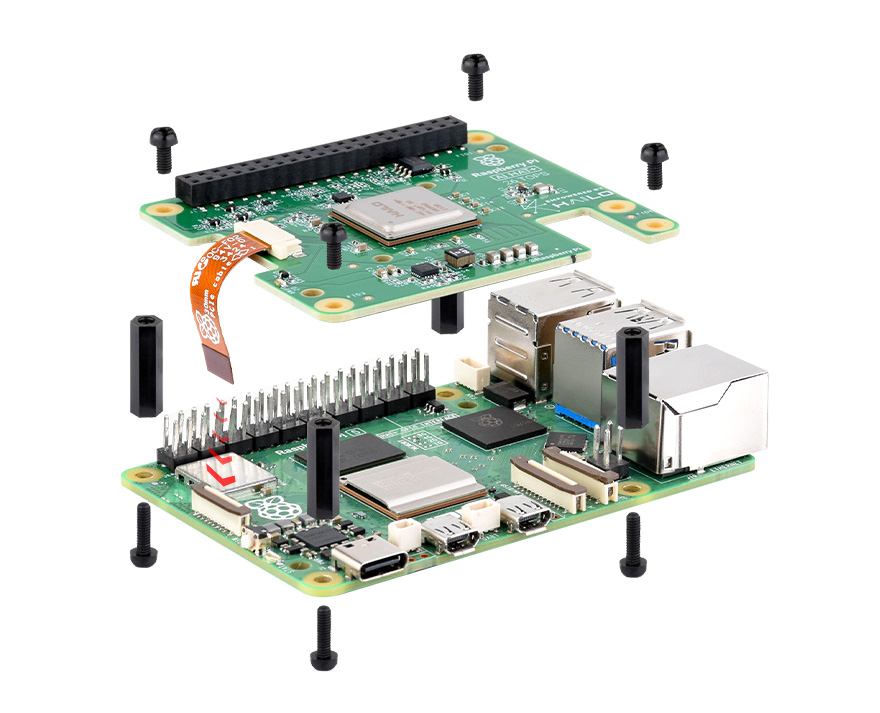
For AI vision applications, a compatible Raspberry Pi camera can be connected to the Raspberry Pi 5 separately. The camera captures the image data while supported AI processing is performed by the Hailo-8 accelerator.
| Component | Connection |
|---|---|
| AI HAT+ | Mounted directly above Raspberry Pi 5 using the supplied GPIO stacking hardware. |
| PCIe Interface | Connects the Hailo-8 accelerator to Raspberry Pi 5. |
| Camera | Connects to a compatible Raspberry Pi camera interface when using vision AI applications. |
Software and AI Framework Support
The Raspberry Pi AI HAT+ is integrated into Raspberry Pi's AI software ecosystem. With a supported Raspberry Pi OS installation and the required Hailo software components, the Raspberry Pi 5 can detect the onboard accelerator and make it available for supported AI workloads.
Raspberry Pi's camera software stack, including rpicam-apps and Picamera2, can use the Hailo NPU for supported AI post-processing tasks such as object detection and other computer vision workloads.
The platform can also be used with common machine-learning frameworks and tools, including TensorFlow and PyTorch, when used with compatible Hailo models and software components.
Technical Specifications
| Specification | Details |
|---|---|
| Brand | Raspberry Pi |
| Product | Raspberry Pi AI HAT+ |
| Performance Variant | 26 TOPS |
| AI Accelerator | Hailo-8 Neural Processing Unit |
| Inference Performance | Up to 26 TOPS |
| AI Precision | INT8 inference |
| Host Platform | Raspberry Pi 5 |
| Host Interface | PCIe Gen 3 |
| HAT Standard | Raspberry Pi HAT+ |
| Operating Temperature | 0°C to 50°C ambient |
| Mounting Hardware | 16mm stacking header, spacers, and screws |
Important Notes
- Raspberry Pi 5 Required: The Raspberry Pi AI HAT+ is designed for use with Raspberry Pi 5.
- 26 TOPS Version: This product uses the Hailo-8 accelerator. The separate 13 TOPS AI HAT+ version uses the Hailo-8L accelerator.
- AI Models Required: The accelerator does not automatically accelerate every AI model. Supported models and the appropriate Hailo software stack are required.
- Vision AI: A compatible Raspberry Pi camera is required for camera-based computer vision applications.
- Power Supply: Use an appropriate Raspberry Pi 5 power supply, particularly when operating the Raspberry Pi with additional peripherals and AI workloads.
- Operating System: Use a current supported Raspberry Pi OS release and install the required Hailo software components for AI acceleration.
- Generative AI: The AI HAT+ is intended primarily for neural-network inference and computer vision workloads. It does not provide the local LLM/VLM capabilities of the newer AI HAT+ 2.
Resources
Features
- 26 TOPS AI Performance: Delivers up to 26 tera-operations per second of AI inference performance.
- Built-In Hailo-8 Accelerator: Integrates the Hailo-8 neural network accelerator directly onto the AI HAT+ PCB.
- Designed for Raspberry Pi 5: Specifically developed as an AI accelerator add-on for Raspberry Pi 5.
- PCIe Gen 3 Connectivity: Uses the Raspberry Pi 5's PCIe interface to provide high-speed communication between the host computer and AI accelerator.
- Edge AI Processing: Performs supported AI inference locally without requiring a remote cloud service.
- Computer Vision Acceleration: Suitable for object detection, image segmentation, pose estimation, and other neural-network-based vision applications.
- Multiple AI Networks: The 26 TOPS version can run larger networks faster and is better suited to running multiple neural networks simultaneously than the 13 TOPS version.
- Camera Software Integration: Integrates with Raspberry Pi's camera software stack and supported rpicam-apps and Picamera2 workflows.
- HAT+ Standard: Conforms to the Raspberry Pi HAT+ specification.
- Compact Integrated Design: The Hailo accelerator is mounted directly on the main PCB, eliminating the separate M.2 accelerator module used by the older AI Kit.
- Low-Latency AI: Local processing helps reduce the latency associated with sending camera or sensor data to remote servers.
Principle of Operation
The Raspberry Pi AI HAT+ adds a dedicated Hailo-8 Neural Processing Unit to a Raspberry Pi 5. Instead of requiring the Raspberry Pi CPU to perform all neural-network calculations, supported AI models can be offloaded to the Hailo accelerator.
The Raspberry Pi 5 communicates with the AI HAT+ through the PCIe Gen 3 interface. The host system supplies input data and AI models to the accelerator, while the Hailo-8 performs the computationally intensive neural-network inference operations.
This architecture allows the Raspberry Pi 5 to remain available for other application tasks while the dedicated NPU handles supported AI inference workloads. Raspberry Pi OS can automatically detect the Hailo accelerator when the required software components are installed and configured.
AI Capabilities
| AI Workload | Example Application |
|---|---|
| Object Detection | Detect people, vehicles, products, animals, tools, and other objects in camera images. |
| Image Segmentation | Identify and classify individual regions or objects within an image. |
| Pose Estimation | Track human body positions and key points for interactive and robotics applications. |
| Computer Vision | Build real-time camera-based AI applications and vision processing systems. |
| Multiple Models | Run multiple supported neural-network workloads concurrently. |
Applications
- Artificial intelligence and machine learning projects
- Real-time object detection
- Computer vision systems
- AI-powered security cameras
- Smart surveillance systems
- People and vehicle detection
- Robotics and autonomous systems
- Industrial process monitoring
- Quality inspection systems
- Smart home automation
- Retail and inventory monitoring
- Gesture and pose recognition
- Edge AI and IoT applications
- Educational AI and computer vision projects
Hardware Interface
| Interface | Description |
|---|---|
| PCIe | High-speed connection between the Raspberry Pi 5 and the Hailo-8 accelerator. |
| GPIO Header | 16mm stacking header allows the AI HAT+ to be mounted above the Raspberry Pi 5 while maintaining GPIO access. |
| Hailo-8 | Integrated neural network inference accelerator providing up to 26 TOPS. |
Installation and Wiring
The Raspberry Pi AI HAT+ is installed on top of a compatible Raspberry Pi 5 using the supplied stacking hardware. The accelerator communicates with the Raspberry Pi through its PCIe interface.
For AI vision applications, a compatible Raspberry Pi camera can be connected to the Raspberry Pi 5 separately. The camera captures the image data while supported AI processing is performed by the Hailo-8 accelerator.
| Component | Connection |
|---|---|
| AI HAT+ | Mounted directly above Raspberry Pi 5 using the supplied GPIO stacking hardware. |
| PCIe Interface | Connects the Hailo-8 accelerator to Raspberry Pi 5. |
| Camera | Connects to a compatible Raspberry Pi camera interface when using vision AI applications. |
Software and AI Framework Support
The Raspberry Pi AI HAT+ is integrated into Raspberry Pi's AI software ecosystem. With a supported Raspberry Pi OS installation and the required Hailo software components, the Raspberry Pi 5 can detect the onboard accelerator and make it available for supported AI workloads.
Raspberry Pi's camera software stack, including rpicam-apps and Picamera2, can use the Hailo NPU for supported AI post-processing tasks such as object detection and other computer vision workloads.
The platform can also be used with common machine-learning frameworks and tools, including TensorFlow and PyTorch, when used with compatible Hailo models and software components.
Technical Specifications
| Specification | Details |
|---|---|
| Brand | Raspberry Pi |
| Product | Raspberry Pi AI HAT+ |
| Performance Variant | 26 TOPS |
| AI Accelerator | Hailo-8 Neural Processing Unit |
| Inference Performance | Up to 26 TOPS |
| AI Precision | INT8 inference |
| Host Platform | Raspberry Pi 5 |
| Host Interface | PCIe Gen 3 |
| HAT Standard | Raspberry Pi HAT+ |
| Operating Temperature | 0°C to 50°C ambient |
| Mounting Hardware | 16mm stacking header, spacers, and screws |
Important Notes
- Raspberry Pi 5 Required: The Raspberry Pi AI HAT+ is designed for use with Raspberry Pi 5.
- 26 TOPS Version: This product uses the Hailo-8 accelerator. The separate 13 TOPS AI HAT+ version uses the Hailo-8L accelerator.
- AI Models Required: The accelerator does not automatically accelerate every AI model. Supported models and the appropriate Hailo software stack are required.
- Vision AI: A compatible Raspberry Pi camera is required for camera-based computer vision applications.
- Power Supply: Use an appropriate Raspberry Pi 5 power supply, particularly when operating the Raspberry Pi with additional peripherals and AI workloads.
- Operating System: Use a current supported Raspberry Pi OS release and install the required Hailo software components for AI acceleration.
- Generative AI: The AI HAT+ is intended primarily for neural-network inference and computer vision workloads. It does not provide the local LLM/VLM capabilities of the newer AI HAT+ 2.
Resources