Features
- Solar Power Generation: Converts sunlight into electrical energy.
- Compact Design: Slim construction for integration into small projects and enclosures.
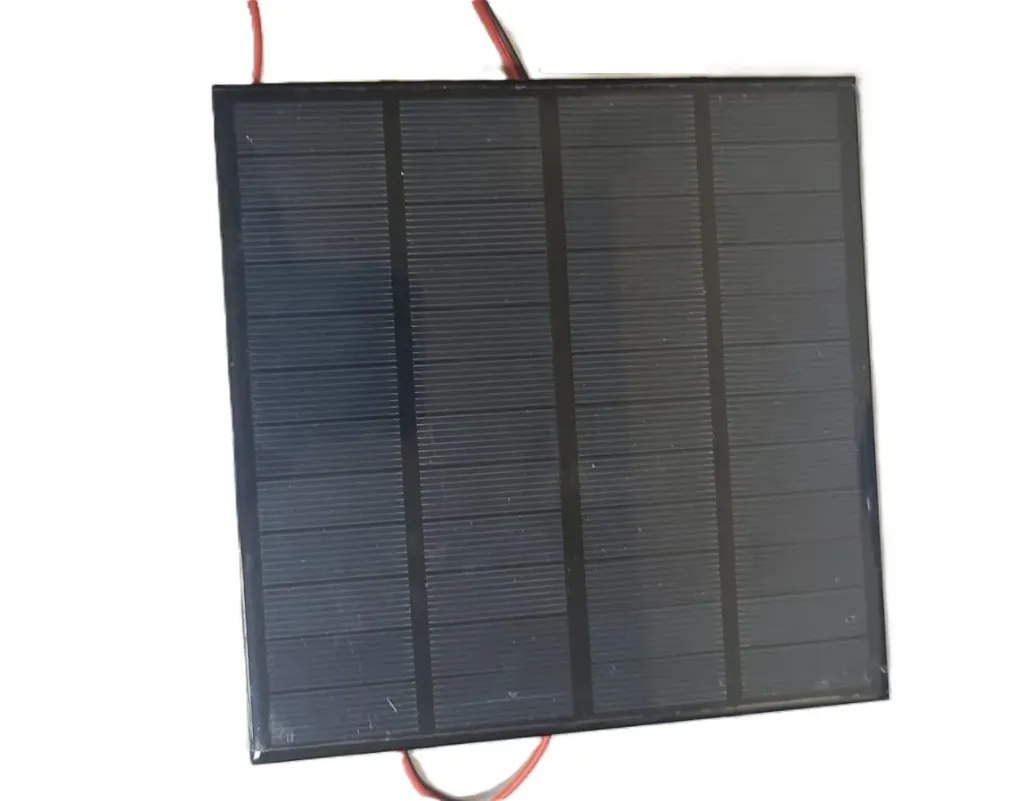
- Pre-Attached Wires: Positive and negative leads simplify electrical connections.
- Outdoor Applications: Suitable for projects designed to operate using solar energy.
- Renewable Energy Source: Provides electricity without requiring a continuous mains power supply.
Principle of Operation
The photovoltaic cells generate DC electricity when exposed to sunlight. The actual output voltage and current depend on sunlight intensity, panel temperature, and the connected load.
Applications
- Small solar-powered electronics
- Educational and STEM projects
- Low-power outdoor lighting projects
- Wireless sensor and monitoring systems
- Small DC motor and fan projects
- Solar battery charging systems when used with a suitable charge controller
Wiring

Connect the panel's positive wire to the positive input of the load or charging circuit, and the negative wire to the negative input. For charging rechargeable batteries, use a compatible solar charge controller suited to the battery chemistry and voltage. Do not connect the panel directly to a battery unless the charging method is specifically designed for that battery.
Specifications
- Maximum Power (Pmax): 3.5W
- Operating Voltage (Vmp): 12V, as stated in the supplied specifications
- Operating Current (Imp): 250mA, as stated in the supplied specifications
- Cell Type: Monocrystalline or polycrystalline silicon; exact type requires confirmation
- Output: DC
- Connection: Pre-attached positive and negative wires
Note: The supplied specifications list 3.5W, 12V, and 250mA. However, 12V × 250mA equals 3W, not 3.5W. Confirm the panel's rated voltage, current, and cell type with the supplier before publishing the final specifications.
Features
- Solar Power Generation: Converts sunlight into electrical energy.
- Compact Design: Slim construction for integration into small projects and enclosures.
- Pre-Attached Wires: Positive and negative leads simplify electrical connections.
- Outdoor Applications: Suitable for projects designed to operate using solar energy.
- Renewable Energy Source: Provides electricity without requiring a continuous mains power supply.
Principle of Operation
The photovoltaic cells generate DC electricity when exposed to sunlight. The actual output voltage and current depend on sunlight intensity, panel temperature, and the connected load.
Applications
- Small solar-powered electronics
- Educational and STEM projects
- Low-power outdoor lighting projects
- Wireless sensor and monitoring systems
- Small DC motor and fan projects
- Solar battery charging systems when used with a suitable charge controller
Wiring
Connect the panel's positive wire to the positive input of the load or charging circuit, and the negative wire to the negative input. For charging rechargeable batteries, use a compatible solar charge controller suited to the battery chemistry and voltage. Do not connect the panel directly to a battery unless the charging method is specifically designed for that battery.
Specifications
- Maximum Power (Pmax): 3.5W
- Operating Voltage (Vmp): 12V, as stated in the supplied specifications
- Operating Current (Imp): 250mA, as stated in the supplied specifications
- Cell Type: Monocrystalline or polycrystalline silicon; exact type requires confirmation
- Output: DC
- Connection: Pre-attached positive and negative wires
Note: The supplied specifications list 3.5W, 12V, and 250mA. However, 12V × 250mA equals 3W, not 3.5W. Confirm the panel's rated voltage, current, and cell type with the supplier before publishing the final specifications.