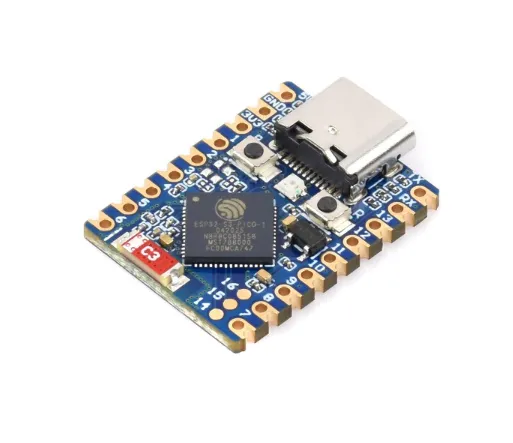
Features:
- ESP32-S3 dual-core Xtensa 32-bit LX7 processor, up to 240MHz
- 8MB Flash memory and 8MB PSRAM
- 2.4GHz Wi-Fi supporting IEEE 802.11 b/g/n
- Bluetooth 5 Low Energy (BLE)
- 24 GPIO pins with configurable functions, subject to pin availability and board design
- USB Type-C port for programming, debugging and USB communication
- Onboard ceramic Wi-Fi/Bluetooth antenna
- Onboard WS2812 RGB LED
- BOOT and RESET buttons
- Castellated edges for direct PCB integration
- Supports Arduino IDE, ESP-IDF and MicroPython
- Low-power operating modes for suitable battery-powered applications
Principle of Operation:
The ESP32-S3 integrates processing, wireless communication and peripheral interfaces in a compact microcontroller platform. The processor executes the application firmware and communicates with external devices through GPIO, UART, SPI, I2C, I2S and ADC interfaces.

Wi-Fi enables network communication with local servers, web interfaces and other networked devices. Bluetooth Low Energy supports short-range wireless communication with compatible devices. The USB Type-C interface provides access to the chip's native USB functionality for firmware programming and communication.
Library:
- Arduino IDE: ESP32 board support package by Espressif Systems.
- ESP-IDF: Espressif's official development framework for ESP32-S3.
- MicroPython: Compatible ESP32-S3 firmware and supporting tools.
- WS2812 RGB LED: A compatible LED library, such as Adafruit NeoPixel, when controlling the onboard RGB LED.
Simple Code:
Example for Arduino IDE to blink the onboard WS2812 RGB LED using the Adafruit NeoPixel library. The onboard LED data line is connected to GPIO21.
#include <Adafruit_NeoPixel.h>

#define LED_PIN 21
#define LED_COUNT 1

Adafruit_NeoPixel led(
  LED_COUNT,
  LED_PIN,
  NEO_GRB + NEO_KHZ800
);

void setup() {
  led.begin();
  led.clear();
  led.show();
}

void loop() {
  led.setPixelColor(0, led.Color(255, 0, 0));
  led.show();
  delay(1000);

  led.clear();
  led.show();
  delay(1000);
}Install the Adafruit NeoPixel library before compiling. Select the appropriate ESP32-S3 board in Arduino IDE and configure USB CDC options as required by the installed board package.
Applications:
- IoT devices and wireless sensor nodes
- Smart home automation and remote control
- Wi-Fi-enabled monitoring systems
- Bluetooth Low Energy devices
- Compact embedded controllers
- Wearable electronics and portable devices
- Custom PCB and SMD development
- Robotics and wireless interfaces
- Prototyping with Arduino IDE, ESP-IDF or MicroPython
Pinout:

The board provides GPIO connections and peripheral interfaces. The exact functions available on each pin depend on the pin mapping and the functions assigned by the firmware.
- GPIO: General-purpose digital input and output, with supported alternate functions
- UART: Serial communication; default UART0 uses TX on GPIO43 and RX on GPIO44
- I2C: Two I2C controllers, with pins configurable in firmware
- SPI: Four SPI controllers listed in the chip specifications; usable pin assignments depend on the design
- I2S: Two I2S interfaces for supported digital audio applications
- ADC: Two ADC units for reading compatible analog signals
- GPIO21: Connected to the onboard WS2812 RGB LED
- BOOT: Boot-mode selection button
- RESET: Resets the board
- USB Type-C: USB connection for programming, debugging and communication
- Power input: USB Type-C power or supported external input through the designated 5V connection
GPIO33–GPIO37 are reserved for the Octal PSRAM configuration and are not brought out as usable pins on this variant. Consult the manufacturer pinout before connecting peripherals.
Specifications:

- Brand: Waveshare
- Model: ESP32-S3-Zero-N8R8
- SKU: 33879
- Processor: ESP32-S3-PICO-1-N8R8
- Architecture: Xtensa 32-bit LX7 dual-core
- Maximum Clock Frequency: 240MHz
- SRAM: 512KB
- ROM: 384KB
- Flash Memory: 8MB
- PSRAM: 8MB
- Wireless Connectivity: 2.4GHz Wi-Fi 802.11 b/g/n and Bluetooth 5 LE
- GPIO: 24 configurable GPIO pins listed for the board; some pins are reserved or unavailable depending on the design
- Communication Interfaces: 4 x SPI, 2 x I2C, 3 x UART, 2 x I2S and 2 x ADC, as listed by the manufacturer
- USB Interface: USB Type-C, native USB functionality
- Onboard LED: WS2812 RGB LED on GPIO21
- Antenna: Ceramic antenna
- Voltage Regulator: ME6217C33M5G LDO, maximum output current 800mA
- Pin Headers: Not pre-soldered on this version
- Programming Support: Arduino IDE, ESP-IDF and MicroPython
Resources:
- Waveshare ESP32-S3-Zero-N8R8 Product Page
- Waveshare ESP32-S3-Zero Wiki
- Waveshare ESP32-S3-Zero Documentation
- Espressif ESP-IDF Documentation for ESP32-S3
- Arduino Documentation
Features:
- ESP32-S3 dual-core Xtensa 32-bit LX7 processor, up to 240MHz
- 8MB Flash memory and 8MB PSRAM
- 2.4GHz Wi-Fi supporting IEEE 802.11 b/g/n
- Bluetooth 5 Low Energy (BLE)
- 24 GPIO pins with configurable functions, subject to pin availability and board design
- USB Type-C port for programming, debugging and USB communication
- Onboard ceramic Wi-Fi/Bluetooth antenna
- Onboard WS2812 RGB LED
- BOOT and RESET buttons
- Castellated edges for direct PCB integration
- Supports Arduino IDE, ESP-IDF and MicroPython
- Low-power operating modes for suitable battery-powered applications
Principle of Operation:
The ESP32-S3 integrates processing, wireless communication and peripheral interfaces in a compact microcontroller platform. The processor executes the application firmware and communicates with external devices through GPIO, UART, SPI, I2C, I2S and ADC interfaces.
Wi-Fi enables network communication with local servers, web interfaces and other networked devices. Bluetooth Low Energy supports short-range wireless communication with compatible devices. The USB Type-C interface provides access to the chip's native USB functionality for firmware programming and communication.
Library:
- Arduino IDE: ESP32 board support package by Espressif Systems.
- ESP-IDF: Espressif's official development framework for ESP32-S3.
- MicroPython: Compatible ESP32-S3 firmware and supporting tools.
- WS2812 RGB LED: A compatible LED library, such as Adafruit NeoPixel, when controlling the onboard RGB LED.
Simple Code:
Example for Arduino IDE to blink the onboard WS2812 RGB LED using the Adafruit NeoPixel library. The onboard LED data line is connected to GPIO21.
#include <Adafruit_NeoPixel.h>

#define LED_PIN 21
#define LED_COUNT 1

Adafruit_NeoPixel led(
  LED_COUNT,
  LED_PIN,
  NEO_GRB + NEO_KHZ800
);

void setup() {
  led.begin();
  led.clear();
  led.show();
}

void loop() {
  led.setPixelColor(0, led.Color(255, 0, 0));
  led.show();
  delay(1000);

  led.clear();
  led.show();
  delay(1000);
}
Install the Adafruit NeoPixel library before compiling. Select the appropriate ESP32-S3 board in Arduino IDE and configure USB CDC options as required by the installed board package.
Applications:
- IoT devices and wireless sensor nodes
- Smart home automation and remote control
- Wi-Fi-enabled monitoring systems
- Bluetooth Low Energy devices
- Compact embedded controllers
- Wearable electronics and portable devices
- Custom PCB and SMD development
- Robotics and wireless interfaces
- Prototyping with Arduino IDE, ESP-IDF or MicroPython
Pinout:
The board provides GPIO connections and peripheral interfaces. The exact functions available on each pin depend on the pin mapping and the functions assigned by the firmware.
- GPIO: General-purpose digital input and output, with supported alternate functions
- UART: Serial communication; default UART0 uses TX on GPIO43 and RX on GPIO44
- I2C: Two I2C controllers, with pins configurable in firmware
- SPI: Four SPI controllers listed in the chip specifications; usable pin assignments depend on the design
- I2S: Two I2S interfaces for supported digital audio applications
- ADC: Two ADC units for reading compatible analog signals
- GPIO21: Connected to the onboard WS2812 RGB LED
- BOOT: Boot-mode selection button
- RESET: Resets the board
- USB Type-C: USB connection for programming, debugging and communication
- Power input: USB Type-C power or supported external input through the designated 5V connection
GPIO33–GPIO37 are reserved for the Octal PSRAM configuration and are not brought out as usable pins on this variant. Consult the manufacturer pinout before connecting peripherals.
Specifications:
- Brand: Waveshare
- Model: ESP32-S3-Zero-N8R8
- SKU: 33879
- Processor: ESP32-S3-PICO-1-N8R8
- Architecture: Xtensa 32-bit LX7 dual-core
- Maximum Clock Frequency: 240MHz
- SRAM: 512KB
- ROM: 384KB
- Flash Memory: 8MB
- PSRAM: 8MB
- Wireless Connectivity: 2.4GHz Wi-Fi 802.11 b/g/n and Bluetooth 5 LE
- GPIO: 24 configurable GPIO pins listed for the board; some pins are reserved or unavailable depending on the design
- Communication Interfaces: 4 x SPI, 2 x I2C, 3 x UART, 2 x I2S and 2 x ADC, as listed by the manufacturer
- USB Interface: USB Type-C, native USB functionality
- Onboard LED: WS2812 RGB LED on GPIO21
- Antenna: Ceramic antenna
- Voltage Regulator: ME6217C33M5G LDO, maximum output current 800mA
- Pin Headers: Not pre-soldered on this version
- Programming Support: Arduino IDE, ESP-IDF and MicroPython