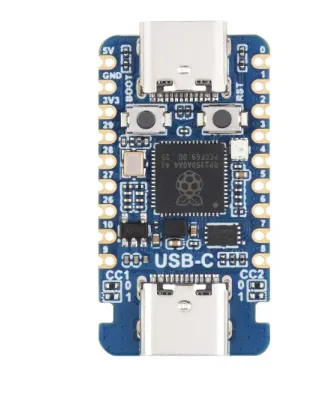
Features:
- Raspberry Pi RP2350A microcontroller
- Dual-core, dual-architecture processor supporting ARM Cortex-M33 or Hazard3 RISC-V cores
- Operating frequency up to 150MHz
- 520KB SRAM and 2MB onboard Flash memory
- 15 multifunction GPIO pins
- Primary USB Type-C port for programming, power and USB communication
- Additional female USB Type-C port supporting PIO-USB applications
- USB 1.1 host and device functionality
- 2 x SPI, 2 x I2C and 2 x UART interfaces
- 4 x 12-bit ADC channels
- 14 controllable PWM channels
- 12 programmable I/O (PIO) state machines
- Onboard WS2812 RGB LED
- Built-in temperature sensor, timers and clock functions
- Low-power sleep and dormant modes
- Castellated PCB edges for direct soldering onto a custom PCB
- Supports C/C++, MicroPython and compatible Arduino development environments
Principle of Operation:
The RP2350A executes application firmware using either its dual ARM Cortex-M33 cores or its dual Hazard3 RISC-V cores. The selected processor architecture depends on the firmware and development environment. Its GPIO pins and integrated peripherals allow it to interface with sensors, displays, actuators and other electronic devices.

The primary USB Type-C port supports programming, power and USB communication. The additional female USB Type-C port uses the RP2350's programmable I/O resources to implement PIO-USB functionality for supported USB host or device applications. Operation depends on the firmware, connected hardware and available power.
Library:
- Arduino IDE: Compatible RP2350 board support package and libraries required for the project.
- MicroPython: Compatible RP2350 firmware and a supported development environment, such as Thonny.
- C/C++: Raspberry Pi Pico SDK and a supported compiler toolchain.
- RGB LED: A compatible WS2812 library or driver for controlling the onboard RGB LED.
The required libraries depend on the selected development environment and connected peripherals.
Simple Code:
The following Arduino-style example demonstrates controlling a WS2812 RGB LED. Confirm the onboard LED GPIO assignment in the official Waveshare pinout and select a compatible RP2350 board package before using the code.
#include <Adafruit_NeoPixel.h>

#define LED_PIN 16
#define LED_COUNT 1

Adafruit_NeoPixel led(
  LED_COUNT,
  LED_PIN,
  NEO_GRB + NEO_KHZ800
);

void setup() {
  led.begin();
  led.clear();
  led.show();
}

void loop() {
  led.setPixelColor(0, led.Color(0, 0, 255));
  led.show();
  delay(1000);

  led.clear();
  led.show();
  delay(1000);
}Install the Adafruit NeoPixel library before compiling. Verify that GPIO16 is the correct RGB LED data pin for this board revision; do not publish or use this example without confirming the pin mapping.
Applications:
- Embedded control systems
- USB host and device development
- Custom USB peripherals and interfaces
- Robotics and automation prototypes
- Sensor monitoring and data acquisition
- Electronic prototyping and education
- Custom PCB development and integration
- Microcontroller-based control systems
- Low-power embedded applications
Pinout:
The board exposes 15 multifunction GPIO pins. Peripheral assignments depend on the selected firmware and the RP2350's configurable pin functions.

- GPIO: Digital input/output and alternate peripheral functions
- SPI: 2 hardware interfaces
- I2C: 2 hardware interfaces
- UART: 2 hardware interfaces
- ADC: 4 channels with 12-bit resolution
- PWM: 14 controllable channels
- PIO: 12 programmable I/O state machines
- Primary USB Type-C: Programming, power and USB communication
- Female USB Type-C: Additional PIO-USB connection
- BOOT: Used to enter the firmware download mode according to the board's procedure
- RUN: Reset control, where provided by the board layout
- RGB LED: Onboard WS2812 programmable LED
- GND: Ground reference for external circuits
Consult the official pinout diagram for exact GPIO assignments and available peripheral mappings.
Specifications:

- Brand: Waveshare
- SKU: 34641
- Part Number: RP2350-USB-C
- Microcontroller: Raspberry Pi RP2350A
- Processor: Dual-core ARM Cortex-M33 or dual-core Hazard3 RISC-V
- Maximum Operating Frequency: 150MHz
- SRAM: 520KB
- Flash Memory: 2MB NOR Flash
- GPIO: 15 multifunction pins
- SPI: 2 interfaces
- I2C: 2 interfaces
- UART: 2 interfaces
- ADC: 4 x 12-bit channels
- PWM: 14 controllable channels
- Programmable I/O: 12 PIO state machines
- USB: USB 1.1 host and device support
- USB Connectors: Primary USB Type-C and additional female USB Type-C port for PIO-USB
- Onboard LED: WS2812 RGB LED
- Voltage Regulator: RT9013-33GB, 500mA LDO
- Temperature Monitoring: Built-in chip temperature sensor
- PCB Design: Castellated module for custom PCB integration
- Programming Support: C/C++, MicroPython and compatible Arduino environments
Resources:
- Waveshare RP2350-USB-C Product Page
- Waveshare RP2350-USB-C Documentation
- Raspberry Pi Microcontroller Documentation
Features:
- Raspberry Pi RP2350A microcontroller
- Dual-core, dual-architecture processor supporting ARM Cortex-M33 or Hazard3 RISC-V cores
- Operating frequency up to 150MHz
- 520KB SRAM and 2MB onboard Flash memory
- 15 multifunction GPIO pins
- Primary USB Type-C port for programming, power and USB communication
- Additional female USB Type-C port supporting PIO-USB applications
- USB 1.1 host and device functionality
- 2 x SPI, 2 x I2C and 2 x UART interfaces
- 4 x 12-bit ADC channels
- 14 controllable PWM channels
- 12 programmable I/O (PIO) state machines
- Onboard WS2812 RGB LED
- Built-in temperature sensor, timers and clock functions
- Low-power sleep and dormant modes
- Castellated PCB edges for direct soldering onto a custom PCB
- Supports C/C++, MicroPython and compatible Arduino development environments
Principle of Operation:
The RP2350A executes application firmware using either its dual ARM Cortex-M33 cores or its dual Hazard3 RISC-V cores. The selected processor architecture depends on the firmware and development environment. Its GPIO pins and integrated peripherals allow it to interface with sensors, displays, actuators and other electronic devices.
The primary USB Type-C port supports programming, power and USB communication. The additional female USB Type-C port uses the RP2350's programmable I/O resources to implement PIO-USB functionality for supported USB host or device applications. Operation depends on the firmware, connected hardware and available power.
Library:
- Arduino IDE: Compatible RP2350 board support package and libraries required for the project.
- MicroPython: Compatible RP2350 firmware and a supported development environment, such as Thonny.
- C/C++: Raspberry Pi Pico SDK and a supported compiler toolchain.
- RGB LED: A compatible WS2812 library or driver for controlling the onboard RGB LED.
The required libraries depend on the selected development environment and connected peripherals.
Simple Code:
The following Arduino-style example demonstrates controlling a WS2812 RGB LED. Confirm the onboard LED GPIO assignment in the official Waveshare pinout and select a compatible RP2350 board package before using the code.
#include <Adafruit_NeoPixel.h>

#define LED_PIN 16
#define LED_COUNT 1

Adafruit_NeoPixel led(
  LED_COUNT,
  LED_PIN,
  NEO_GRB + NEO_KHZ800
);

void setup() {
  led.begin();
  led.clear();
  led.show();
}

void loop() {
  led.setPixelColor(0, led.Color(0, 0, 255));
  led.show();
  delay(1000);

  led.clear();
  led.show();
  delay(1000);
}
Install the Adafruit NeoPixel library before compiling. Verify that GPIO16 is the correct RGB LED data pin for this board revision; do not publish or use this example without confirming the pin mapping.
Applications:
- Embedded control systems
- USB host and device development
- Custom USB peripherals and interfaces
- Robotics and automation prototypes
- Sensor monitoring and data acquisition
- Electronic prototyping and education
- Custom PCB development and integration
- Microcontroller-based control systems
- Low-power embedded applications
Pinout:
The board exposes 15 multifunction GPIO pins. Peripheral assignments depend on the selected firmware and the RP2350's configurable pin functions.
- GPIO: Digital input/output and alternate peripheral functions
- SPI: 2 hardware interfaces
- I2C: 2 hardware interfaces
- UART: 2 hardware interfaces
- ADC: 4 channels with 12-bit resolution
- PWM: 14 controllable channels
- PIO: 12 programmable I/O state machines
- Primary USB Type-C: Programming, power and USB communication
- Female USB Type-C: Additional PIO-USB connection
- BOOT: Used to enter the firmware download mode according to the board's procedure
- RUN: Reset control, where provided by the board layout
- RGB LED: Onboard WS2812 programmable LED
- GND: Ground reference for external circuits
Consult the official pinout diagram for exact GPIO assignments and available peripheral mappings.
Specifications:
- Brand: Waveshare
- SKU: 34641
- Part Number: RP2350-USB-C
- Microcontroller: Raspberry Pi RP2350A
- Processor: Dual-core ARM Cortex-M33 or dual-core Hazard3 RISC-V
- Maximum Operating Frequency: 150MHz
- SRAM: 520KB
- Flash Memory: 2MB NOR Flash
- GPIO: 15 multifunction pins
- SPI: 2 interfaces
- I2C: 2 interfaces
- UART: 2 interfaces
- ADC: 4 x 12-bit channels
- PWM: 14 controllable channels
- Programmable I/O: 12 PIO state machines
- USB: USB 1.1 host and device support
- USB Connectors: Primary USB Type-C and additional female USB Type-C port for PIO-USB
- Onboard LED: WS2812 RGB LED
- Voltage Regulator: RT9013-33GB, 500mA LDO
- Temperature Monitoring: Built-in chip temperature sensor
- PCB Design: Castellated module for custom PCB integration
- Programming Support: C/C++, MicroPython and compatible Arduino environments