Features
- Designed for Arduino Nano version 3.0.
- Provides convenient access to the Arduino Nano I/O pins.
- Uses terminal connections for easier external wiring.
- Maintains the original Arduino Nano footprint.
- Suitable for connecting multiple digital and analog lines.
- Fully assembled and ready to use.
- No soldering is required for normal terminal connections.
- Suitable for temporary projects and prototype development.
- Compact design suitable for electronics workbenches and embedded projects.
- Allows the Nano to be connected to external circuits using hookup wires.
Principle of Operation
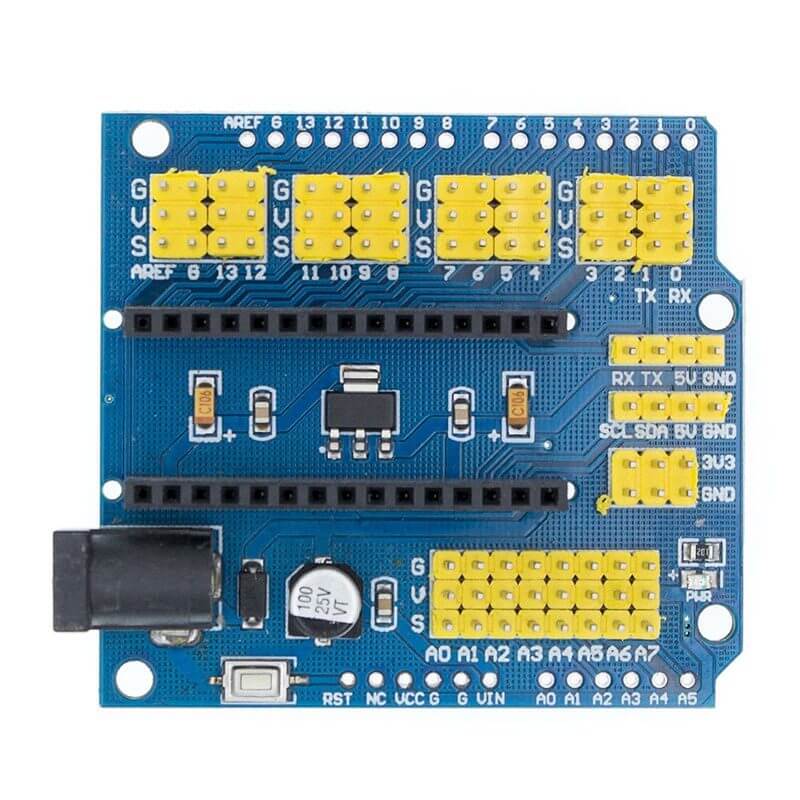
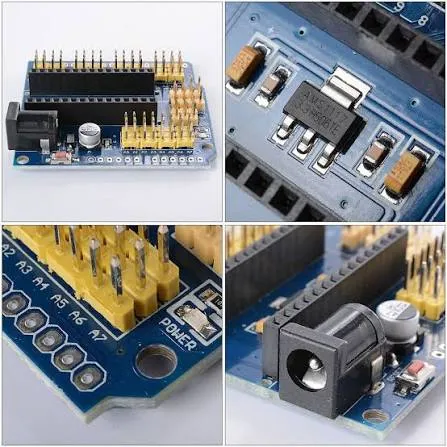
The expansion board acts as a wiring and terminal interface for an Arduino Nano. The Nano is installed on the expansion board, and its available pins are brought out to convenient terminal connections.
This allows sensors, switches, LEDs, motors, communication modules, and other external circuits to be connected without repeatedly working directly with the small Nano header pins.
The expansion board does not replace the Arduino Nano or add processing functionality. It provides a convenient physical connection between the Nano and the external circuit.
Arduino Nano Compatibility
The board is designed for Arduino Nano version 3.0 and is also compatible with older Nano versions. When using an older Nano version, the A0-A7 analog pins may be arranged in the reverse order compared with the V3.0 layout.
Check the pin labels on the Nano and expansion board before connecting analog signals, especially when using an older Arduino Nano version.
Wiring
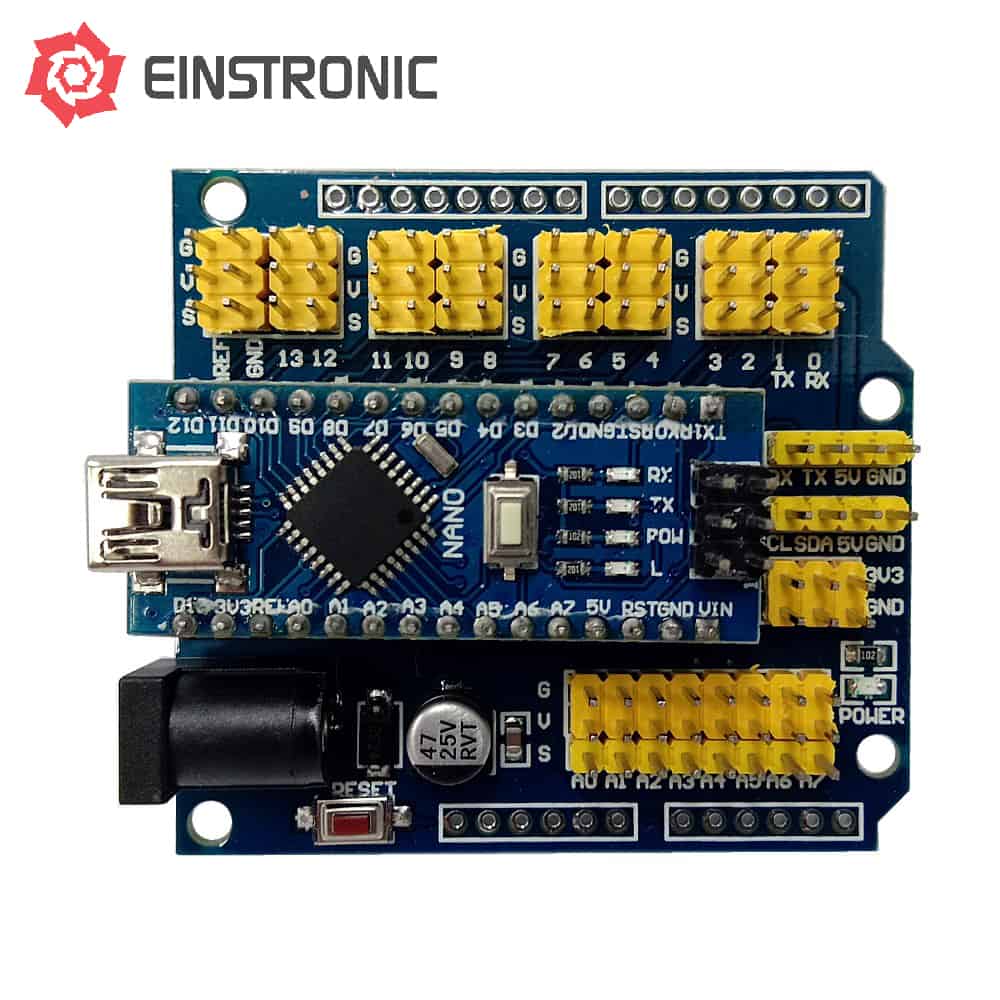
The external circuit can be connected to the expansion board through its terminal connections. The appropriate Arduino Nano pin can then be used in the Arduino program in the same way as when connecting directly to the Nano.
| Connection | Function |
|---|---|
| Digital I/O | Access to Arduino Nano digital input/output pins |
| Analog I/O | Access to Arduino Nano analog input pins |
| Power | Access to the Nano power connections |
Applications
- Arduino Nano prototyping.
- Educational electronics projects.
- Sensor interface projects.
- Digital input and output experiments.
- Analog sensor projects.
- Relay and actuator control projects.
- Temporary wiring and testing.
- DIY embedded systems.
- Arduino-based automation projects.
- Projects requiring easier access to Nano I/O pins.
Advantages for Prototyping
The small pin spacing of an Arduino Nano can make direct wiring inconvenient during development. This expansion board provides a larger and more accessible terminal interface, making it easier to connect external wires during testing and prototyping.
Because the board is already assembled, it is also suitable for temporary circuits where components may need to be connected and disconnected several times during development.
Technical Specifications
| Specification | Details |
|---|---|
| Product Type | Arduino Nano terminal expansion board |
| Version | V3.0 |
| Compatible Board | Arduino Nano V3.0 |
| Older Nano Versions | Supported, with A0-A7 pin order difference |
| Supply Voltage | 3V - 5V |
| Dimensions | Approx. 5.4 × 4.2 × 1 cm |
| Assembly | Fully assembled |
Important Notes
- Arduino Nano development board is not included.
- The expansion board is designed for Arduino Nano V3.0. Older Nano versions may have the A0-A7 pins in a different order.
- Check the pin labels carefully before connecting external components.
- Do not exceed the voltage or current limits of the connected Arduino Nano pins.
- The expansion board provides convenient connections but does not provide additional GPIO pins beyond those available on the Arduino Nano.
- The specified dimensions are approximate.
Features
- Designed for Arduino Nano version 3.0.
- Provides convenient access to the Arduino Nano I/O pins.
- Uses terminal connections for easier external wiring.
- Maintains the original Arduino Nano footprint.
- Suitable for connecting multiple digital and analog lines.
- Fully assembled and ready to use.
- No soldering is required for normal terminal connections.
- Suitable for temporary projects and prototype development.
- Compact design suitable for electronics workbenches and embedded projects.
- Allows the Nano to be connected to external circuits using hookup wires.
Principle of Operation
The expansion board acts as a wiring and terminal interface for an Arduino Nano. The Nano is installed on the expansion board, and its available pins are brought out to convenient terminal connections.
This allows sensors, switches, LEDs, motors, communication modules, and other external circuits to be connected without repeatedly working directly with the small Nano header pins.
The expansion board does not replace the Arduino Nano or add processing functionality. It provides a convenient physical connection between the Nano and the external circuit.
Arduino Nano Compatibility
The board is designed for Arduino Nano version 3.0 and is also compatible with older Nano versions. When using an older Nano version, the A0-A7 analog pins may be arranged in the reverse order compared with the V3.0 layout.
Check the pin labels on the Nano and expansion board before connecting analog signals, especially when using an older Arduino Nano version.
Wiring
The external circuit can be connected to the expansion board through its terminal connections. The appropriate Arduino Nano pin can then be used in the Arduino program in the same way as when connecting directly to the Nano.
| Connection | Function |
|---|---|
| Digital I/O | Access to Arduino Nano digital input/output pins |
| Analog I/O | Access to Arduino Nano analog input pins |
| Power | Access to the Nano power connections |
Applications
- Arduino Nano prototyping.
- Educational electronics projects.
- Sensor interface projects.
- Digital input and output experiments.
- Analog sensor projects.
- Relay and actuator control projects.
- Temporary wiring and testing.
- DIY embedded systems.
- Arduino-based automation projects.
- Projects requiring easier access to Nano I/O pins.
Advantages for Prototyping
The small pin spacing of an Arduino Nano can make direct wiring inconvenient during development. This expansion board provides a larger and more accessible terminal interface, making it easier to connect external wires during testing and prototyping.
Because the board is already assembled, it is also suitable for temporary circuits where components may need to be connected and disconnected several times during development.
Technical Specifications
| Specification | Details |
|---|---|
| Product Type | Arduino Nano terminal expansion board |
| Version | V3.0 |
| Compatible Board | Arduino Nano V3.0 |
| Older Nano Versions | Supported, with A0-A7 pin order difference |
| Supply Voltage | 3V - 5V |
| Dimensions | Approx. 5.4 × 4.2 × 1 cm |
| Assembly | Fully assembled |
Important Notes
- Arduino Nano development board is not included.
- The expansion board is designed for Arduino Nano V3.0. Older Nano versions may have the A0-A7 pins in a different order.
- Check the pin labels carefully before connecting external components.
- Do not exceed the voltage or current limits of the connected Arduino Nano pins.
- The expansion board provides convenient connections but does not provide additional GPIO pins beyond those available on the Arduino Nano.
- The specified dimensions are approximate.