

Features
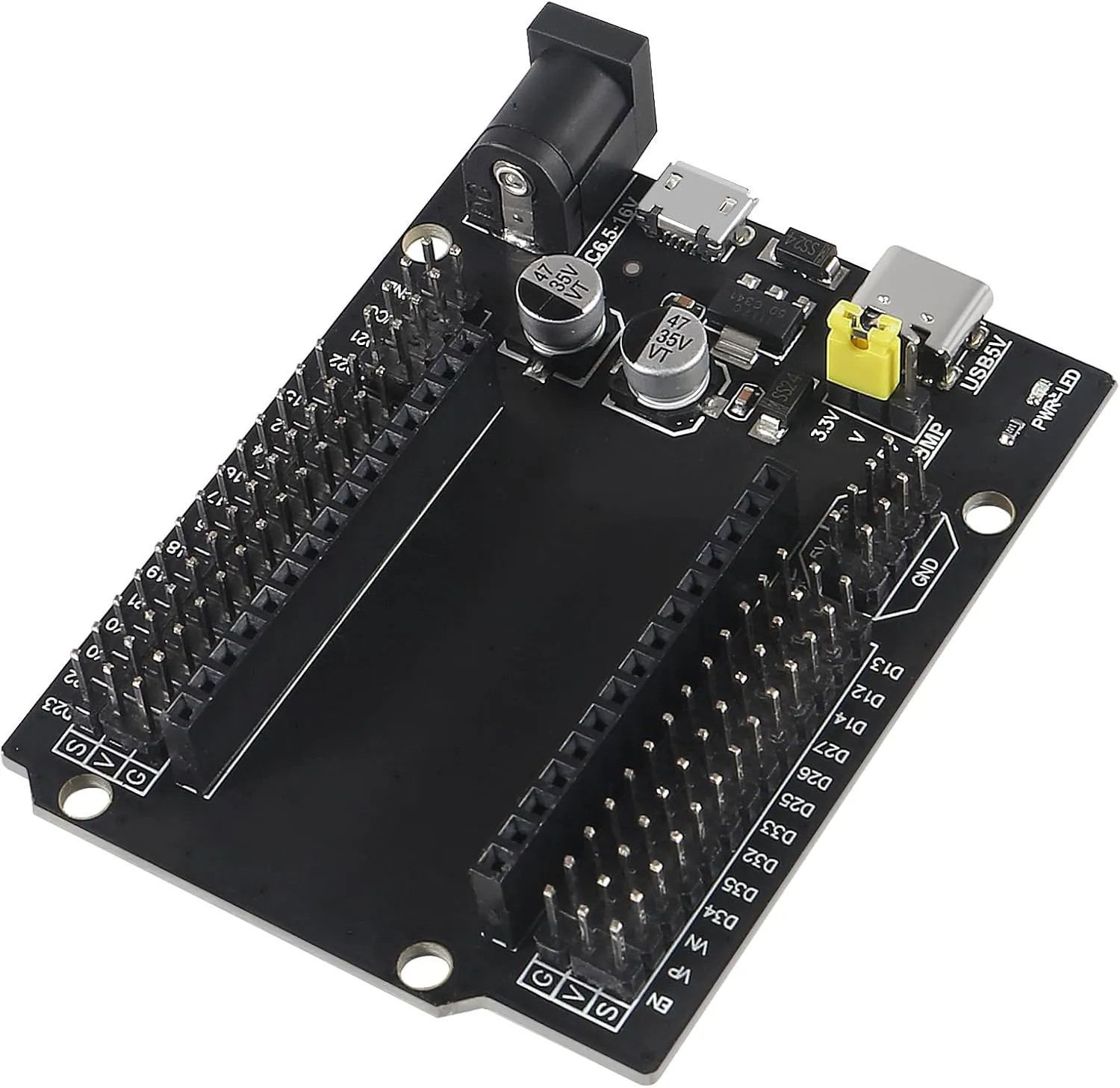
- Designed for ESP32 DEVKIT V1 30-pin development boards.
- Supports USB Type-C and Micro USB power input options.
- Compatible with external DC power input.
- Provides regulated and stable power output.
- Onboard voltage regulation for safe ESP32 operation.
- Plug-and-play installation without additional wiring.
- Compact and lightweight expansion board design.
- Reduces power connection complexity during development.
- Improves ESP32 stability by reducing voltage fluctuations.
- Suitable for IoT, automation, and embedded applications.
Principle of Operation
The ESP32 power board operates by accepting power from USB or an external DC input source and converting it into regulated voltage levels suitable for the ESP32 DEVKIT V1. The onboard voltage regulator maintains a stable output voltage even when the input supply varies.
After regulation, the power is delivered directly to the ESP32 development board through the connected power pins. This provides a more reliable power source compared to unstable USB connections or insufficient external supplies, helping prevent issues such as ESP32 resets and brownouts.
Applications
- ESP32 IoT development projects
- Wireless communication systems
- Smart home automation devices
- Embedded control systems
- Standalone ESP32 installations
- Sensor monitoring systems
- Robotics and automation projects
- Prototype development platforms
- Industrial ESP32 applications
Pinout

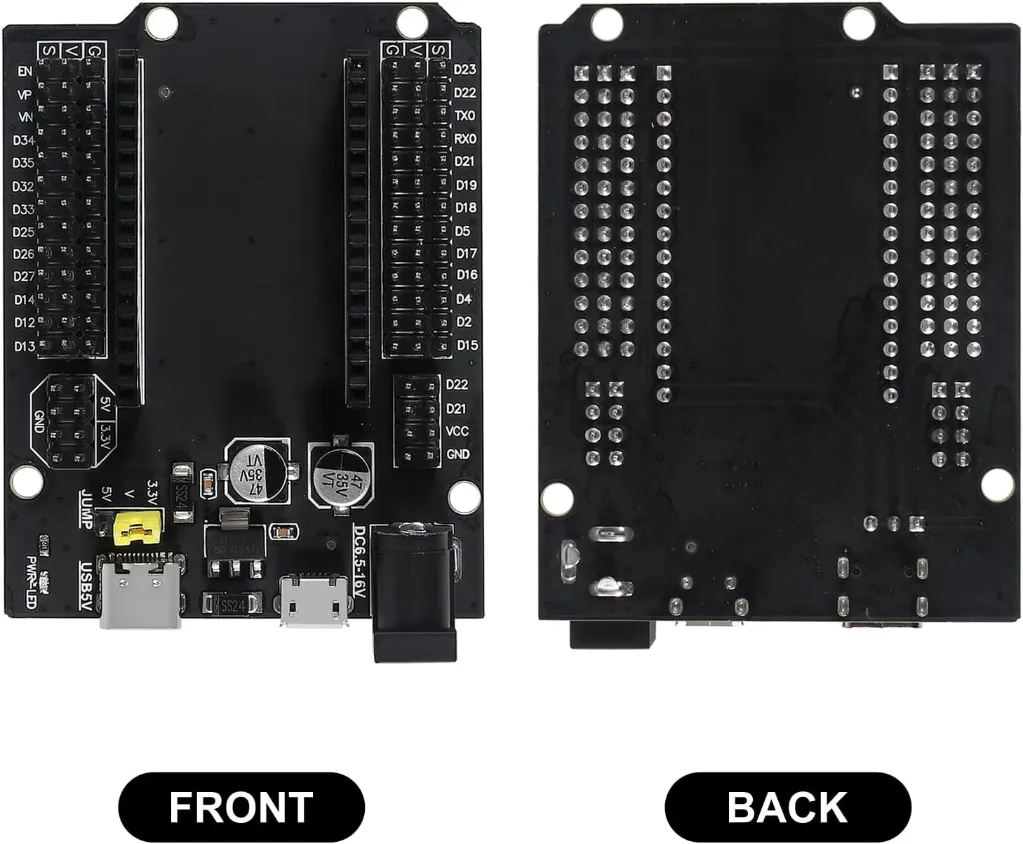
| Pin / Connector | Function |
|---|---|
| USB Type-C | 5V Power Input |
| Micro USB | 5V Power Input |
| DC Input | External Power Input |
| 5V Output | Regulated 5V Supply |
| 3.3V Output | Regulated 3.3V Supply |
| GND | Ground Connection |
Wiring
The power board connects directly to an ESP32 DEVKIT V1 30-pin development board. No additional jumper wires are required. Power can be supplied through USB connectors or an external DC source depending on the application requirements.

| Connection | Description |
|---|---|
| ESP32 DEVKIT V1 | Install directly onto the power expansion board |
| USB Type-C / Micro USB | Connect 5V USB power source |
| External DC Input | Connect external regulated power source |
| 5V / 3.3V Output | Supply power to external peripherals |
Specifications
| Product Type | ESP32 Power Expansion Board |
| Compatible Board | ESP32 DEVKIT V1 30-Pin Development Board |
| USB Interface | USB Type-C and Micro USB |
| USB Driver | CH340C |
| Input Voltage | 5V USB or External DC Input |
| Output Voltage | Regulated 5V / 3.3V |
| Voltage Regulation | Integrated Voltage Regulator |
| Board Compatibility | ESP32 30-Pin DEVKIT V1 |
| Form Factor | Compact Expansion Module |
| Application | ESP32 Power Management and Prototyping |
Library Required
This power expansion board does not require any additional software libraries. It works as a hardware power management accessory for ESP32 development boards.
For programming the ESP32 DEVKIT V1, install the following software packages:
- ESP32 Arduino Core for Arduino IDE development.
- CH340 USB Driver for USB communication with the ESP32 board.
Example Arduino Code
// ESP32 Power Board Test Example
// Tests ESP32 onboard LED

#define LED_PIN 2

void setup() {

  pinMode(LED_PIN, OUTPUT);

}

void loop() {

  digitalWrite(LED_PIN, HIGH);
  delay(1000);

  digitalWrite(LED_PIN, LOW);
  delay(1000);

}
Resources
- ESP32 Arduino Core:
https://github.com/espressif/arduino-esp32 - Espressif ESP32 Documentation:
https://docs.espressif.com/projects/esp-idf/en/latest/esp32/ - CH340 USB Driver:
https://www.wch-ic.com/downloads/CH341SER_ZIP.html - Arduino IDE:
https://www.arduino.cc/en/software
Features
- Designed for ESP32 DEVKIT V1 30-pin development boards.
- Supports USB Type-C and Micro USB power input options.
- Compatible with external DC power input.
- Provides regulated and stable power output.
- Onboard voltage regulation for safe ESP32 operation.
- Plug-and-play installation without additional wiring.
- Compact and lightweight expansion board design.
- Reduces power connection complexity during development.
- Improves ESP32 stability by reducing voltage fluctuations.
- Suitable for IoT, automation, and embedded applications.
Principle of Operation
The ESP32 power board operates by accepting power from USB or an external DC input source and converting it into regulated voltage levels suitable for the ESP32 DEVKIT V1. The onboard voltage regulator maintains a stable output voltage even when the input supply varies.
After regulation, the power is delivered directly to the ESP32 development board through the connected power pins. This provides a more reliable power source compared to unstable USB connections or insufficient external supplies, helping prevent issues such as ESP32 resets and brownouts.
Applications
- ESP32 IoT development projects
- Wireless communication systems
- Smart home automation devices
- Embedded control systems
- Standalone ESP32 installations
- Sensor monitoring systems
- Robotics and automation projects
- Prototype development platforms
- Industrial ESP32 applications
Pinout
| Pin / Connector | Function |
|---|---|
| USB Type-C | 5V Power Input |
| Micro USB | 5V Power Input |
| DC Input | External Power Input |
| 5V Output | Regulated 5V Supply |
| 3.3V Output | Regulated 3.3V Supply |
| GND | Ground Connection |
Wiring
The power board connects directly to an ESP32 DEVKIT V1 30-pin development board. No additional jumper wires are required. Power can be supplied through USB connectors or an external DC source depending on the application requirements.
| Connection | Description |
|---|---|
| ESP32 DEVKIT V1 | Install directly onto the power expansion board |
| USB Type-C / Micro USB | Connect 5V USB power source |
| External DC Input | Connect external regulated power source |
| 5V / 3.3V Output | Supply power to external peripherals |
Specifications
| Product Type | ESP32 Power Expansion Board |
| Compatible Board | ESP32 DEVKIT V1 30-Pin Development Board |
| USB Interface | USB Type-C and Micro USB |
| USB Driver | CH340C |
| Input Voltage | 5V USB or External DC Input |
| Output Voltage | Regulated 5V / 3.3V |
| Voltage Regulation | Integrated Voltage Regulator |
| Board Compatibility | ESP32 30-Pin DEVKIT V1 |
| Form Factor | Compact Expansion Module |
| Application | ESP32 Power Management and Prototyping |
Library Required
This power expansion board does not require any additional software libraries. It works as a hardware power management accessory for ESP32 development boards.
For programming the ESP32 DEVKIT V1, install the following software packages:
- ESP32 Arduino Core for Arduino IDE development.
- CH340 USB Driver for USB communication with the ESP32 board.
Example Arduino Code
// ESP32 Power Board Test Example
// Tests ESP32 onboard LED

#define LED_PIN 2

void setup() {

  pinMode(LED_PIN, OUTPUT);

}

void loop() {

  digitalWrite(LED_PIN, HIGH);
  delay(1000);

  digitalWrite(LED_PIN, LOW);
  delay(1000);

}
Resources
- ESP32 Arduino Core:
https://github.com/espressif/arduino-esp32 - Espressif ESP32 Documentation:
https://docs.espressif.com/projects/esp-idf/en/latest/esp32/ - CH340 USB Driver:
https://www.wch-ic.com/downloads/CH341SER_ZIP.html - Arduino IDE:
https://www.arduino.cc/en/software