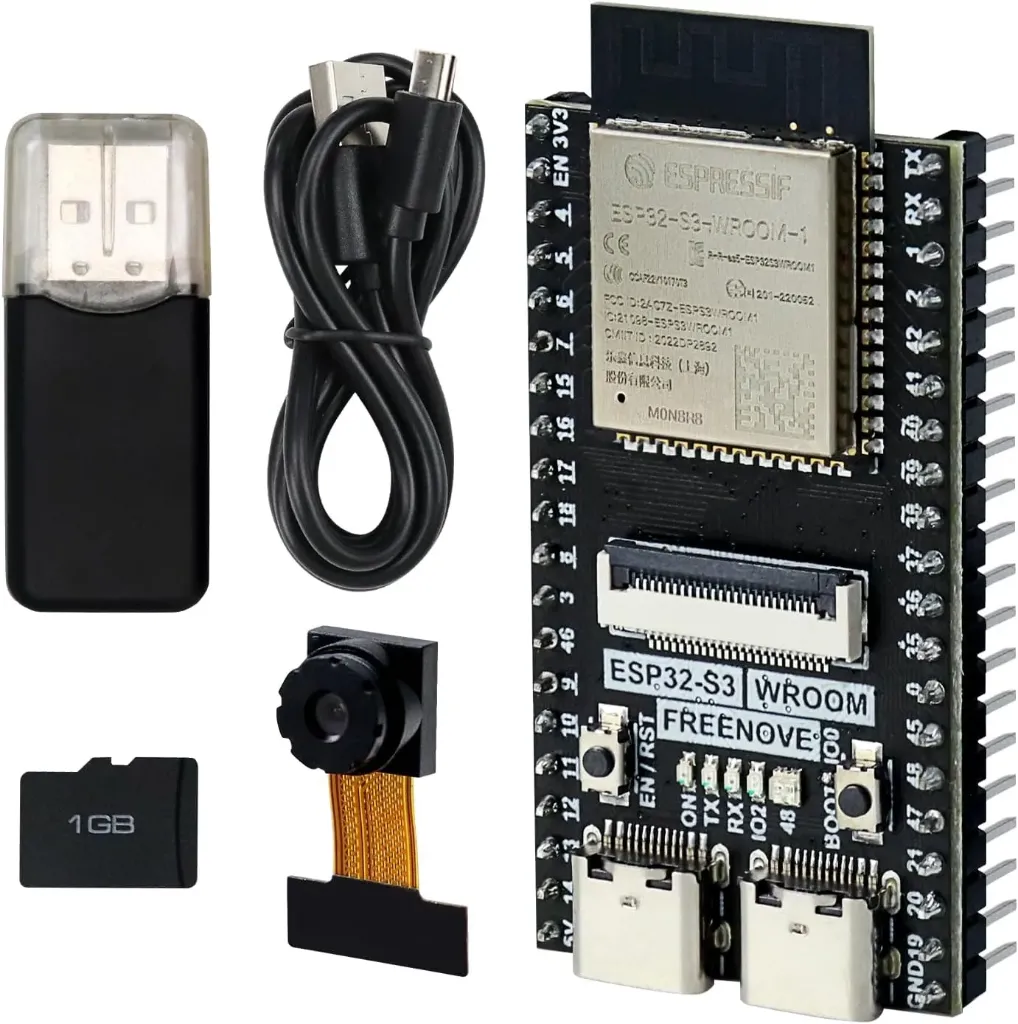
Features:
- ESP32-S3 dual-core 32-bit processor running up to 240 MHz
- Integrated Wi-Fi and Bluetooth connectivity
- Onboard camera module for image and video applications
- Supports AI and edge computing tasks
- Multiple GPIO pins for flexible interfacing
- Low power consumption with deep sleep support
- USB interface for programming and power
- Compact and lightweight design for embedded systems
- Compatible with Arduino IDE and ESP-IDF development environments
Principle of Work:
The ESP32-S3 microcontroller processes data from the onboard camera and executes application logic. Captured images or video streams can be processed locally or transmitted wirelessly via Wi-Fi or Bluetooth. The system can perform tasks such as motion detection, object recognition, or live streaming. Developers can program the board to respond to camera input and send data to cloud services or other connected devices.
Pinout:
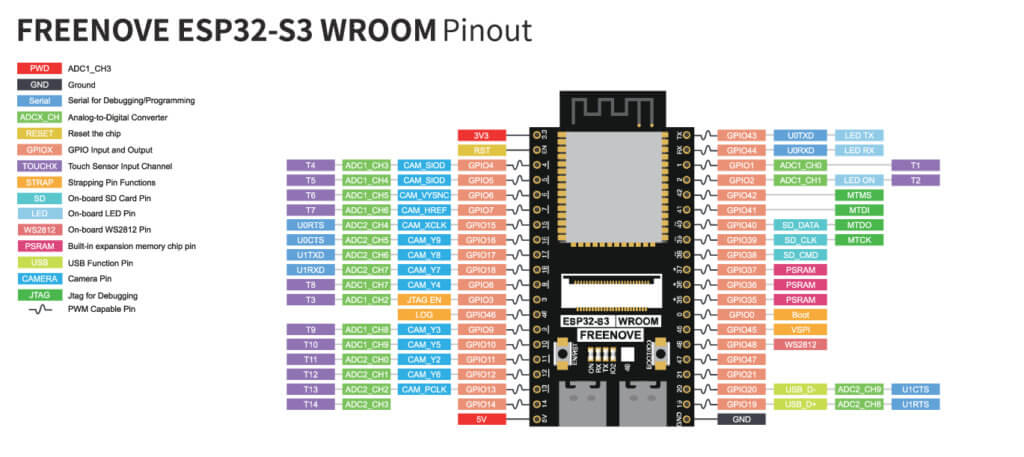

- 5V / VIN: Power input
- GND: Ground
- GPIO Pins: General-purpose input/output for sensors and peripherals
- TX / RX: UART communication
- USB: Programming and power interface
- Camera Interface: Connected internally to the onboard camera module
Applications:
- Smart surveillance and security systems
- Face detection and recognition projects
- IoT camera and monitoring systems
- Robotics with vision capabilities
- Home automation with visual feedback
- Industrial inspection and automation
Circuit:

- Power the board via USB or 5V/VIN pin
- Connect sensors or peripherals to GPIO pins as needed
- Use the onboard camera without external wiring
- Program via USB using Arduino IDE or ESP-IDF
Code:
#include "esp_camera.h"
#include <WiFi.h>

void setup() {
  Serial.begin(115200);

  // Initialize camera (configuration depends on module)
  camera_config_t config;
  // Camera configuration settings go here

  esp_camera_init(&config);

  WiFi.begin("YOUR_SSID", "YOUR_PASSWORD");
  while (WiFi.status() != WL_CONNECTED) {
    delay(500);
    Serial.print(".");
  }
  Serial.println("WiFi connected");
}

void loop() {
  camera_fb_t * fb = esp_camera_fb_get();
  if (!fb) {
    Serial.println("Camera capture failed");
    return;
  }

  // Process image or send data
  esp_camera_fb_return(fb);
  delay(1000);
}
Technical Details:
- Microcontroller: ESP32-S3 Dual-core 32-bit
- Clock Speed: Up to 240 MHz
- Wireless: Wi-Fi + Bluetooth
- Camera: Onboard camera module
- Interface: USB, UART, GPIO
- Power Supply: 5V via USB or VIN
- Low Power Modes: Supported (deep sleep)
- Development Support: Arduino IDE, ESP-IDF
Resources:
Comparisons:
Compared to standard ESP32 boards without a camera, this module offers integrated vision capabilities, eliminating the need for external camera modules and simplifying design. Compared to ESP32-CAM (ESP32-based), the ESP32-S3 version provides improved performance, enhanced AI capabilities, and better support for modern IoT and edge computing applications.
Features:
- ESP32-S3 dual-core 32-bit processor running up to 240 MHz
- Integrated Wi-Fi and Bluetooth connectivity
- Onboard camera module for image and video applications
- Supports AI and edge computing tasks
- Multiple GPIO pins for flexible interfacing
- Low power consumption with deep sleep support
- USB interface for programming and power
- Compact and lightweight design for embedded systems
- Compatible with Arduino IDE and ESP-IDF development environments
Principle of Work:
The ESP32-S3 microcontroller processes data from the onboard camera and executes application logic. Captured images or video streams can be processed locally or transmitted wirelessly via Wi-Fi or Bluetooth. The system can perform tasks such as motion detection, object recognition, or live streaming. Developers can program the board to respond to camera input and send data to cloud services or other connected devices.
Pinout:
- 5V / VIN: Power input
- GND: Ground
- GPIO Pins: General-purpose input/output for sensors and peripherals
- TX / RX: UART communication
- USB: Programming and power interface
- Camera Interface: Connected internally to the onboard camera module
Applications:
- Smart surveillance and security systems
- Face detection and recognition projects
- IoT camera and monitoring systems
- Robotics with vision capabilities
- Home automation with visual feedback
- Industrial inspection and automation
Circuit:
- Power the board via USB or 5V/VIN pin
- Connect sensors or peripherals to GPIO pins as needed
- Use the onboard camera without external wiring
- Program via USB using Arduino IDE or ESP-IDF
Code:
#include "esp_camera.h"
#include <WiFi.h>

void setup() {
  Serial.begin(115200);

  // Initialize camera (configuration depends on module)
  camera_config_t config;
  // Camera configuration settings go here

  esp_camera_init(&config);

  WiFi.begin("YOUR_SSID", "YOUR_PASSWORD");
  while (WiFi.status() != WL_CONNECTED) {
    delay(500);
    Serial.print(".");
  }
  Serial.println("WiFi connected");
}

void loop() {
  camera_fb_t * fb = esp_camera_fb_get();
  if (!fb) {
    Serial.println("Camera capture failed");
    return;
  }

  // Process image or send data
  esp_camera_fb_return(fb);
  delay(1000);
}
Technical Details:
- Microcontroller: ESP32-S3 Dual-core 32-bit
- Clock Speed: Up to 240 MHz
- Wireless: Wi-Fi + Bluetooth
- Camera: Onboard camera module
- Interface: USB, UART, GPIO
- Power Supply: 5V via USB or VIN
- Low Power Modes: Supported (deep sleep)
- Development Support: Arduino IDE, ESP-IDF
Resources:
Comparisons:
Compared to standard ESP32 boards without a camera, this module offers integrated vision capabilities, eliminating the need for external camera modules and simplifying design. Compared to ESP32-CAM (ESP32-based), the ESP32-S3 version provides improved performance, enhanced AI capabilities, and better support for modern IoT and edge computing applications.