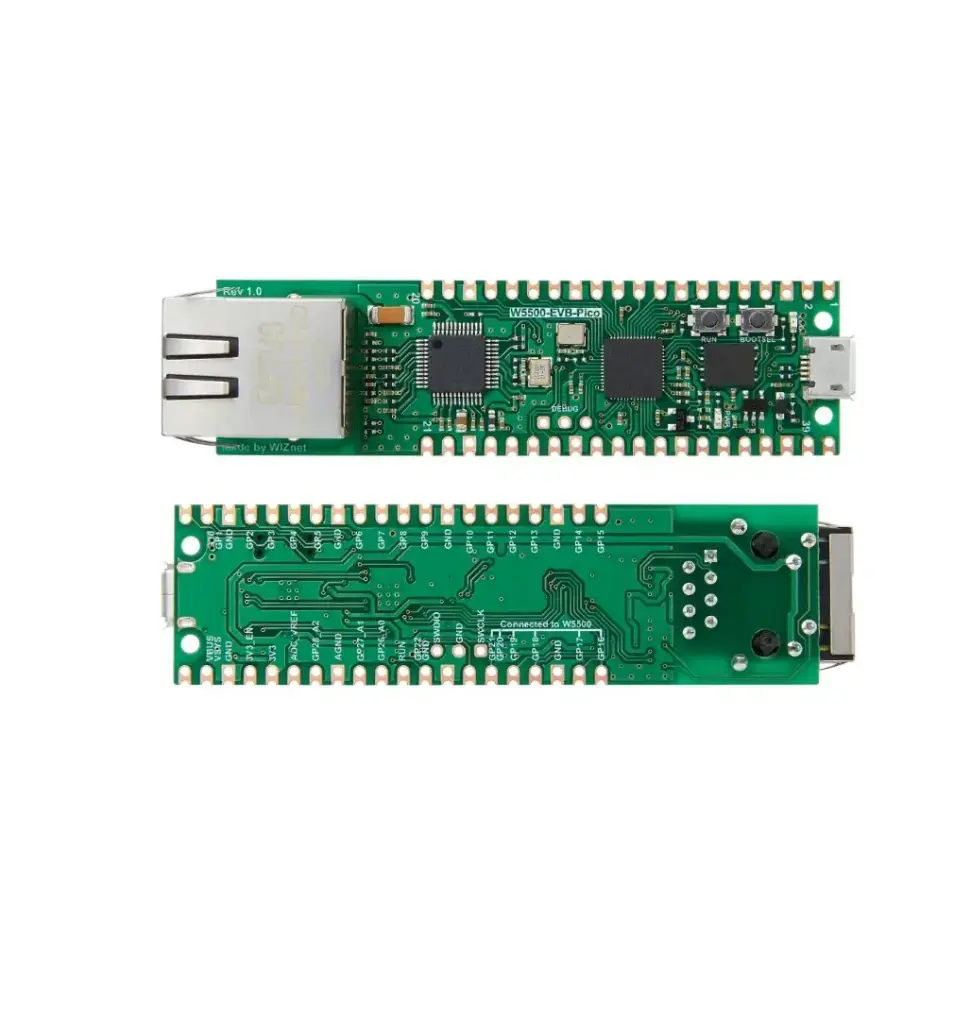


Features
- RP2040 dual-core ARM Cortex-M0+ microcontroller.
- CPU frequency up to 133 MHz.
- 2 MB onboard Quad-SPI Flash memory.
- 264 KB multi-bank SRAM.
- Integrated WIZnet W5500 hardwired TCP/IP Ethernet controller.
- 10/100 Mbps Ethernet connectivity with auto-negotiation.
- Integrated RJ45 Ethernet connector.
- Hardware TCP/IP networking for reliable embedded Ethernet applications.
- Supports TCP, UDP, IPv4, ICMP, ARP, IGMP, and PPPoE protocols.
- Supports up to 8 independent hardware network sockets.
- 32 KB internal Ethernet TX/RX buffer memory.
- High-speed SPI communication between RP2040 and W5500.
- 30 GPIO pins with 4 ADC-capable inputs.
- 12-bit, 500 ksps ADC.
- 2 × UART, 2 × I2C, and 2 × SPI interfaces.
- 16 × PWM channels.
- 2 × PIO blocks with 8 state machines.
- Micro-USB Type-B port for power and programming.
- 3-pin ARM SWD debugging interface.
- Onboard user LED.
- RUN and BOOTSEL/ROOTSEL controls for reset and boot selection.
- 40-pin DIP-style layout with 0.1-inch pin spacing.
- Suitable for IoT, industrial networking, automation, and embedded projects.
Principle of Operation
The W5500-EVB-Pico combines two main components: the RP2040 microcontroller and the W5500 Ethernet controller. The RP2040 executes the user's application code and controls connected peripherals, while the W5500 handles Ethernet communication and the TCP/IP networking functions.
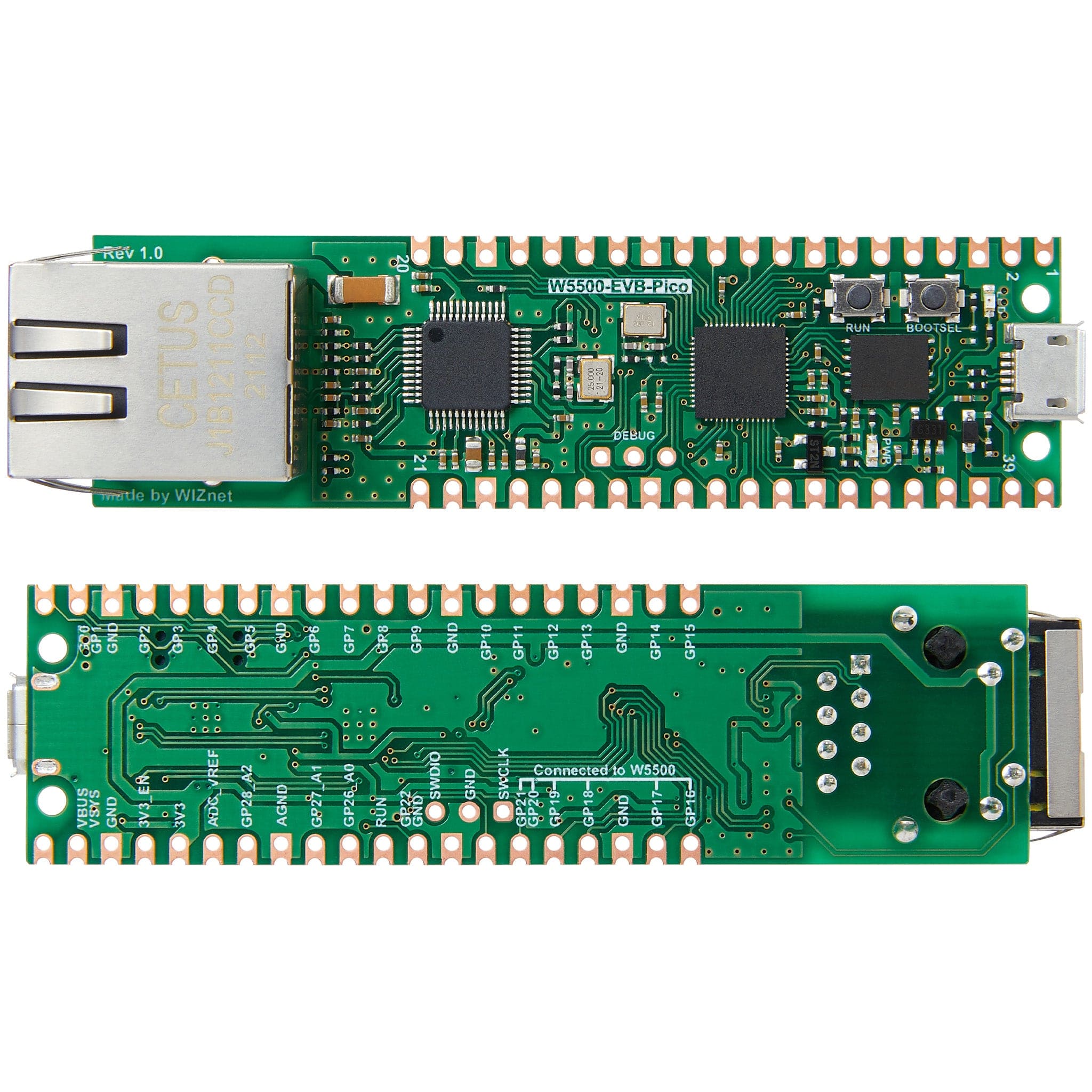
The RP2040 communicates with the W5500 through a dedicated high-speed SPI interface. Network data received by the W5500 through the Ethernet port is processed by its integrated hardware TCP/IP stack and made available to the RP2040 through SPI. Similarly, data generated by the RP2040 can be transferred to the W5500 and transmitted over the Ethernet network.
Because the W5500 implements the TCP/IP protocol stack in hardware, the RP2040 does not need to perform all of the low-level network processing itself. This can simplify embedded Ethernet applications and leave additional processor resources available for the user's application. The board supports multiple network sockets, allowing the RP2040 to communicate with several network services or devices simultaneously. This makes the W5500-EVB-Pico particularly suitable for embedded servers, industrial controllers, network gateways, data acquisition systems, and IoT devices.
Applications
- Industrial Ethernet and automation projects.
- IoT devices requiring reliable wired networking.
- Embedded Ethernet controllers.
- Networked sensors and data acquisition systems.
- Industrial monitoring and control systems.
- Ethernet-enabled robotics projects.
- Web servers and network services on RP2040.
- TCP/IP communication projects.
- Network gateways and communication bridges.
- Custom Ethernet-connected embedded systems.
- Educational networking and microcontroller projects.
- Rapid prototyping of wired IoT products.
Pinout
The W5500-EVB-Pico provides a 40-pin DIP-style interface similar to the Raspberry Pi Pico, while several RP2040 GPIO pins are dedicated to communication with the onboard W5500 Ethernet controller.
.
RP2040 to W5500 Connections
| Direction | GPIO | Function |
|---|---|---|
| Input | GPIO16 | MISO from W5500 |
| Output | GPIO17 | W5500 Chip Select (CSn) |
| Output | GPIO18 | SPI Clock (SCLK) |
| Output | GPIO19 | MOSI / SPI Data |
| Output | GPIO20 | W5500 Reset (RSTn) |
| Input | GPIO21 | W5500 Interrupt (INTn) |
| Input | GPIO24 | VBUS Sense |
| Output | GPIO25 | Onboard User LED |
| Input | GPIO29 | ADC3 for VSYS/3 measurement |
Power and Control Pins
| Pin | Name | Description |
|---|---|---|
| 40 | VBUS | Micro-USB input voltage, approximately 5V. |
| 39 | VSYS | System power input, approximately 4.3V–5.5V. |
| 37 | 3V3_EN | 3.3V LDO enable input. Pulling low disables the 3.3V supply. |
| 36 | 3V3 | 3.3V output from the onboard LDO regulator. |
| 35 | ADC_VREF | ADC power/reference input from the filtered 3.3V supply. |
| 33 | AGND | Analog ground. |
| 30 | RUN | RP2040 reset/run control pin. |
Technical Specifications
| Parameter | Specification |
|---|---|
| Board | WIZnet W5500-EVB-Pico |
| Microcontroller | Raspberry Pi RP2040 |
| CPU | Dual-core ARM Cortex-M0+ |
| Maximum CPU Frequency | 133 MHz |
| Flash Memory | 2 MB Quad-SPI Flash |
| SRAM | 264 KB |
| GPIO | 30 |
| ADC | 4 × ADC-capable inputs, 12-bit, 500 ksps |
| UART | 2 × UART |
| I2C | 2 × I2C |
| SPI | 2 × SPI |
| PWM | 16 × PWM channels |
| Programmable I/O | 2 PIO blocks / 8 state machines |
| Ethernet Controller | WIZnet W5500 |
| Ethernet Speed | 10/100 Mbps |
| Ethernet Protocols | TCP, UDP, IPv4, ICMP, ARP, IGMP, PPPoE |
| Hardware Sockets | 8 |
| W5500 TX/RX Buffer | 32 KB internal memory |
| Ethernet Interface | RJ45 |
| Ethernet SPI | High-speed SPI, Mode 0 and Mode 3 |
| Logic Voltage | 3.3V |
| USB Connector | Micro-USB Type-B |
| Debug Interface | 3-pin ARM SWD |
| Form Factor | 40-pin DIP-style |
| Board Dimensions | Approximately 21 × 51 mm |
| Pin Pitch | 0.1 inch / 2.54 mm |
Important Notes
- The W5500 Ethernet controller uses dedicated RP2040 GPIO pins for its SPI and control signals.
- GPIO16–GPIO21 are used by the onboard W5500 interface and should not be treated as freely available GPIO when Ethernet is required.
- The board operates with 3.3V logic levels.
- Do not apply incompatible voltage levels to the RP2040 GPIO pins.
- A Micro-USB cable is required for USB programming and is not included unless specifically stated.
- Ethernet network performance depends on the connected network, cable quality, configuration, and network conditions.
- The onboard RJ45 connector provides a wired Ethernet interface without requiring an external Ethernet module.
- The included male headers can be soldered to the board for breadboard or standard 2.54 mm connections.
Resources
- WIZnet W5500-EVB-Pico Product Page
- WIZnet W5500 Documentation
- Raspberry Pi RP2040 Datasheet
- Raspberry Pi Pico Documentation
- WIZnet RP2040 Ethernet Examples and Resources
Features
- RP2040 dual-core ARM Cortex-M0+ microcontroller.
- CPU frequency up to 133 MHz.
- 2 MB onboard Quad-SPI Flash memory.
- 264 KB multi-bank SRAM.
- Integrated WIZnet W5500 hardwired TCP/IP Ethernet controller.
- 10/100 Mbps Ethernet connectivity with auto-negotiation.
- Integrated RJ45 Ethernet connector.
- Hardware TCP/IP networking for reliable embedded Ethernet applications.
- Supports TCP, UDP, IPv4, ICMP, ARP, IGMP, and PPPoE protocols.
- Supports up to 8 independent hardware network sockets.
- 32 KB internal Ethernet TX/RX buffer memory.
- High-speed SPI communication between RP2040 and W5500.
- 30 GPIO pins with 4 ADC-capable inputs.
- 12-bit, 500 ksps ADC.
- 2 × UART, 2 × I2C, and 2 × SPI interfaces.
- 16 × PWM channels.
- 2 × PIO blocks with 8 state machines.
- Micro-USB Type-B port for power and programming.
- 3-pin ARM SWD debugging interface.
- Onboard user LED.
- RUN and BOOTSEL/ROOTSEL controls for reset and boot selection.
- 40-pin DIP-style layout with 0.1-inch pin spacing.
- Suitable for IoT, industrial networking, automation, and embedded projects.
Principle of Operation
The W5500-EVB-Pico combines two main components: the RP2040 microcontroller and the W5500 Ethernet controller. The RP2040 executes the user's application code and controls connected peripherals, while the W5500 handles Ethernet communication and the TCP/IP networking functions.
The RP2040 communicates with the W5500 through a dedicated high-speed SPI interface. Network data received by the W5500 through the Ethernet port is processed by its integrated hardware TCP/IP stack and made available to the RP2040 through SPI. Similarly, data generated by the RP2040 can be transferred to the W5500 and transmitted over the Ethernet network.
Because the W5500 implements the TCP/IP protocol stack in hardware, the RP2040 does not need to perform all of the low-level network processing itself. This can simplify embedded Ethernet applications and leave additional processor resources available for the user's application. The board supports multiple network sockets, allowing the RP2040 to communicate with several network services or devices simultaneously. This makes the W5500-EVB-Pico particularly suitable for embedded servers, industrial controllers, network gateways, data acquisition systems, and IoT devices.
Applications
- Industrial Ethernet and automation projects.
- IoT devices requiring reliable wired networking.
- Embedded Ethernet controllers.
- Networked sensors and data acquisition systems.
- Industrial monitoring and control systems.
- Ethernet-enabled robotics projects.
- Web servers and network services on RP2040.
- TCP/IP communication projects.
- Network gateways and communication bridges.
- Custom Ethernet-connected embedded systems.
- Educational networking and microcontroller projects.
- Rapid prototyping of wired IoT products.
Pinout
The W5500-EVB-Pico provides a 40-pin DIP-style interface similar to the Raspberry Pi Pico, while several RP2040 GPIO pins are dedicated to communication with the onboard W5500 Ethernet controller.
.
RP2040 to W5500 Connections
| Direction | GPIO | Function |
|---|---|---|
| Input | GPIO16 | MISO from W5500 |
| Output | GPIO17 | W5500 Chip Select (CSn) |
| Output | GPIO18 | SPI Clock (SCLK) |
| Output | GPIO19 | MOSI / SPI Data |
| Output | GPIO20 | W5500 Reset (RSTn) |
| Input | GPIO21 | W5500 Interrupt (INTn) |
| Input | GPIO24 | VBUS Sense |
| Output | GPIO25 | Onboard User LED |
| Input | GPIO29 | ADC3 for VSYS/3 measurement |
Power and Control Pins
| Pin | Name | Description |
|---|---|---|
| 40 | VBUS | Micro-USB input voltage, approximately 5V. |
| 39 | VSYS | System power input, approximately 4.3V–5.5V. |
| 37 | 3V3_EN | 3.3V LDO enable input. Pulling low disables the 3.3V supply. |
| 36 | 3V3 | 3.3V output from the onboard LDO regulator. |
| 35 | ADC_VREF | ADC power/reference input from the filtered 3.3V supply. |
| 33 | AGND | Analog ground. |
| 30 | RUN | RP2040 reset/run control pin. |
Technical Specifications
| Parameter | Specification |
|---|---|
| Board | WIZnet W5500-EVB-Pico |
| Microcontroller | Raspberry Pi RP2040 |
| CPU | Dual-core ARM Cortex-M0+ |
| Maximum CPU Frequency | 133 MHz |
| Flash Memory | 2 MB Quad-SPI Flash |
| SRAM | 264 KB |
| GPIO | 30 |
| ADC | 4 × ADC-capable inputs, 12-bit, 500 ksps |
| UART | 2 × UART |
| I2C | 2 × I2C |
| SPI | 2 × SPI |
| PWM | 16 × PWM channels |
| Programmable I/O | 2 PIO blocks / 8 state machines |
| Ethernet Controller | WIZnet W5500 |
| Ethernet Speed | 10/100 Mbps |
| Ethernet Protocols | TCP, UDP, IPv4, ICMP, ARP, IGMP, PPPoE |
| Hardware Sockets | 8 |
| W5500 TX/RX Buffer | 32 KB internal memory |
| Ethernet Interface | RJ45 |
| Ethernet SPI | High-speed SPI, Mode 0 and Mode 3 |
| Logic Voltage | 3.3V |
| USB Connector | Micro-USB Type-B |
| Debug Interface | 3-pin ARM SWD |
| Form Factor | 40-pin DIP-style |
| Board Dimensions | Approximately 21 × 51 mm |
| Pin Pitch | 0.1 inch / 2.54 mm |
Important Notes
- The W5500 Ethernet controller uses dedicated RP2040 GPIO pins for its SPI and control signals.
- GPIO16–GPIO21 are used by the onboard W5500 interface and should not be treated as freely available GPIO when Ethernet is required.
- The board operates with 3.3V logic levels.
- Do not apply incompatible voltage levels to the RP2040 GPIO pins.
- A Micro-USB cable is required for USB programming and is not included unless specifically stated.
- Ethernet network performance depends on the connected network, cable quality, configuration, and network conditions.
- The onboard RJ45 connector provides a wired Ethernet interface without requiring an external Ethernet module.
- The included male headers can be soldered to the board for breadboard or standard 2.54 mm connections.