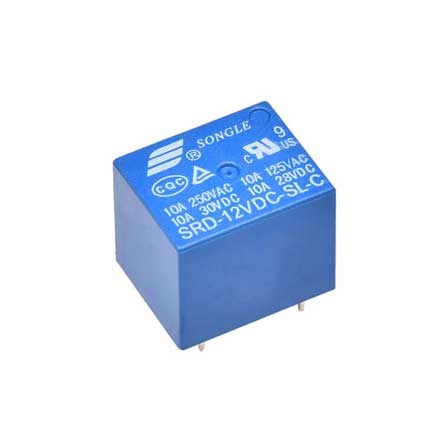
Features
- 10A switching capacity for suitable electrical loads.
- 12V DC coil for reliable relay activation.
- SPDT contact configuration with COM, NC, and NO terminals.
- Sealed plastic housing for improved mechanical protection.
- Compact through-hole/DIP-style construction for PCB mounting.
- Suitable for switching AC and DC loads within the specified contact ratings.
- Reliable electromagnetic switching mechanism.
- Suitable for motors, lighting, solenoids, appliances, and automation systems.
- Plastic materials designed for good thermal and chemical resistance.
- Blue relay housing.
Principle of Operation
The SRD-12VDC-SL-C is an electromechanical relay. When 12V DC is applied to the relay coil, an electromagnetic field is generated. This magnetic field attracts the internal armature and mechanically changes the position of the relay contacts.
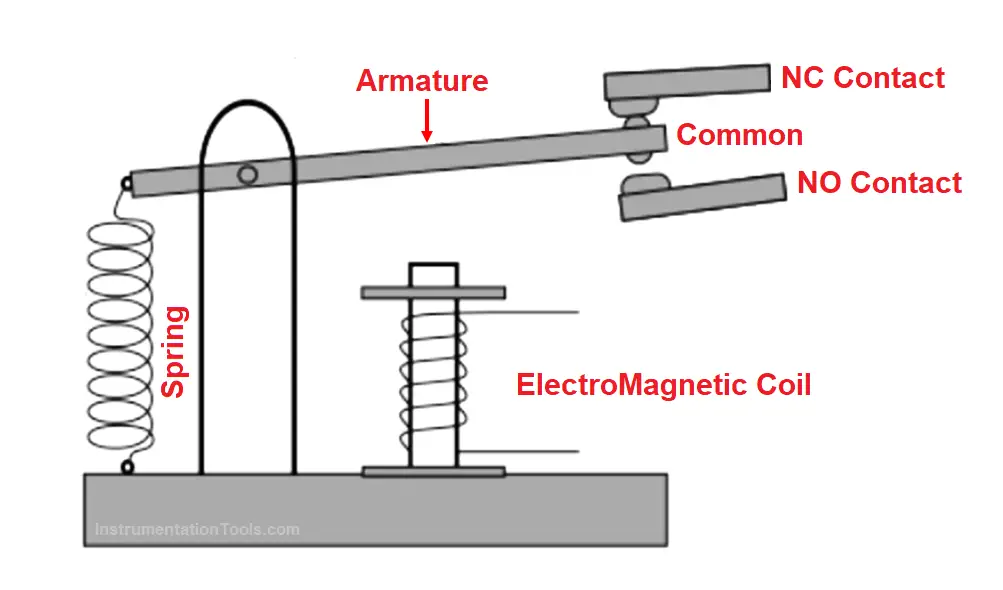
In the normal, de-energized state, the COM terminal is connected to the NC (Normally Closed) terminal. When the coil is energized, the armature moves and COM changes its connection to the NO (Normally Open) terminal.
When coil power is removed, the internal spring returns the contacts to their original position. This allows a low-voltage control circuit to switch a separate higher-voltage or higher-current load circuit.
Applications
- Home appliance control
- Motor switching and control
- Lighting control
- Solenoid control
- Industrial automation
- DC motor switching
- IoT and smart home systems
- Temperature control systems
- Traffic signal control systems
- General-purpose electrical switching
- Automotive and embedded control systems
Pinout
| Pin / Terminal | Function |
|---|---|
| Coil End 1 | One side of the 12V DC relay coil |
| Coil End 2 | Other side of the 12V DC relay coil |
| COM | Common contact connected to either NC or NO |
| NC | Normally Closed contact; connected to COM when the coil is de-energized |
| NO | Normally Open contact; connected to COM when the coil is energized |
Wiring
The relay coil requires 12V DC and should not be driven directly from an Arduino GPIO pin. A transistor or dedicated relay driver should be used between the microcontroller and the relay coil. A flyback diode is also recommended across the coil when using a transistor driver.
| Relay Connection | Example Connection |
|---|---|
| Coil End 1 | +12V DC |
| Coil End 2 | Collector/drain of relay driver |
| Driver Control | Arduino digital output through suitable driver circuit |
| COM | Load supply or common load connection |
| NO | Load connection when the relay should activate the load |
| NC | Load connection for a circuit that should remain active when the relay is OFF |
Safety: When switching mains voltage, use appropriate insulation, fusing, enclosure, wiring, and clearances. Do not handle or modify energized mains circuits.
Arduino Example
The following example demonstrates the control signal for a relay driver connected to Arduino digital pin 3. The Arduino should control the relay through an appropriate transistor or relay-driver circuit rather than powering the 12V coil directly.
void setup() {
  pinMode(3, OUTPUT);
}

void loop() {
  digitalWrite(3, HIGH);  // Turn relay ON
  delay(1000);

  digitalWrite(3, LOW);   // Turn relay OFF
  delay(1000);
}Specifications
| Product Name | Songle SRD-12VDC-SL-C Relay |
| Model | SRD-12VDC-SL-C |
| Relay Type | Electromechanical Power Relay |
| Coil Voltage | 12V DC |
| Contact Configuration | SPDT |
| Contact Rating | Up to 10A at 250VAC, subject to load and relay specifications |
| Number of Pins | 5 |
| Mounting | DIP / Through-hole PCB mounting |
| Construction | Plastic housing with metal contacts and coil |
| Color | Blue |
| Dimensions | Approximately 19.2 × 15.5 × 15.2 mm |
Relay vs. Solid-State Relay
| Feature | SRD-12VDC-SL-C | Solid-State Relay |
|---|---|---|
| Switching Method | Mechanical contacts | Semiconductor switching |
| Moving Parts | Yes | No |
| Switching Speed | Relatively slower | Generally faster |
| Electrical Isolation | Yes | Typically available through the solid-state design |
| Mechanical Wear | Contact wear over time | No mechanical contact wear |
Features
- 10A switching capacity for suitable electrical loads.
- 12V DC coil for reliable relay activation.
- SPDT contact configuration with COM, NC, and NO terminals.
- Sealed plastic housing for improved mechanical protection.
- Compact through-hole/DIP-style construction for PCB mounting.
- Suitable for switching AC and DC loads within the specified contact ratings.
- Reliable electromagnetic switching mechanism.
- Suitable for motors, lighting, solenoids, appliances, and automation systems.
- Plastic materials designed for good thermal and chemical resistance.
- Blue relay housing.
Principle of Operation
The SRD-12VDC-SL-C is an electromechanical relay. When 12V DC is applied to the relay coil, an electromagnetic field is generated. This magnetic field attracts the internal armature and mechanically changes the position of the relay contacts.
In the normal, de-energized state, the COM terminal is connected to the NC (Normally Closed) terminal. When the coil is energized, the armature moves and COM changes its connection to the NO (Normally Open) terminal.
When coil power is removed, the internal spring returns the contacts to their original position. This allows a low-voltage control circuit to switch a separate higher-voltage or higher-current load circuit.
Applications
- Home appliance control
- Motor switching and control
- Lighting control
- Solenoid control
- Industrial automation
- DC motor switching
- IoT and smart home systems
- Temperature control systems
- Traffic signal control systems
- General-purpose electrical switching
- Automotive and embedded control systems
Pinout
| Pin / Terminal | Function |
|---|---|
| Coil End 1 | One side of the 12V DC relay coil |
| Coil End 2 | Other side of the 12V DC relay coil |
| COM | Common contact connected to either NC or NO |
| NC | Normally Closed contact; connected to COM when the coil is de-energized |
| NO | Normally Open contact; connected to COM when the coil is energized |
Wiring
The relay coil requires 12V DC and should not be driven directly from an Arduino GPIO pin. A transistor or dedicated relay driver should be used between the microcontroller and the relay coil. A flyback diode is also recommended across the coil when using a transistor driver.
| Relay Connection | Example Connection |
|---|---|
| Coil End 1 | +12V DC |
| Coil End 2 | Collector/drain of relay driver |
| Driver Control | Arduino digital output through suitable driver circuit |
| COM | Load supply or common load connection |
| NO | Load connection when the relay should activate the load |
| NC | Load connection for a circuit that should remain active when the relay is OFF |
Safety: When switching mains voltage, use appropriate insulation, fusing, enclosure, wiring, and clearances. Do not handle or modify energized mains circuits.
Arduino Example
The following example demonstrates the control signal for a relay driver connected to Arduino digital pin 3. The Arduino should control the relay through an appropriate transistor or relay-driver circuit rather than powering the 12V coil directly.
void setup() {
  pinMode(3, OUTPUT);
}

void loop() {
  digitalWrite(3, HIGH);  // Turn relay ON
  delay(1000);

  digitalWrite(3, LOW);   // Turn relay OFF
  delay(1000);
}
Specifications
| Product Name | Songle SRD-12VDC-SL-C Relay |
| Model | SRD-12VDC-SL-C |
| Relay Type | Electromechanical Power Relay |
| Coil Voltage | 12V DC |
| Contact Configuration | SPDT |
| Contact Rating | Up to 10A at 250VAC, subject to load and relay specifications |
| Number of Pins | 5 |
| Mounting | DIP / Through-hole PCB mounting |
| Construction | Plastic housing with metal contacts and coil |
| Color | Blue |
| Dimensions | Approximately 19.2 × 15.5 × 15.2 mm |
Relay vs. Solid-State Relay
| Feature | SRD-12VDC-SL-C | Solid-State Relay |
|---|---|---|
| Switching Method | Mechanical contacts | Semiconductor switching |
| Moving Parts | Yes | No |
| Switching Speed | Relatively slower | Generally faster |
| Electrical Isolation | Yes | Typically available through the solid-state design |
| Mechanical Wear | Contact wear over time | No mechanical contact wear |