Features:
- Suitable for various applications such as electronics cooling, power generation, and DIY heating/cooling projects.
- Capable of reaching sub-zero temperatures or heating up to high temperatures by reversing polarity.
- Solid-state design with no moving parts ensures high reliability and long lifespan.
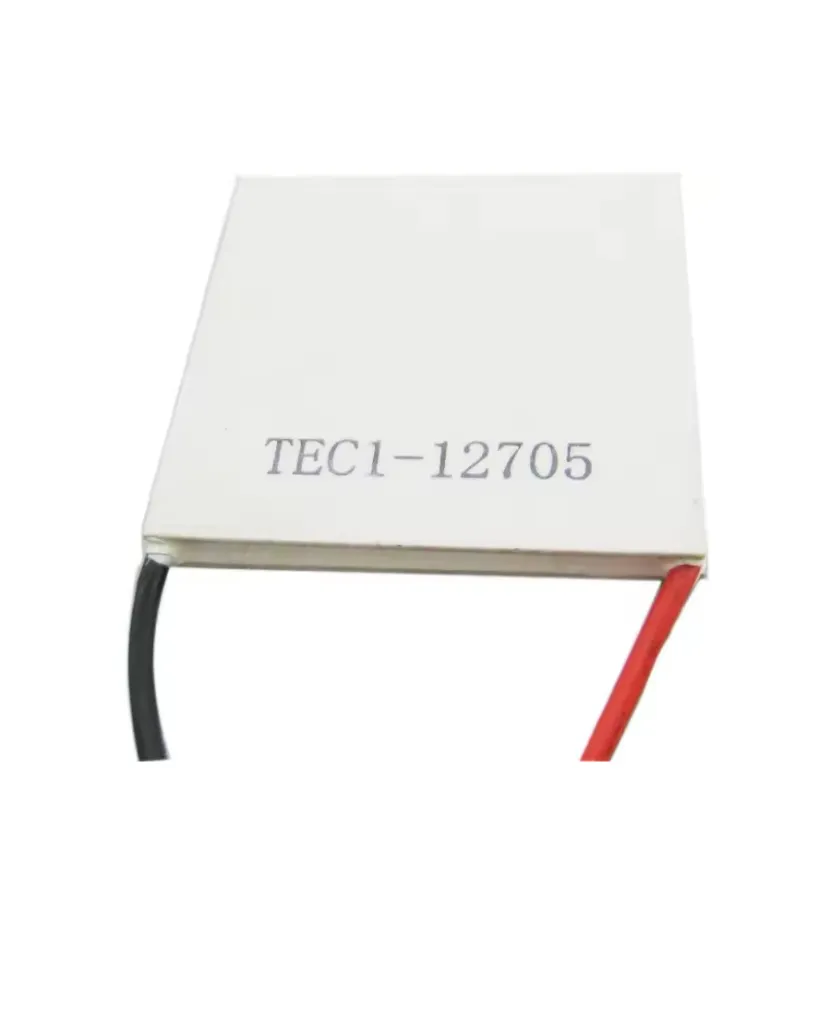
- Constructed with semiconductor material between ceramic plates for efficient heat transfer.
- Requires a heatsink for proper operation and overheating protection.
- Equipped with insulated leads for safe and easy connection.
- Maximum power rating of approximately 50W.
Principle of Work:
The TEC1-12705 operates based on the Peltier effect, where applying a voltage across two dissimilar semiconductor materials creates a temperature difference. When current flows through the module, heat is transferred from one side to the other. Reversing the polarity swaps the hot and cold sides, allowing both heating and cooling functionality. To prevent overheating and ensure efficient performance, a heatsink must be attached to dissipate heat effectively.
Pinout of the Module:
Same for 12705 and 12706
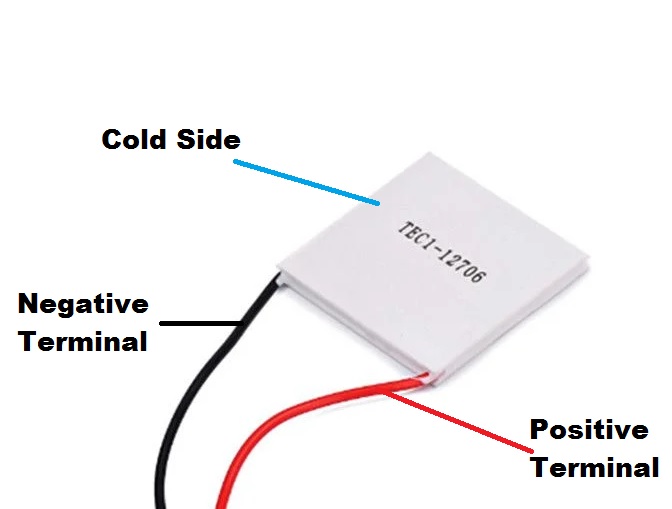
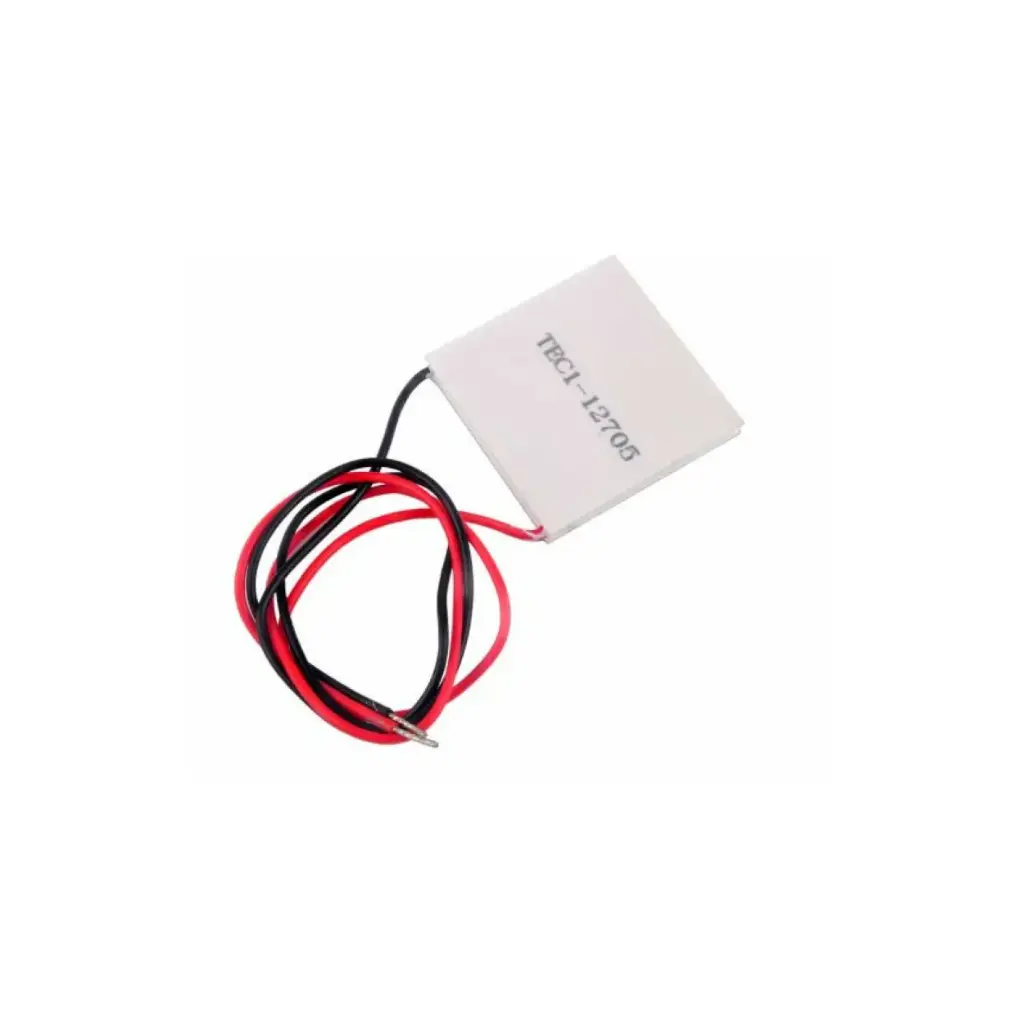
- The module has two wires: red (positive) and black (negative). Applying voltage across these leads initiates heat transfer from one side to the other. Reversing the polarity reverses the heat flow direction.
Applications:
- Cooling electronic components such as CPUs and power devices.
- Thermoelectric power generation using the Seebeck effect.
- Temperature control in medical and laboratory equipment.
- Portable heating/cooling systems such as car beverage holders.
- Environmental temperature regulation in aquariums and greenhouses.
Circuit:
- Peltier modules transfer heat when electrical current is applied.
- They can function as both heaters and coolers.
- The TEC1-12705 supports up to approximately 15.2V and 6A.
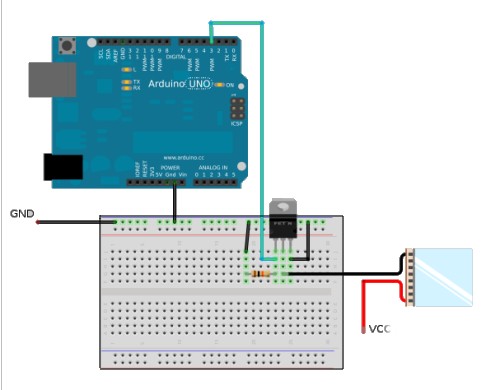
- To control it using Arduino, an N-channel MOSFET and a 10K resistor are required.
- PWM control can be applied (e.g., using Arduino pin 3) to regulate power.
Library:
No library is required.
Code:
int peltier = 3; // MOSFET connected to pin 3
int power = 0;
int peltier_level = map(power, 0, 99, 0, 255);
void setup(){
 Serial.begin(9600);
}
void loop(){
 char option;
 if(Serial.available() > 0){
 option = Serial.read();
 if(option == 'a') power += 5;
 else if(option == 'z') power -= 5;
 if(power > 99) power = 99;
 if(power < 0) power = 0;
 peltier_level = map(power, 0, 99, 0, 255);
 }
 Serial.print("Power=");
 Serial.print(power);
 Serial.print(" PLevel=");
 Serial.println(peltier_level);
 analogWrite(peltier, peltier_level);
}
The MOSFET and resistor regulate the current supplied to the Peltier module. PWM allows precise control over heating or cooling intensity.
Technical Details:
- Module name: TEC1-12705
- Dimensions: 40 × 40 × 3.6 mm
- Internal resistance: ~2.3 Ω (at 25°C)
- Maximum temperature difference (Tmax): ~65°C
- Maximum current (Imax): 5–6A
- Rated voltage: 12V (Max 15.2V)
- Cooling capacity (Qcmax): ~50W
- Operating temperature range: -55°C to +83°C
Resources:
Comparisons:
The TEC1-12705 and TEC1-12706 are both thermoelectric cooling modules with similar structures, but differ slightly in performance:
- Current Rating: TEC1-12705 operates up to ~6A, while TEC1-12706 supports up to ~7A.
- Voltage Rating: TEC1-12705 supports up to ~15.2V, slightly lower than TEC1-12706 (~15.4V).
- Cooling Capacity: TEC1-12705 provides slightly lower cooling power (~50W vs ~55W).
Features:
- Suitable for various applications such as electronics cooling, power generation, and DIY heating/cooling projects.
- Capable of reaching sub-zero temperatures or heating up to high temperatures by reversing polarity.
- Solid-state design with no moving parts ensures high reliability and long lifespan.
- Constructed with semiconductor material between ceramic plates for efficient heat transfer.
- Requires a heatsink for proper operation and overheating protection.
- Equipped with insulated leads for safe and easy connection.
- Maximum power rating of approximately 50W.
Principle of Work:
The TEC1-12705 operates based on the Peltier effect, where applying a voltage across two dissimilar semiconductor materials creates a temperature difference. When current flows through the module, heat is transferred from one side to the other. Reversing the polarity swaps the hot and cold sides, allowing both heating and cooling functionality. To prevent overheating and ensure efficient performance, a heatsink must be attached to dissipate heat effectively.
Pinout of the Module:
Same for 12705 and 12706
- The module has two wires: red (positive) and black (negative). Applying voltage across these leads initiates heat transfer from one side to the other. Reversing the polarity reverses the heat flow direction.
Applications:
- Cooling electronic components such as CPUs and power devices.
- Thermoelectric power generation using the Seebeck effect.
- Temperature control in medical and laboratory equipment.
- Portable heating/cooling systems such as car beverage holders.
- Environmental temperature regulation in aquariums and greenhouses.
Circuit:
- Peltier modules transfer heat when electrical current is applied.
- They can function as both heaters and coolers.
- The TEC1-12705 supports up to approximately 15.2V and 6A.
- To control it using Arduino, an N-channel MOSFET and a 10K resistor are required.
- PWM control can be applied (e.g., using Arduino pin 3) to regulate power.
Library:
No library is required.
Code:
int peltier = 3; // MOSFET connected to pin 3
int power = 0;
int peltier_level = map(power, 0, 99, 0, 255);
void setup(){
 Serial.begin(9600);
}
void loop(){
 char option;
 if(Serial.available() > 0){
 option = Serial.read();
 if(option == 'a') power += 5;
 else if(option == 'z') power -= 5;
 if(power > 99) power = 99;
 if(power < 0) power = 0;
 peltier_level = map(power, 0, 99, 0, 255);
 }
 Serial.print("Power=");
 Serial.print(power);
 Serial.print(" PLevel=");
 Serial.println(peltier_level);
 analogWrite(peltier, peltier_level);
}
The MOSFET and resistor regulate the current supplied to the Peltier module. PWM allows precise control over heating or cooling intensity.
Technical Details:
- Module name: TEC1-12705
- Dimensions: 40 × 40 × 3.6 mm
- Internal resistance: ~2.3 Ω (at 25°C)
- Maximum temperature difference (Tmax): ~65°C
- Maximum current (Imax): 5–6A
- Rated voltage: 12V (Max 15.2V)
- Cooling capacity (Qcmax): ~50W
- Operating temperature range: -55°C to +83°C
Resources:
Comparisons:
The TEC1-12705 and TEC1-12706 are both thermoelectric cooling modules with similar structures, but differ slightly in performance:
- Current Rating: TEC1-12705 operates up to ~6A, while TEC1-12706 supports up to ~7A.
- Voltage Rating: TEC1-12705 supports up to ~15.2V, slightly lower than TEC1-12706 (~15.4V).
- Cooling Capacity: TEC1-12705 provides slightly lower cooling power (~50W vs ~55W).