- All products
- Sensors & Modules
- Tilt & Shock
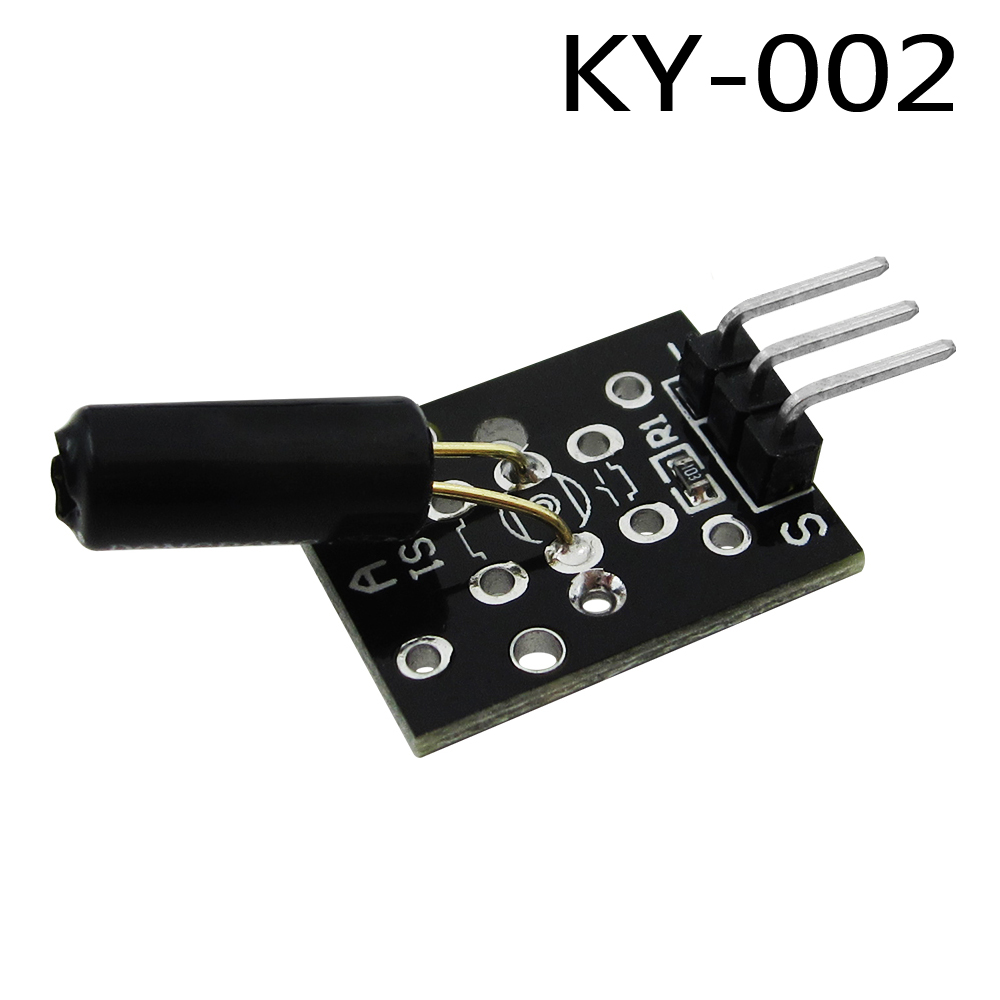
- Tilt Shock Sensor Module KY-002
- Tilt & Shock
Features
- Safer alternative to mercury based tilt switches
- Spring type vibration detection with fast response
- Environmentally friendly construction materials
- Direct digital output with onboard pull up resistor
- Easy interfacing with microcontrollers
- Low cost and reliable operation
- Good mechanical durability
Principle of Work
Inside the sensor is a thin metal spring wrapped around a conductive pin and enclosed within a cylindrical metal shell. One side of the sensor is connected to the supply voltage through a resistor. Under normal conditions, the spring does not touch the conductive pin. When vibration or shock occurs, the spring briefly contacts the pin, closing the circuit and allowing current to flow. This change is detected as a digital signal by the microcontroller. Once the vibration stops, the spring separates again and the signal returns to its default state.
Pinout
- Minus: Ground connection at zero volts
- S: Signal output connected to a digital input
- Plus: VCC supply input supporting 3.3V or 5V
Applications
- Robotics motion and impact detection
- Automotive vibration sensing
- Tilt and movement awareness
- Security and anti tamper systems
- Interactive toys and gadgets
Circuit Notes
The module can be connected directly to a microcontroller digital input. A typical setup uses the signal pin connected to a GPIO input, VCC connected to 5V or 3.3V, and ground connected to system ground. An external LED or buzzer can be driven by the microcontroller to indicate detected vibration.
Library
No external library is required for operation of the KY 002 module.
Code Notes
The sensor is read using a digital input pin. Software debouncing is recommended to avoid false triggering caused by mechanical noise. A debounce delay is applied, and the current sensor state is compared with the previous state to determine valid vibration events. The sensor state can be monitored through a serial interface for debugging or data logging.
Technical Details
- Maximum operating voltage: 5V
- Maximum current: 30 mA
- Insulation resistance: greater than 10 mega ohm
- Operating voltage: 3.3V to 5V
- Module dimensions: approximately 1.8 cm by 1.5 cm by 0.9 cm
Comparisons
Vibration switches are commonly divided into spring type and ball type sensors. Spring type switches, such as the KY 002, respond to vibration magnitude and force direction and are suitable for multidirectional detection. Ball type switches primarily detect tilt angle and are more sensitive to orientation. Spring switches offer higher sensitivity to shock and are better suited for vibration detection, while ball switches are preferred for simple tilt sensing applications.
Features
- Safer alternative to mercury based tilt switches
- Spring type vibration detection with fast response
- Environmentally friendly construction materials
- Direct digital output with onboard pull up resistor
- Easy interfacing with microcontrollers
- Low cost and reliable operation
- Good mechanical durability
Principle of Work
Inside the sensor is a thin metal spring wrapped around a conductive pin and enclosed within a cylindrical metal shell. One side of the sensor is connected to the supply voltage through a resistor. Under normal conditions, the spring does not touch the conductive pin. When vibration or shock occurs, the spring briefly contacts the pin, closing the circuit and allowing current to flow. This change is detected as a digital signal by the microcontroller. Once the vibration stops, the spring separates again and the signal returns to its default state.
Pinout
- Minus: Ground connection at zero volts
- S: Signal output connected to a digital input
- Plus: VCC supply input supporting 3.3V or 5V
Applications
- Robotics motion and impact detection
- Automotive vibration sensing
- Tilt and movement awareness
- Security and anti tamper systems
- Interactive toys and gadgets
Circuit Notes
The module can be connected directly to a microcontroller digital input. A typical setup uses the signal pin connected to a GPIO input, VCC connected to 5V or 3.3V, and ground connected to system ground. An external LED or buzzer can be driven by the microcontroller to indicate detected vibration.
Library
No external library is required for operation of the KY 002 module.
Code Notes
The sensor is read using a digital input pin. Software debouncing is recommended to avoid false triggering caused by mechanical noise. A debounce delay is applied, and the current sensor state is compared with the previous state to determine valid vibration events. The sensor state can be monitored through a serial interface for debugging or data logging.
Technical Details
- Maximum operating voltage: 5V
- Maximum current: 30 mA
- Insulation resistance: greater than 10 mega ohm
- Operating voltage: 3.3V to 5V
- Module dimensions: approximately 1.8 cm by 1.5 cm by 0.9 cm
Comparisons
Vibration switches are commonly divided into spring type and ball type sensors. Spring type switches, such as the KY 002, respond to vibration magnitude and force direction and are suitable for multidirectional detection. Ball type switches primarily detect tilt angle and are more sensitive to orientation. Spring switches offer higher sensitivity to shock and are better suited for vibration detection, while ball switches are preferred for simple tilt sensing applications.