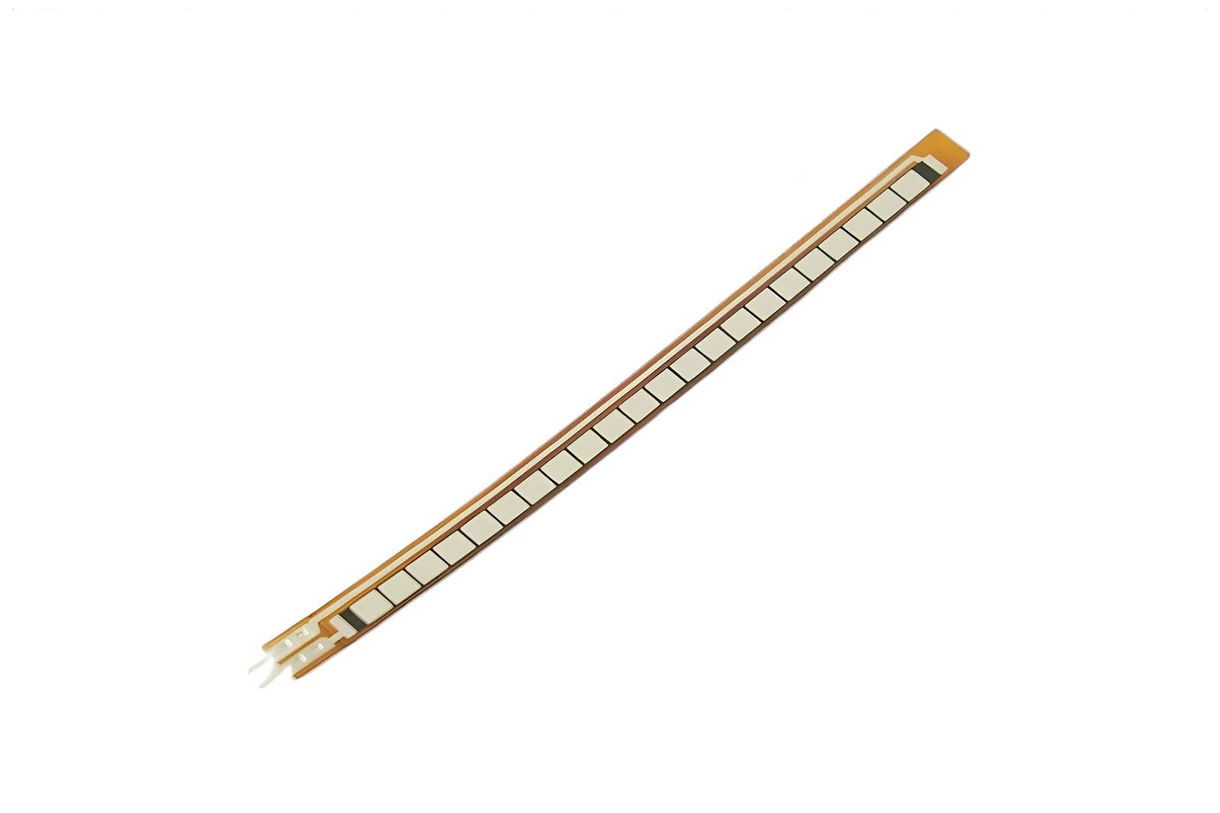
Features
- Measures angle displacement by resistance change
- High durability with more than one million bend cycles
- Thin and flexible low profile design
- Breadboard friendly connector with standard spacing
- Patented sensing technology by Spectra Symbol
- Stable operation over a wide temperature range
Specifications
- Active length 95.25 mm or 3.75 inches
- Total length 112.24 mm or 4.5 inches
- Height 0.43 mm
- Flat resistance 10K ohms
- Bend resistance range 60K to 110K ohms
- Resistance tolerance plus or minus 30 percent
- Life cycle greater than one million bends
- Operating temperature range minus 35 to plus 80 degrees Celsius
- Power rating 0.5 watts continuous and 1 watt peak
- Connector type 0.1 inch spaced and breadboard friendly
Applications
- Robotics and robotic joint movement measurement
- Gaming and virtual motion capture systems
- Medical and rehabilitation devices
- Human computer interaction and custom controllers
- Musical instruments and motion based sound control
- Physical therapy and movement tracking systems
How It Works
The flex sensor operates as a variable resistor. When the sensor is flat, it has a lower resistance. As it bends, the resistance increases. By placing the sensor in a voltage divider circuit and reading the voltage with an analog input, a microcontroller can determine the amount of bend and translate it into motion or position data.
How to Connect
The flex sensor is typically connected in a voltage divider configuration with a fixed resistor. One end of the sensor is connected to a power supply, the other end to an analog input, and a fixed resistor is connected to ground. Changes in resistance due to bending result in a changing analog voltage that can be measured by a microcontroller.

Features
- Measures angle displacement by resistance change
- High durability with more than one million bend cycles
- Thin and flexible low profile design
- Breadboard friendly connector with standard spacing
- Patented sensing technology by Spectra Symbol
- Stable operation over a wide temperature range
Specifications
- Active length 95.25 mm or 3.75 inches
- Total length 112.24 mm or 4.5 inches
- Height 0.43 mm
- Flat resistance 10K ohms
- Bend resistance range 60K to 110K ohms
- Resistance tolerance plus or minus 30 percent
- Life cycle greater than one million bends
- Operating temperature range minus 35 to plus 80 degrees Celsius
- Power rating 0.5 watts continuous and 1 watt peak
- Connector type 0.1 inch spaced and breadboard friendly
Applications
- Robotics and robotic joint movement measurement
- Gaming and virtual motion capture systems
- Medical and rehabilitation devices
- Human computer interaction and custom controllers
- Musical instruments and motion based sound control
- Physical therapy and movement tracking systems
How It Works
The flex sensor operates as a variable resistor. When the sensor is flat, it has a lower resistance. As it bends, the resistance increases. By placing the sensor in a voltage divider circuit and reading the voltage with an analog input, a microcontroller can determine the amount of bend and translate it into motion or position data.
How to Connect
The flex sensor is typically connected in a voltage divider configuration with a fixed resistor. One end of the sensor is connected to a power supply, the other end to an analog input, and a fixed resistor is connected to ground. Changes in resistance due to bending result in a changing analog voltage that can be measured by a microcontroller.