Skip to Content

Potentiometer - Analog Slide Position - Potentiometer 10KOhm RobotDYN

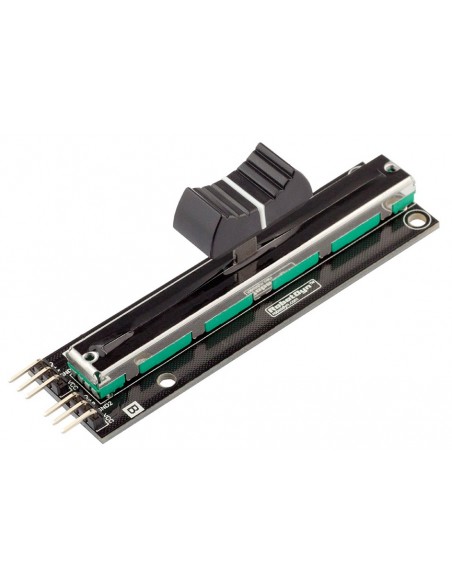
The RobotDYN Slide Potentiometer Module is a linear variable resistor rated at 10KΩ. By sliding the knob along its track, the resistance changes, producing a variable analog voltage that can be read directly by a microcontroller through an analog input pin. This module is ideal for calibration, parameter adjustment, brightness control, speed control, and any project requiring smooth linear analog input.

Package Includes

  • 1 × RobotDYN Slide Potentiometer Module (10KΩ)
Slide Variable Resistor
15.75 AED 15.75 AED (Tax included)

Terms and Conditions
30-day money-back guarantee
Shipping: 2-3 Business Days
 

Features

  • 10KΩ linear potentiometer
  • Smooth sliding action
  • Provides variable analog voltage output
  • Compatible with Arduino and other microcontrollers
  • Simple 3-pin interface (VCC, GND, Signal)

Technical Specifications

  • Resistance Value: 10KΩ
  • Output Type: Analog voltage
  • Operating Voltage: 3.3V – 5V
  • Control Type: Linear slide
  • Interface Pins: VCC, GND, OUT

Working Principle

A slide potentiometer works as a voltage divider. When voltage is applied across VCC and GND, the sliding contact (wiper) outputs a fraction of that voltage depending on its position.

When connected to an analog input, the microcontroller reads a value typically between 0 and 1023 (for 10-bit ADC on Arduino), corresponding to the slider position.

Pinout

Slide position potentiometer (analog). 10KOhm

Pin Description
VCC Power Supply (3.3V–5V)
GND Ground
OUT Analog Output Signal

Applications

  • Calibration adjustment
  • Motor speed control
  • LED brightness control
  • Audio level adjustment
  • User input interface

Arduino Connection Example

  • VCC → 5V
  • GND → GND
  • OUT → A0

Arduino Example Code

int potPin = A0;
int potValue = 0;

void setup() {
  Serial.begin(9600);
}

void loop() {
  potValue = analogRead(potPin);
  Serial.print("Potentiometer Value: ");
  Serial.println(potValue);
  delay(200);
}

Library

No external library is required. The module uses the built-in analogRead() function.